


Question: Bill's Demand Numbers Bill had put together data on his business's soda sales each month over the past 12 months (peri- ods). The following table
Bill's Demand Numbers Bill had put together data

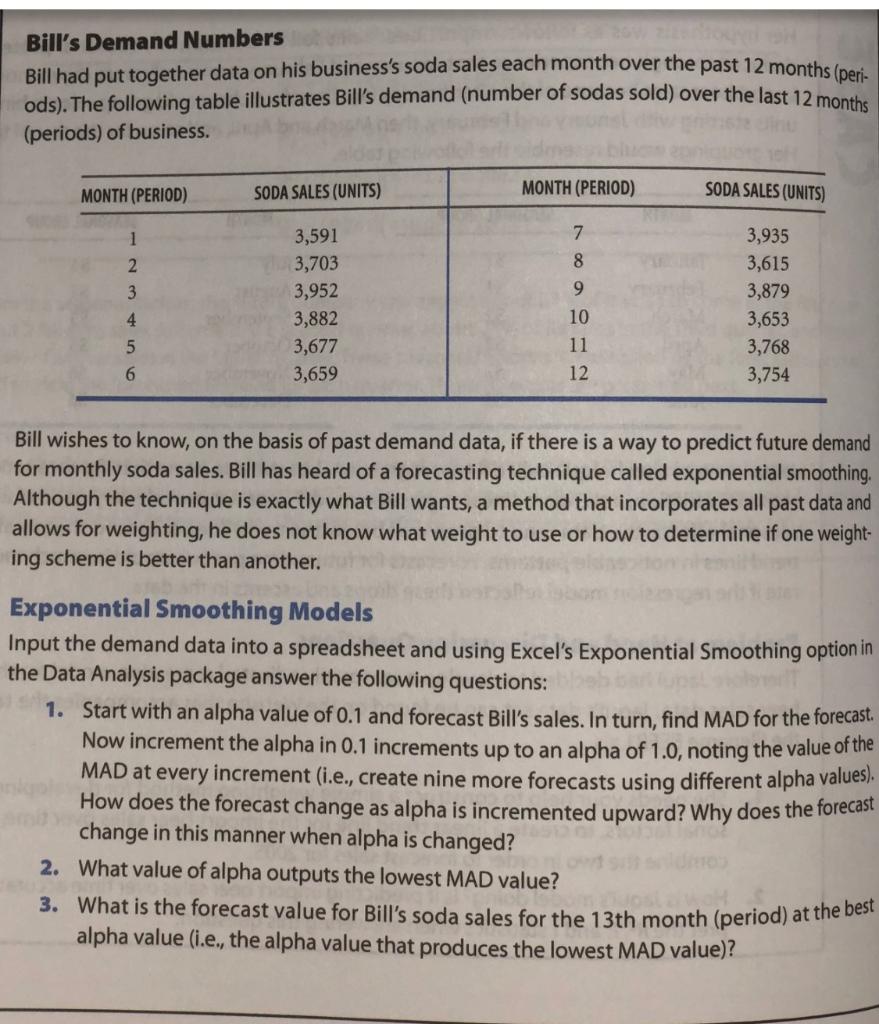
Bill's Demand Numbers Bill had put together data on his business's soda sales each month over the past 12 months (peri- ods). The following table illustrates Bill's demand (number of sodas sold) over the last 12 months (periods) of business. MONTH (PERIOD) SODA SALES (UNITS) MONTH (PERIOD) SODA SALES (UNITS) 1 2 3 3,591 3,703 3,952 3,882 3,677 3,659 7 8 9 10 11 12 3,935 3,615 3,879 3,653 3,768 3,754 4 5 6 Bill wishes to know, on the basis of past demand data, if there is a way to predict future demand for monthly soda sales. Bill has heard of a forecasting technique called exponential smoothing. Although the technique is exactly what Bill wants, a method that incorporates all past data and allows for weighting, he does not know what weight to use or how to determine if one weight- ing scheme is better than another. Exponential Smoothing Models Input the demand data into a spreadsheet and using Excel's Exponential Smoothing option in the Data Analysis package answer the following questions: 1. Start with an alpha value of 0.1 and forecast Bill's sales. In turn, find MAD for the forecast. Now increment the alpha in 0.1 increments up to an alpha of 1.0, noting the value of the MAD at every increment (i.e., create nine more forecasts using different alpha values). How does the forecast change as alpha is incremented upward? Why does the forecast change in this manner when alpha is changed? 2. What value of alpha outputs the lowest MAD value? 3. What is the forecast value for Bill's soda sales for the 13th month (period) at the best alpha value (i.e., the alpha value that produces the lowest MAD value)

Step by Step Solution

There are 3 Steps involved in it

1 Expert Approved Answer
Step: 1 Unlock blur-text-image

Question Has Been Solved by an Expert!

Get step-by-step solutions from verified subject matter experts

Step: 2 Unlock
Step: 3 Unlock

Students Have Also Explored These Related General Management Questions!