







Question: Building Series and Parallel Circuits I. Series Circuit Construct the circuit figure 1 using The Circuit Construction Kit (CCK) simulation at the PHeT site.
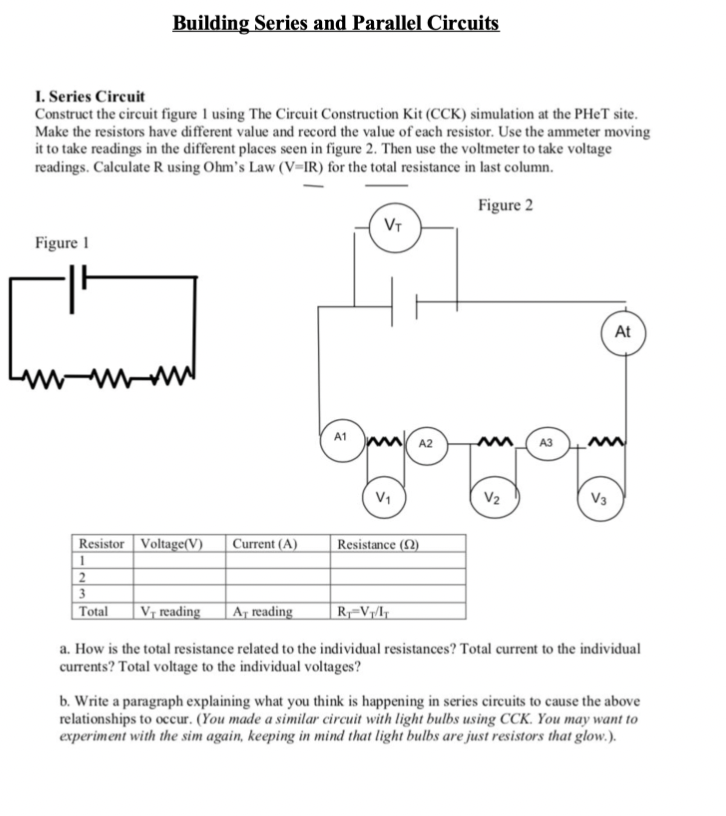
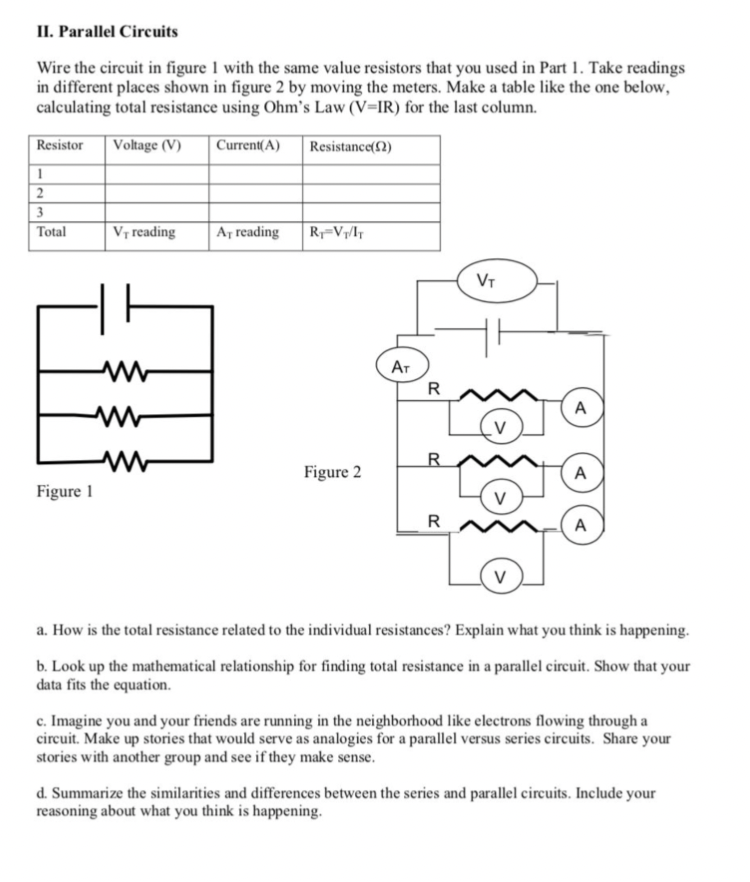
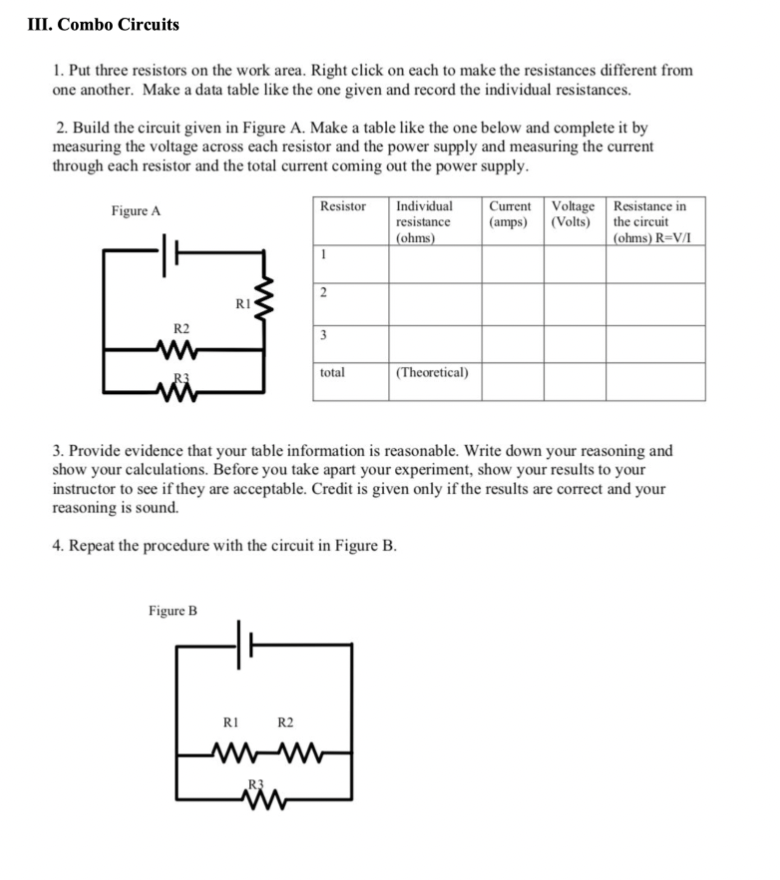
Building Series and Parallel Circuits I. Series Circuit Construct the circuit figure 1 using The Circuit Construction Kit (CCK) simulation at the PHeT site. Make the resistors have different value and record the value of each resistor. Use the ammeter moving it to take readings in the different places seen in figure 2. Then use the voltmeter to take voltage readings. Calculate R using Ohm's Law (V-IR) for the total resistance in last column. Figure 1 VT Figure 2 A2 M A3 V V2 V3 Resistor Voltage(V) 1 Current (A) Resistance (2) 2 3 Total V reading A reading R-V/I At a. How is the total resistance related to the individual resistances? Total current to the individual currents? Total voltage to the individual voltages? b. Write a paragraph explaining what you think is happening in series circuits to cause the above relationships to occur. (You made a similar circuit with light bulbs using CCK. You may want to experiment with the sim again, keeping in mind that light bulbs are just resistors that glow.). II. Parallel Circuits Wire the circuit in figure 1 with the same value resistors that you used in Part 1. Take readings in different places shown in figure 2 by moving the meters. Make a table like the one below, calculating total resistance using Ohm's Law (V-IR) for the last column. Resistor Voltage (V) 1 2 Current(A) Resistance(2) 3 Total V reading A reading R=V/IT VT www AT R www A V w R Figure 2 A Figure 1 V R A V a. How is the total resistance related to the individual resistances? Explain what you think is happening. b. Look up the mathematical relationship for finding total resistance in a parallel circuit. Show that your data fits the equation. c. Imagine you and your friends are running in the neighborhood like electrons flowing through a circuit. Make up stories that would serve as analogies for a parallel versus series circuits. Share your stories with another group and see if they make sense. d. Summarize the similarities and differences between the series and parallel circuits. Include your reasoning about what you think is happening. III. Combo Circuits 1. Put three resistors on the work area. Right click on each to make the resistances different from one another. Make a data table like the one given and record the individual resistances. 2. Build the circuit given in Figure A. Make a table like the one below and complete it by measuring the voltage across each resistor and the power supply and measuring the current through each resistor and the total current coming out the power supply. Figure A R2 www R3 RI ww 2 3 Resistor Individual resistance (ohms) Current Voltage (amps) (Volts) Resistance in the circuit (ohms) R=V/I 1 total (Theoretical) 3. Provide evidence that your table information is reasonable. Write down your reasoning and show your calculations. Before you take apart your experiment, show your results to your instructor to see if they are acceptable. Credit is given only if the results are correct and your reasoning is sound. 4. Repeat the procedure with the circuit in Figure B. Figure B RI R2 12 w-w R3
Step by Step Solution
There are 3 Steps involved in it

Get step-by-step solutions from verified subject matter experts
 Study Help