Question: BUS230_Assignment 2_Version M1 (15%) This document contains the questions and content for BUS230 Fall 2021, Assignment 2. Your answers should be typed on the Answer
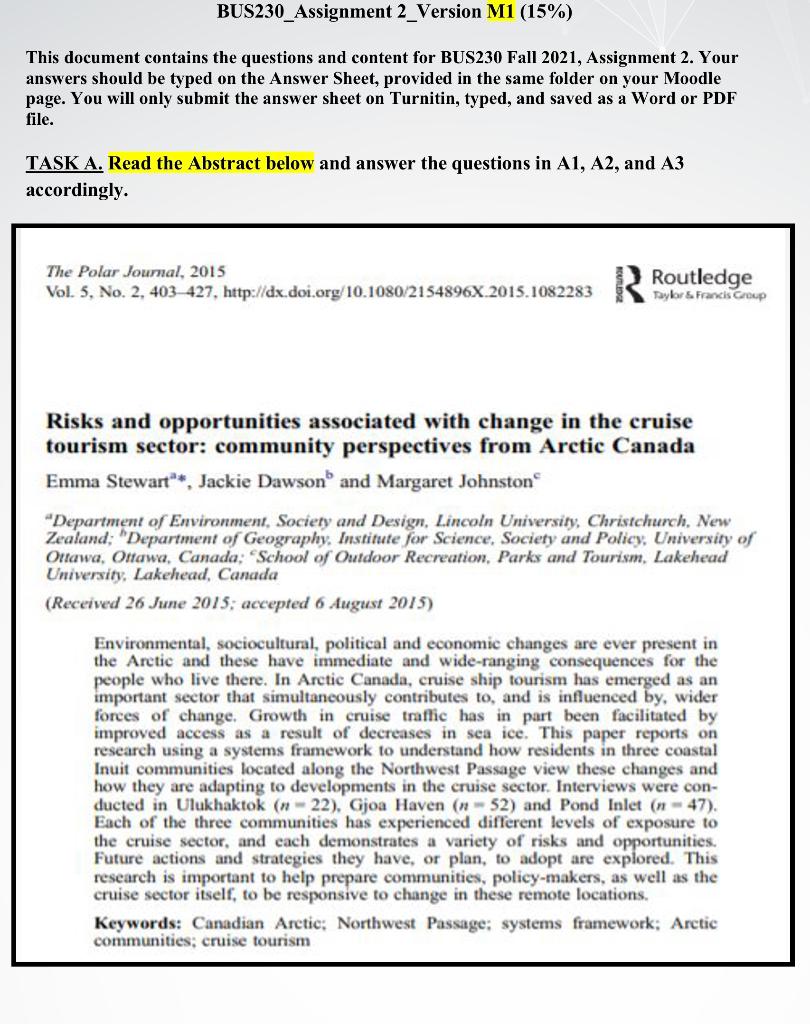
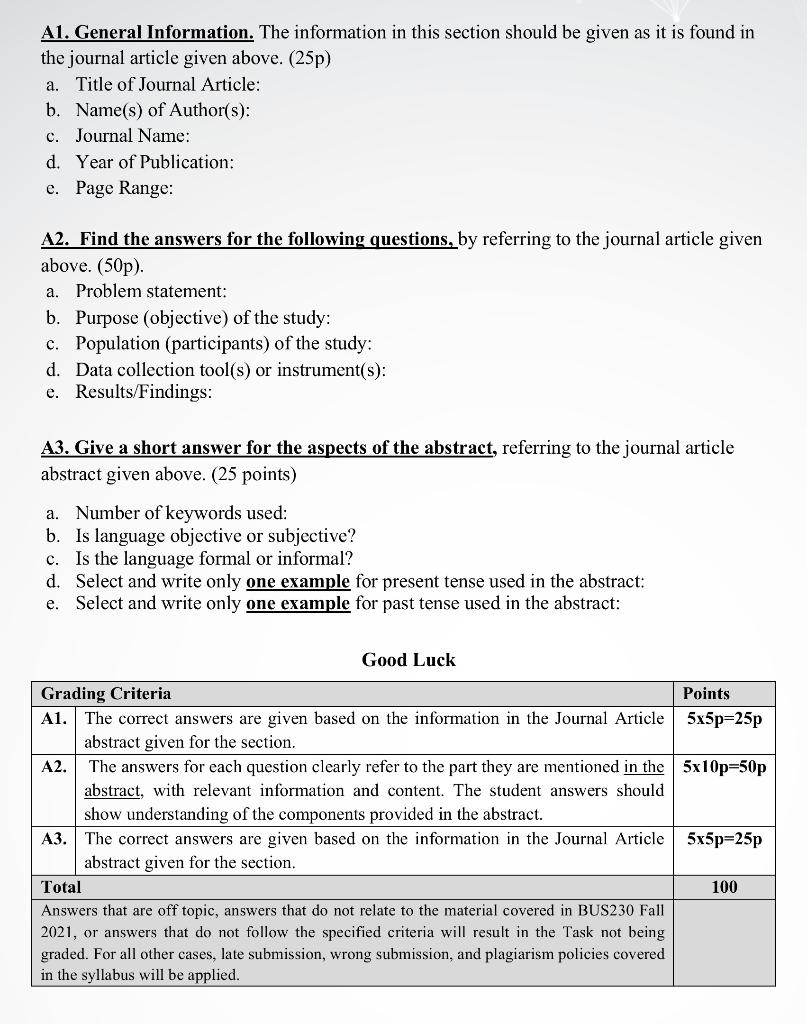
BUS230_Assignment 2_Version M1 (15%) This document contains the questions and content for BUS230 Fall 2021, Assignment 2. Your answers should be typed on the Answer Sheet, provided in the same folder on your Moodle page. You will only submit the answer sheet on Turnitin, typed, and saved as a Word or PDF file. TASK A. Read the Abstract below and answer the questions in A1, A2, and A3 accordingly. The Polar Journal, 2015 Vol. 5, No. 2, 403-427, http://dx.doi.org/10.1080/2154896X.2015.1082283 Taylor Francis Group Risks and opportunities associated with change in the cruise tourism sector: community perspectives from Arctic Canada Emma Stewart"*, Jackie Dawson and Margaret Johnston "Department of Environment, Society and Design, Lincoln University, Christchurch. New Zealand; "Department of Geography. Institute for Science, Society and Policy, University of Ottawa, Ottawa, Canada: School of Outdoor Recreation, Parks and Tourism, Lakehead University, Lakehead, Canada (Received 26 June 2013; accepted 6 August 2015) Environmental, sociocultural, political and economic changes are ever present in the Arctic and these have immediate and wide-ranging consequences for the people who live there. In Arctic Canada, cruise ship tourism has emerged as an important sector that simultaneously contributes to, and is influenced by, wider forces of change. Growth in cruise traffic has in part been facilitated by improved access as a result of decreases in sea ice. This paper reports on research using a systems framework to understand how residents in three coastal Inuit communities located along the Northwest Passage View these changes and how they are adapting to developments in the cruise sector. Interviews were con- ducted in Ulukhaktok (n - 22), Gjoa Haven ( 152) and Pond Inlet (n=47). Each of the three communities has experienced different levels of exposure to the cruise sector, and each demonstrates a variety of risks and opportunities. Future actions and strategies they have, or plan, to adopt are explored. This research is important to help prepare communities, policy-makers, as well as the cruise sector itself, to be responsive to change in these remote locations. Keywords: Canadian Arctic: Northwest Passage; systems framework; Arctic communities; cruise tourism A1. General Information. The information in this section should be given as it is found in the journal article given above. (25p) a. Title of Journal Article: b. Name(s) of Author(s): c. Journal Name: d. Year of Publication: e. Page Range: A2. Find the answers for the following questions, by referring to the journal article given above. (50p). a. Problem statement: b. Purpose (objective) of the study: c. Population (participants) of the study: d. Data collection tool(s) or instrument(s); e. Results/Findings: A3. Give a short answer for the aspects of the abstract, referring to the journal article abstract given above. (25 points) a. Number of keywords used: b. Is language objective or subjective? c. Is the language formal or informal? d. Select and write only one example for present tense used in the abstract: e. Select and write only one example for past tense used in the abstract: Good Luck Grading Criteria Points A1. The correct answers are given based on the information in the Journal Article 5x5p=25p abstract given for the section. 2. The answers for each question clearly refer to the part they are mentioned in the 5x10p=50p abstract, with relevant information and content. The student answers should show understanding of the components provided in the abstract. A3. The correct answers are given based on the information in the Journal Article 5x5p=25p abstract given for the section. Total 100 Answers that are off topic, answers that do not relate to the material covered in BUS230 Fall 2021, or answers that do not follow the specified criteria will result in the Task not being graded. For all other cases, late submission, wrong submission, and plagiarism policies covered in the syllabus will be applied. BUS230_Assignment 2_Version M1 (15%) This document contains the questions and content for BUS230 Fall 2021, Assignment 2. Your answers should be typed on the Answer Sheet, provided in the same folder on your Moodle page. You will only submit the answer sheet on Turnitin, typed, and saved as a Word or PDF file. TASK A. Read the Abstract below and answer the questions in A1, A2, and A3 accordingly. The Polar Journal, 2015 Vol. 5, No. 2, 403-427, http://dx.doi.org/10.1080/2154896X.2015.1082283 Taylor Francis Group Risks and opportunities associated with change in the cruise tourism sector: community perspectives from Arctic Canada Emma Stewart"*, Jackie Dawson and Margaret Johnston "Department of Environment, Society and Design, Lincoln University, Christchurch. New Zealand; "Department of Geography. Institute for Science, Society and Policy, University of Ottawa, Ottawa, Canada: School of Outdoor Recreation, Parks and Tourism, Lakehead University, Lakehead, Canada (Received 26 June 2013; accepted 6 August 2015) Environmental, sociocultural, political and economic changes are ever present in the Arctic and these have immediate and wide-ranging consequences for the people who live there. In Arctic Canada, cruise ship tourism has emerged as an important sector that simultaneously contributes to, and is influenced by, wider forces of change. Growth in cruise traffic has in part been facilitated by improved access as a result of decreases in sea ice. This paper reports on research using a systems framework to understand how residents in three coastal Inuit communities located along the Northwest Passage View these changes and how they are adapting to developments in the cruise sector. Interviews were con- ducted in Ulukhaktok (n - 22), Gjoa Haven ( 152) and Pond Inlet (n=47). Each of the three communities has experienced different levels of exposure to the cruise sector, and each demonstrates a variety of risks and opportunities. Future actions and strategies they have, or plan, to adopt are explored. This research is important to help prepare communities, policy-makers, as well as the cruise sector itself, to be responsive to change in these remote locations. Keywords: Canadian Arctic: Northwest Passage; systems framework; Arctic communities; cruise tourism A1. General Information. The information in this section should be given as it is found in the journal article given above. (25p) a. Title of Journal Article: b. Name(s) of Author(s): c. Journal Name: d. Year of Publication: e. Page Range: A2. Find the answers for the following questions, by referring to the journal article given above. (50p). a. Problem statement: b. Purpose (objective) of the study: c. Population (participants) of the study: d. Data collection tool(s) or instrument(s); e. Results/Findings: A3. Give a short answer for the aspects of the abstract, referring to the journal article abstract given above. (25 points) a. Number of keywords used: b. Is language objective or subjective? c. Is the language formal or informal? d. Select and write only one example for present tense used in the abstract: e. Select and write only one example for past tense used in the abstract: Good Luck Grading Criteria Points A1. The correct answers are given based on the information in the Journal Article 5x5p=25p abstract given for the section. 2. The answers for each question clearly refer to the part they are mentioned in the 5x10p=50p abstract, with relevant information and content. The student answers should show understanding of the components provided in the abstract. A3. The correct answers are given based on the information in the Journal Article 5x5p=25p abstract given for the section. Total 100 Answers that are off topic, answers that do not relate to the material covered in BUS230 Fall 2021, or answers that do not follow the specified criteria will result in the Task not being graded. For all other cases, late submission, wrong submission, and plagiarism policies covered in the syllabus will be applied









 Study Help