







Question: 14 11 12 13 10 A charge Q is enclosed by a Gaussian spherical surface of radius R. If the radius of Gaussian surface
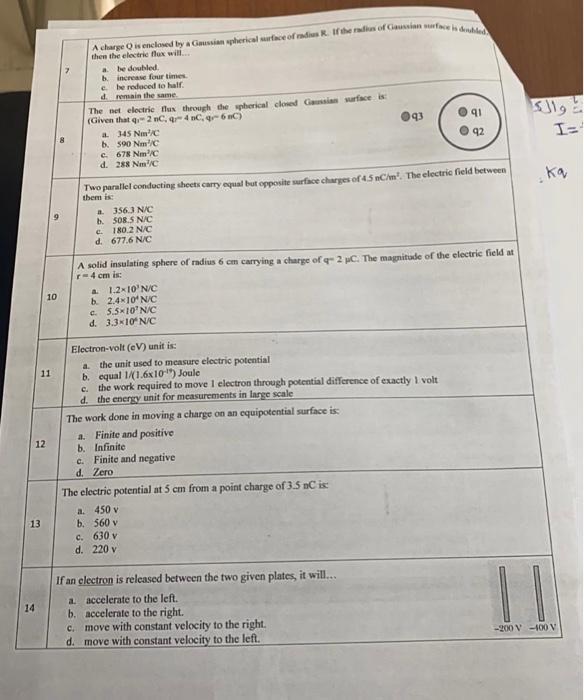
14 11 12 13 10 A charge Q is enclosed by a Gaussian spherical surface of radius R. If the radius of Gaussian surface is deabled then the electric flux will.... a. be doubled. b. increase four times. C be reduced to half. d. remain the same. The net electric flux through the spherical closed Gaussian surface is (Given that q 2 nC, q 4 nC, q6 aC) a. 345 Nm/C 590 Nm/C b. c. 678 Nm/C d. 288 Nm/C a. 356.3 N/C b. 508.5 N/C Two parallel conducting sheets carry equal but opposite surface charges of 4.5 nC/m. The electric field between them is: c. 180.2 N/C d. 677.6 N/C a 1.210' N/C b. 2.410' N/C c. 5.510' N/C d. 3.310 N/C A solid insulating sphere of radius 6 cm carrying a charge of q- 2 pC. The magnitude of the electric field at r-4 cm is: Electron-volt (eV) unit is: the unit used to measure electric potential 093 a. b. equal 1/(1.6x10) Joule c. the work required to move 1 electron through potential difference of exactly 1 volt d. the energy unit for measurements in large scale The work done in moving a charge on an equipotential surface is: a. Finite and positive b. Infinite c. Finite and negative d. Zero The electric potential at 5 cm from a point charge of 3.5 nC is: a. 450 v b. 560 v c. 630 v d. 220 v q1 If an electron is released between the two given plates, it will... a. accelerate to the left. b. accelerate to the right. c. move with constant velocity to the right. d. move with constant velocity to the left. I= -200 V-400 V
Step by Step Solution
There are 3 Steps involved in it
The detailed answer for the above question is provided below Question 1 A charge is enclosed by a Gaussian spherical face of ends If the office is d t... View full answer

Get step-by-step solutions from verified subject matter experts
 Study Help