Question: Can anyone help answer this? You work as a supply chain manager for Primo Caf Inc. Primo Caf is a small-sized manufacturer of stylish coffee
 Can anyone help answer this?
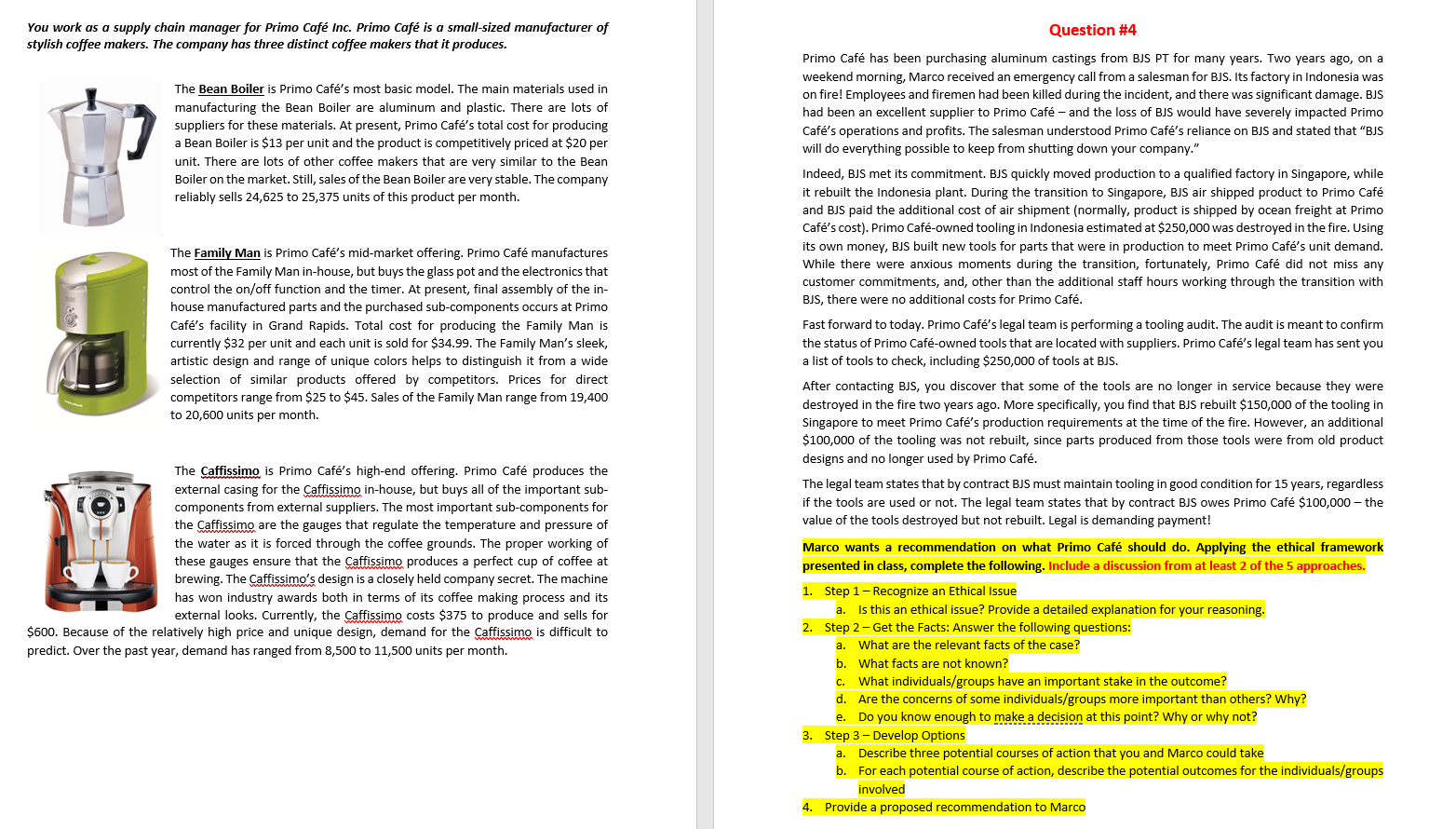
You work as a supply chain manager for Primo Caf Inc. Primo Caf is a small-sized manufacturer of stylish coffee makers. The company has three distinct coffee makers that it produces. The Bean Boiler is Primo Caf's most basic model. The main materials used in manufacturing the Bean Boiler are aluminum and plastic. There are lots of suppliers for these materials. At present, Primo Caf's total cost for producing a Bean Boiler is $13 per unit and the product is competitively priced at $20 per unit. There are lots of other coffee makers that are very similar to the Bean Boiler on the market. Still, sales of the Bean Boiler are very stable. The company reliably sells 24,625 to 25,375 units of this product per month. The Family Man is Primo Caf's mid-market offering. Primo Caf manufactures most of the Family Man in-house, but buys the glass pot and the electronics that control the on/off function and the timer. At present, final assembly of the in- house manufactured parts and the purchased sub-components occurs at Primo Caf's facility in Grand Rapids. Total cost for producing the Family Man is currently $32 per unit and each unit is sold for $34.99. The Family Man's sleek, artistic design and range of unique colors helps to distinguish it from a wide selection of similar products offered by competitors. Prices for direct competitors range from $25 to $45. Sales of the Family Man range from 19,400 to 20,600 units per month. Question #4 Primo Caf has been purchasing aluminum castings from BJS PT for many years. Two years ago, on a weekend morning, Marco received an emergency call from a salesman for BJS. Its factory in Indonesia was on fire! Employees and firemen had been killed during the incident, and there was significant damage. BJS had been an excellent supplier to Primo Caf - and the loss of BJS would have severely impacted Primo Caf's operations and profits. The salesman understood Primo Caf's reliance on BJS and stated that "BJS will do everything possible to keep from shutting down your company." Indeed, BJS met its commitment. BJS quickly moved production to a qualified factory in Singapore, while it rebuilt the Indonesia plant. During the transition to Singapore, BJS air shipped product to Primo Caf and BJS paid the additional cost of air shipment (normally, product is shipped by ocean freight at Primo Caf's cost). Primo Caf-owned tooling in Indonesia estimated at $250,000 was destroyed in the fire. Using its own money, BJS built new tools for parts that were in production to meet Primo Caf's unit demand. While there were anxious moments during the transition, fortunately, Primo Caf did not miss any customer commitments, and, other than the additional staff hours working through the transition with BJS, there were no additional costs for Primo Caf. Fast forward to today. Primo Caf's legal team is performing a tooling audit. The audit is meant to confirm the status of Primo Caf-owned tools that are located with suppliers. Primo Caf's legal team has sent you a list of tools to check, including $250,000 of tools at BJS. After contacting BJS, you discover that some of the tools are no longer in service because they were destroyed in the fire two years ago. More specifically, you find that BJS rebuilt $150,000 of the tooling in Singapore to meet Primo Caf's production requirements at the time of the fire. However, an additional $100,000 of the tooling was not rebuilt, since parts produced from those tools were from old product designs and no longer used by Primo Caf. The legal team states that by contract BJS must maintain tooling in good condition for 15 years, regardless if the tools are used or not. The legal team states that by contract BJS owes Primo Caf $100,000 - the value of the tools destroyed but not rebuilt. Legal is demanding payment! Marco wants a recommendation on what Primo Caf should do. Applying the ethical framework presented in class, complete the following. Include a discussion from at least 2 of the 5 approaches. 1. Step 1 - Recognize an Ethical Issue a. Is this an ethical issue? Provide a detailed explanation for your reasoning. 2. Step 2 - Get the Facts: Answer the following questions: a. What are the relevant facts of the case? b. What facts are not known? C. What individuals/groups have an important stake in the outcome? d. Are the concerns of some individuals/groups more important than others? Why? e. Do you know enough to make a decision at this point? Why or why not? 3. Step 3 - Develop Options a. Describe three potential courses of action that you and Marco could take b. For each potential course of action, describe the potential outcomes for the individuals/groups involved 4. Provide a proposed recommendation to Marco The Caffissimo is Primo Caf's high-end offering. Primo Caf produces the external casing for the Caffissimo in-house, but buys all of the important sub- components from external suppliers. The most important sub-components for the Caffissimo are the gauges that regulate the temperature and pressure of the water as it is forced through the coffee grounds. The proper working of these gauges ensure that the Caffissimo produces a perfect cup of coffee at brewing. The Caffissimo's design is a closely held company secret. The machine has won industry awards both in terms of its coffee making process and its external looks. Currently, the Caffissimo costs $375 to produce and sells for $600. Because of the relatively high price and unique design, demand for the Caffissimo is difficult to predict. Over the past year, demand has ranged from 8,500 to 11,500 units per month. You work as a supply chain manager for Primo Caf Inc. Primo Caf is a small-sized manufacturer of stylish coffee makers. The company has three distinct coffee makers that it produces. The Bean Boiler is Primo Caf's most basic model. The main materials used in manufacturing the Bean Boiler are aluminum and plastic. There are lots of suppliers for these materials. At present, Primo Caf's total cost for producing a Bean Boiler is $13 per unit and the product is competitively priced at $20 per unit. There are lots of other coffee makers that are very similar to the Bean Boiler on the market. Still, sales of the Bean Boiler are very stable. The company reliably sells 24,625 to 25,375 units of this product per month. The Family Man is Primo Caf's mid-market offering. Primo Caf manufactures most of the Family Man in-house, but buys the glass pot and the electronics that control the on/off function and the timer. At present, final assembly of the in- house manufactured parts and the purchased sub-components occurs at Primo Caf's facility in Grand Rapids. Total cost for producing the Family Man is currently $32 per unit and each unit is sold for $34.99. The Family Man's sleek, artistic design and range of unique colors helps to distinguish it from a wide selection of similar products offered by competitors. Prices for direct competitors range from $25 to $45. Sales of the Family Man range from 19,400 to 20,600 units per month. Question #4 Primo Caf has been purchasing aluminum castings from BJS PT for many years. Two years ago, on a weekend morning, Marco received an emergency call from a salesman for BJS. Its factory in Indonesia was on fire! Employees and firemen had been killed during the incident, and there was significant damage. BJS had been an excellent supplier to Primo Caf - and the loss of BJS would have severely impacted Primo Caf's operations and profits. The salesman understood Primo Caf's reliance on BJS and stated that "BJS will do everything possible to keep from shutting down your company." Indeed, BJS met its commitment. BJS quickly moved production to a qualified factory in Singapore, while it rebuilt the Indonesia plant. During the transition to Singapore, BJS air shipped product to Primo Caf and BJS paid the additional cost of air shipment (normally, product is shipped by ocean freight at Primo Caf's cost). Primo Caf-owned tooling in Indonesia estimated at $250,000 was destroyed in the fire. Using its own money, BJS built new tools for parts that were in production to meet Primo Caf's unit demand. While there were anxious moments during the transition, fortunately, Primo Caf did not miss any customer commitments, and, other than the additional staff hours working through the transition with BJS, there were no additional costs for Primo Caf. Fast forward to today. Primo Caf's legal team is performing a tooling audit. The audit is meant to confirm the status of Primo Caf-owned tools that are located with suppliers. Primo Caf's legal team has sent you a list of tools to check, including $250,000 of tools at BJS. After contacting BJS, you discover that some of the tools are no longer in service because they were destroyed in the fire two years ago. More specifically, you find that BJS rebuilt $150,000 of the tooling in Singapore to meet Primo Caf's production requirements at the time of the fire. However, an additional $100,000 of the tooling was not rebuilt, since parts produced from those tools were from old product designs and no longer used by Primo Caf. The legal team states that by contract BJS must maintain tooling in good condition for 15 years, regardless if the tools are used or not. The legal team states that by contract BJS owes Primo Caf $100,000 - the value of the tools destroyed but not rebuilt. Legal is demanding payment! Marco wants a recommendation on what Primo Caf should do. Applying the ethical framework presented in class, complete the following. Include a discussion from at least 2 of the 5 approaches. 1. Step 1 - Recognize an Ethical Issue a. Is this an ethical issue? Provide a detailed explanation for your reasoning. 2. Step 2 - Get the Facts: Answer the following questions: a. What are the relevant facts of the case? b. What facts are not known? C. What individuals/groups have an important stake in the outcome? d. Are the concerns of some individuals/groups more important than others? Why? e. Do you know enough to make a decision at this point? Why or why not? 3. Step 3 - Develop Options a. Describe three potential courses of action that you and Marco could take b. For each potential course of action, describe the potential outcomes for the individuals/groups involved 4. Provide a proposed recommendation to Marco The Caffissimo is Primo Caf's high-end offering. Primo Caf produces the external casing for the Caffissimo in-house, but buys all of the important sub- components from external suppliers. The most important sub-components for the Caffissimo are the gauges that regulate the temperature and pressure of the water as it is forced through the coffee grounds. The proper working of these gauges ensure that the Caffissimo produces a perfect cup of coffee at brewing. The Caffissimo's design is a closely held company secret. The machine has won industry awards both in terms of its coffee making process and its external looks. Currently, the Caffissimo costs $375 to produce and sells for $600. Because of the relatively high price and unique design, demand for the Caffissimo is difficult to predict. Over the past year, demand has ranged from 8,500 to 11,500 units per month









 Study Help