







Question: Can someone help me do the calculations for a titration on the data sheet please? I include the materials used and the buret and pH
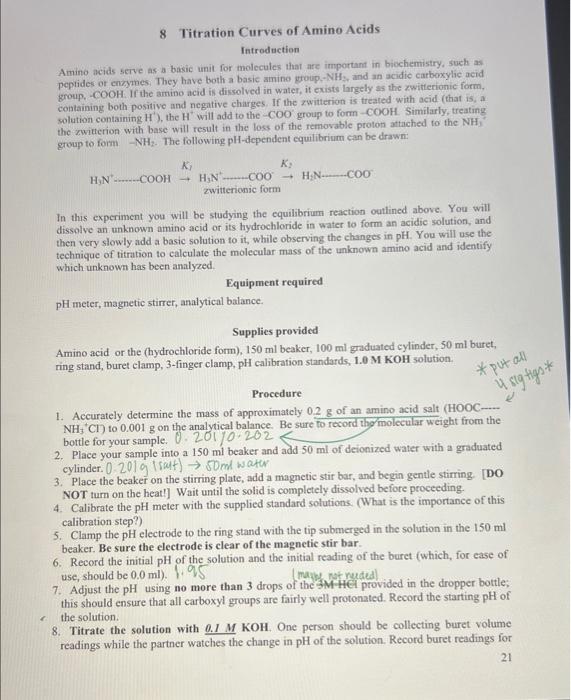
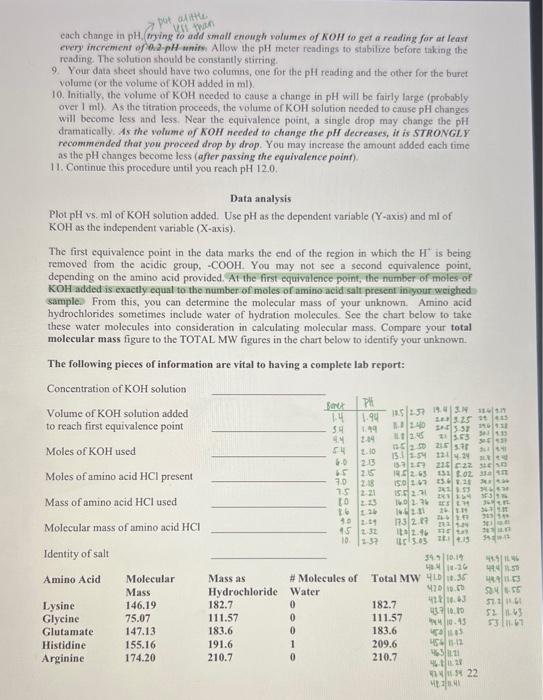
8 Titration Curves of Amino Acids Introduction Amino acids serve as a basic unit for molecules that are important in biochemistry, such as peptides or enzymes. They have both a basic amino group, NH3, and an acidie carbexylie acid group, - COOH. If the amino acid is dissolved in water, it exists largely as the xwitterionic form, containing both positive and negative charges. If the zwitterion is treafed with acid (that is, a solution containing H ), the H+will add to the COO group to form COOH. Similarly, treating the xwitterion with base will result in the loss of the removable proton attached to the NH3 group to form. NH2. The following pH-dependent equilibrium can be drawn: H3+..COOHH3K+COOK2H2NCOO zwitterionic form In this experiment you will be studying the equilibrium reaction outhined above. You will: dissolve an unknown amino acid or its hydrochloride in water to form an acidic solution, and then very stowly add a basic solution to it, while observing the changes in pHH. You will use the technique of titration to calculate the molecular mass of the unknown amino acid and identify which unknown has been analyzed. Equipment required pH meter, magnetic stirrer, analytical balance. Supplies provided Amino acid or the (hydrochloride form), 150ml beaker, 100ml graduated cylinder, 50ml buret, ring stand, buret elamp, 3-finger clamp, pH calibration standards, 1.0MKOH solution. Procedure 1. Accurately determine the mass of approximately 0.2g of an amino acid salt (HOOC-.. NH3+Cl ) to 0.001g on the analytical balance. Be sure to record the molecular weight from the bottle for your sample. 0.201/0.202 2. Place your sample into a 150ml beaker and add 50ml of deionized water with a graduated 3. Place the beaker on the stirring plate, add a magnetic stir bar, and begin gentle stirring, [DO NOT turn on the heat!] Wait until the solid is completely dissolved before proceeding. 4. Calibrate the pH meter with the supplied standard solutions. (What is the importance of this calibration step?) 5. Clamp the pH electrode to the ring stand with the tip submerged in the solution in the 150ml beaker. Be sure the electrode is clear of the magnetic stir bar. 6. Record the initial pH of the solution and the initial reading of the buret (which, for ease of use, should be 0.0ml ). S. 9. (mapes nof reeded). 7. Adjust the pH using no more than 3 drops of the 5 M Hicl provided in the dropper bottle; this should ensure that all carboxyl groups are fairly well protonated. Record the starting pH of the solution. 8. Titrate the solution with 0.IM KOH. One person should be collecting buret volume readings while the partner watches the change in pH of the solution. Record buret readings for 21 every increment of 0.2pH units. Allow the pH meter readings to stabilize before taking the reading. The solution should be constaritly stirring. 9. Your data sbeet should have two columas, one for the plH reading and the other for the buret volume (or the volume of KOH added in ml ). 10. Initially, the volume of KOH needed to cause a change in pH will be fairly large (probably over 1ml. As the titration proceeds, the volume of KOH solution needed to emse pH changes will become less and less. Near the equivalenee point, a single drop may change the pH dramatically. As the volume of KOH needed to change the PH decreases, it is STRONGLY recommended that you proceed drop by drop. You may increase the amount added each fime as the pH changes become less (after passing the equivalence poinf). 11. Continue this procedure until you reach pH12.0. Data analysis Plot pH vs. ml of KOH solution added. Use pH as the dependent variable ( Y-axis) and ml of KOH as the independent variable (X-axis). The first equivalence point in the data marks the end of the region in which the H+is being removed from the acidic group, - COOH. You may not see a second equivalence point, depending on the amino acid provided. At the first equivalence point, the number of moles of KOH added is exactly equal to the number of moles of amino acid salt present iniyour weighed sample. From this, you can determine the molecular mass of your unknown. Amino acid hydrochlorides sometimes include water of hydration molecules. See the chart below to take these water molecules into consideration in calculating molecular mass. Compare your total molecular mass figure to the TOTAL MW figures in the chart below to identify your unknown. 8 Titration Curves of Amino Acids Introduction Amino acids serve as a basic unit for molecules that are important in biochemistry, such as peptides or enzymes. They have both a basic amino group, NH3, and an acidie carbexylie acid group, - COOH. If the amino acid is dissolved in water, it exists largely as the xwitterionic form, containing both positive and negative charges. If the zwitterion is treafed with acid (that is, a solution containing H ), the H+will add to the COO group to form COOH. Similarly, treating the xwitterion with base will result in the loss of the removable proton attached to the NH3 group to form. NH2. The following pH-dependent equilibrium can be drawn: H3+..COOHH3K+COOK2H2NCOO zwitterionic form In this experiment you will be studying the equilibrium reaction outhined above. You will: dissolve an unknown amino acid or its hydrochloride in water to form an acidic solution, and then very stowly add a basic solution to it, while observing the changes in pHH. You will use the technique of titration to calculate the molecular mass of the unknown amino acid and identify which unknown has been analyzed. Equipment required pH meter, magnetic stirrer, analytical balance. Supplies provided Amino acid or the (hydrochloride form), 150ml beaker, 100ml graduated cylinder, 50ml buret, ring stand, buret elamp, 3-finger clamp, pH calibration standards, 1.0MKOH solution. Procedure 1. Accurately determine the mass of approximately 0.2g of an amino acid salt (HOOC-.. NH3+Cl ) to 0.001g on the analytical balance. Be sure to record the molecular weight from the bottle for your sample. 0.201/0.202 2. Place your sample into a 150ml beaker and add 50ml of deionized water with a graduated 3. Place the beaker on the stirring plate, add a magnetic stir bar, and begin gentle stirring, [DO NOT turn on the heat!] Wait until the solid is completely dissolved before proceeding. 4. Calibrate the pH meter with the supplied standard solutions. (What is the importance of this calibration step?) 5. Clamp the pH electrode to the ring stand with the tip submerged in the solution in the 150ml beaker. Be sure the electrode is clear of the magnetic stir bar. 6. Record the initial pH of the solution and the initial reading of the buret (which, for ease of use, should be 0.0ml ). S. 9. (mapes nof reeded). 7. Adjust the pH using no more than 3 drops of the 5 M Hicl provided in the dropper bottle; this should ensure that all carboxyl groups are fairly well protonated. Record the starting pH of the solution. 8. Titrate the solution with 0.IM KOH. One person should be collecting buret volume readings while the partner watches the change in pH of the solution. Record buret readings for 21 every increment of 0.2pH units. Allow the pH meter readings to stabilize before taking the reading. The solution should be constaritly stirring. 9. Your data sbeet should have two columas, one for the plH reading and the other for the buret volume (or the volume of KOH added in ml ). 10. Initially, the volume of KOH needed to cause a change in pH will be fairly large (probably over 1ml. As the titration proceeds, the volume of KOH solution needed to emse pH changes will become less and less. Near the equivalenee point, a single drop may change the pH dramatically. As the volume of KOH needed to change the PH decreases, it is STRONGLY recommended that you proceed drop by drop. You may increase the amount added each fime as the pH changes become less (after passing the equivalence poinf). 11. Continue this procedure until you reach pH12.0. Data analysis Plot pH vs. ml of KOH solution added. Use pH as the dependent variable ( Y-axis) and ml of KOH as the independent variable (X-axis). The first equivalence point in the data marks the end of the region in which the H+is being removed from the acidic group, - COOH. You may not see a second equivalence point, depending on the amino acid provided. At the first equivalence point, the number of moles of KOH added is exactly equal to the number of moles of amino acid salt present iniyour weighed sample. From this, you can determine the molecular mass of your unknown. Amino acid hydrochlorides sometimes include water of hydration molecules. See the chart below to take these water molecules into consideration in calculating molecular mass. Compare your total molecular mass figure to the TOTAL MW figures in the chart below to identify your unknown
Step by Step Solution
There are 3 Steps involved in it

Get step-by-step solutions from verified subject matter experts
 Study Help