







Question: Can someone help me with suede code or something to put this into python? (a) [s0 pts] Employing a numerical integrator (see below), compute and
![this into python? (a) [s0 pts] Employing a numerical integrator (see below),](https://dsd5zvtm8ll6.cloudfront.net/si.experts.images/questions/2024/09/66f05b5e7dcfa_06266f05b5e03ea0.jpg)
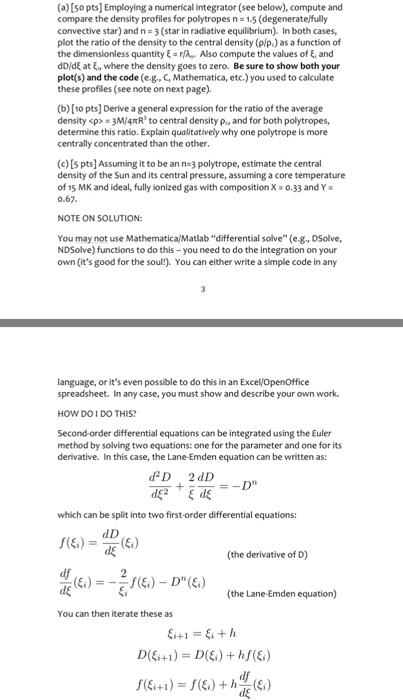
(a) [s0 pts] Employing a numerical integrator (see below), compute and compare the density profiles for polytropes n 1.5 (degenerate/fully convective star) and n (star in radiative equilibrium). In both cases, plot the ratio of the density to the central density (plp) as a function of the dimensionless quantity ra.. Also compute the values of , and dD/dE at " where the density goes to zero. Be sure to show both your plot(s) and the code (e-g., C, Mathematica, etc.) you used to calculate these profiles (see note on next page). (b)[io pts] Derive a general expression for the ratio of the average density
M/4rR, to central density Po and for both polytropes, determine this ratio. Explain qualitatively why one polytrope is more centrally concentrated than the other (c) [5 pts] Assuming it to be an n-3 polytrope, estimate the central density of the Sun and its central pressure, assuming a core temperature of 15 MK and ideal, fully ionized gas with composition X 0.33 and Y 0.67 NOTE ON SOLUTION: You may not use Mathematica/Matlab "differential solve" (e-g., DSolve, NDSolve) functions to do this-you need to do the integration on your own (it's good for the sol). You can either write a simple code in any language, or it's even possible to do this in an Excel/OpenOffice spreadsheet. In any case, you must show and describe your own work HOW DOI DO THIS Second-order differential equations can be integrated using the Euler method by solving two equations: one for the parameter and one for its derivative. In this case, the Lane-Emden equation can be written as: dD 2 dD which can be split into two first-order differential equations: dD dg (the derivative of D) (the Lane-Emden equation) You can then iterate these as (a) [s0 pts] Employing a numerical integrator (see below), compute and compare the density profiles for polytropes n 1.5 (degenerate/fully convective star) and n (star in radiative equilibrium). In both cases, plot the ratio of the density to the central density (plp) as a function of the dimensionless quantity ra.. Also compute the values of , and dD/dE at " where the density goes to zero. Be sure to show both your plot(s) and the code (e-g., C, Mathematica, etc.) you used to calculate these profiles (see note on next page). (b)[io pts] Derive a general expression for the ratio of the average density
M/4rR, to central density Po and for both polytropes, determine this ratio. Explain qualitatively why one polytrope is more centrally concentrated than the other (c) [5 pts] Assuming it to be an n-3 polytrope, estimate the central density of the Sun and its central pressure, assuming a core temperature of 15 MK and ideal, fully ionized gas with composition X 0.33 and Y 0.67 NOTE ON SOLUTION: You may not use Mathematica/Matlab "differential solve" (e-g., DSolve, NDSolve) functions to do this-you need to do the integration on your own (it's good for the sol). You can either write a simple code in any language, or it's even possible to do this in an Excel/OpenOffice spreadsheet. In any case, you must show and describe your own work HOW DOI DO THIS Second-order differential equations can be integrated using the Euler method by solving two equations: one for the parameter and one for its derivative. In this case, the Lane-Emden equation can be written as: dD 2 dD which can be split into two first-order differential equations: dD dg (the derivative of D) (the Lane-Emden equation) You can then iterate these as
Step by Step Solution
There are 3 Steps involved in it

Get step-by-step solutions from verified subject matter experts
 Study Help