







Question: can someone help ne with this case study? He charged through the double swinging doors into the dining room just in to see Steve, one
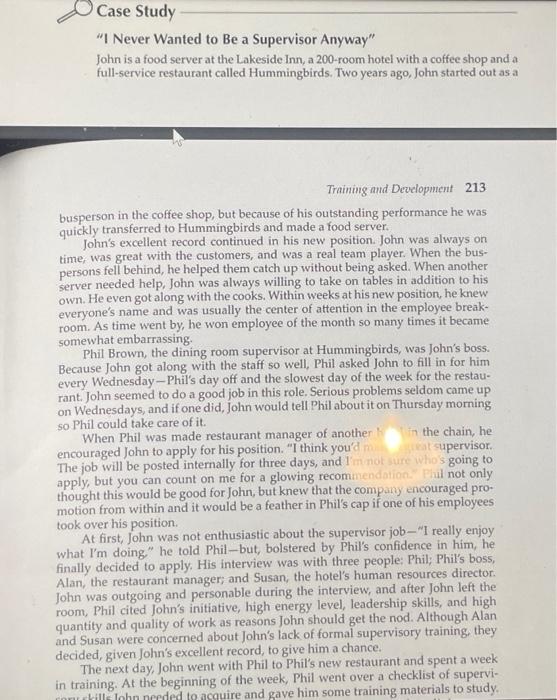
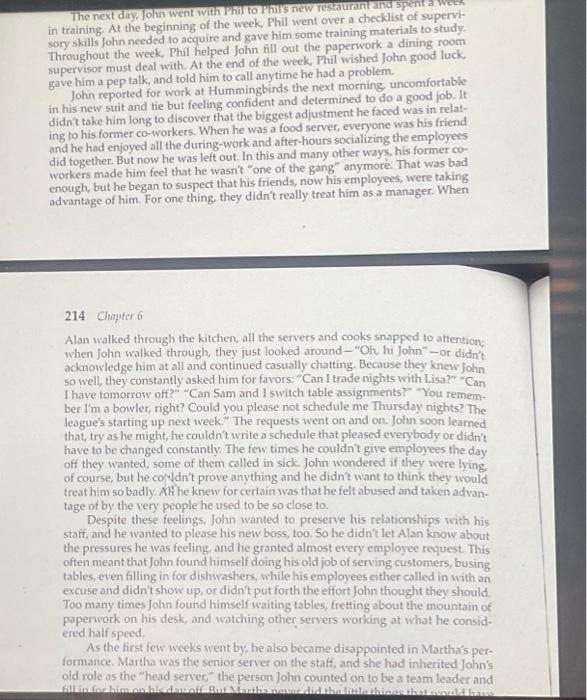
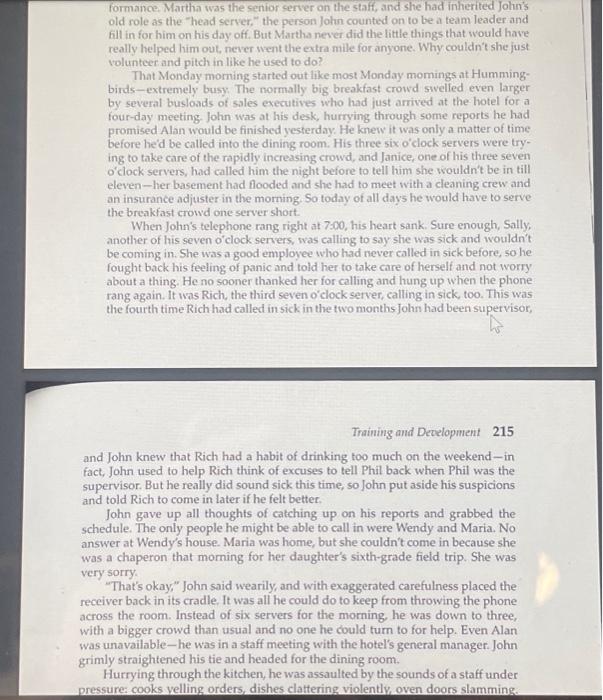
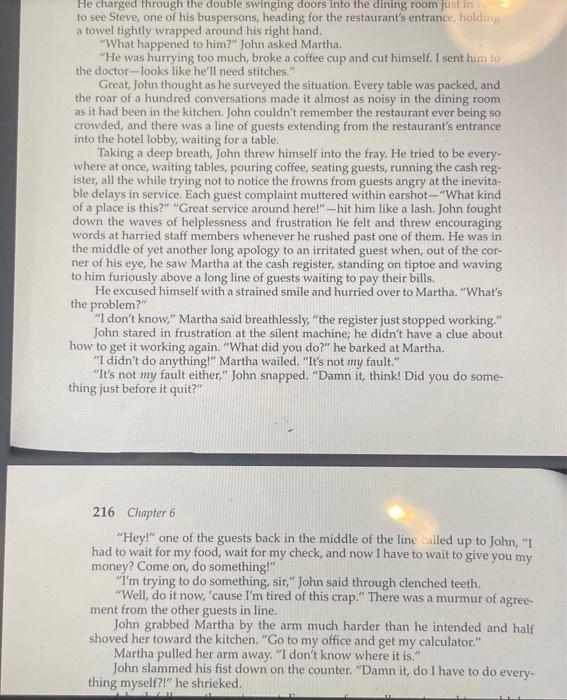
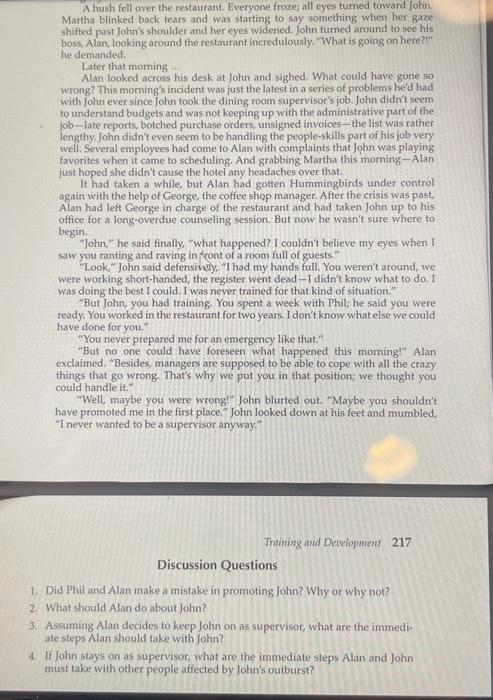
He charged through the double swinging doors into the dining room just in to see Steve, one of his buspersons, heading for the restaurant's entrance, holding. a towel tightly wrapped around his right hand. "What happened to him?" John asked Martha. "He was hurrying too much, broke a coffee cup and cut himself. I sent him to the doctor-looks like he'll need stitches." Great, John thought as he surveyed the situation. Every table was packed, and the roar of a hundred conversations made it almost as noisy in the dining room as it had been in the kitchen. John couldn't remember the restaurant ever being so crowded, and there was a line of guests extending from the restaurant's entrance into the hotel lobby, waiting for a table. Taking a deep breath, John threw himself into the fray. He tried to be everywhere at once, waiting tables, pouring coffee, seating guests, running the cash register, all the while trying not to notice the frowns from guests angry at the inevitable delays in service. Each guest complaint muttered within earshot- "What kind of a place is this?" "Great service around herel" - hit him like a lash. John fought down the waves of helplessness and frustration he felt and threw encouraging words at harried staff members whenever he rushed past one of them. He was in the middle of yet another long apology to an irritated guest when, out of the corner of his eye, he saw Martha at the cash register, standing on tiptoe and waving to him furiously above a long line of guests waiting to pay their bills. He excused himself with a strained smile and hurried over to Martha. "What's the problem?" "I don't know," Martha said breathlessly, "the register just stopped working." John stared in frustration at the silent machine; he didn't have a clue about how to get it working again. "What did you do?" he barked at Martha. "I didn't do anything!" Martha wailed. "It's not my fault." "It's not my fault either," John snapped. "Damn it, think! Did you do something just before it quit?" 216 Chapter 6 "Heyl" one of the guests back in the middle of the line called up to John, "I had to wait for my food, wait for my check, and now I have to wait to give you my money? Come on, do something!" "I'm trying to do something, sir," John said through clenched teeth. "Well, do it now, 'cause I'm tired of this crap." There was a murmur of agreement from the other guests in line. John grabbed Martha by the arm much harder than he intended and half shoved her toward the kitchen. "Go to my office and get my calculator." Martha pulled her arm away, "I don't know where it is." John slammed his fist down on the counter. "Damn it, do I have to do every. thing myself?!" he shrieked. The next day, ohn went with Phil fo Phil's new resta checklist of superviin training. At the beginning of the week, Phil went over a checklist of superv. sory skills john needed to acquire and gave him some training materials to stady. Throughout the week, Phil helped john fill out the paperwork a dining room supervisor must deal with. At the end of the week, Phil wished John good luck. gave him a pep talk, and told him to call anytime he had a problem. John reported for work at Hummingbirds the next morning uncomfortable in his new suit and tie but feeling confident and determined to do a good job. It didn't take him long to discover that the biggest adjustment he faced was in relating to his former co-workers. When he was a food server, everyone was his friend and he had enjoyed all the during-work and after-hours socializing the employees did together. But now he was left out. In this and many other ways, his former coworkers made him feel that he wasn't "one of the gang" anymore: That was bad enough, but he began to suspect that his friends, now his employees, were taking advantage of him. For one thing, they didn't really treat him as a manager. When 214 Chapter 6 Alan walked through the kitchen, all the servers and cooks smapped to attention; when John walked through, they just looked around - "Oh, hi John" - or didn't acknowledge him at all and continued casually chatting. Because they knew John so well, they constantly asked him for favors: "Can I trade nights with Lisa?" "Can thave tomorrow off?" "Can Sam and I switch table assignments?" "You remem. ber I'm a bouvler, right? Could you please not schedule me Thursday nights? The league's starting up next week." The requests went on and on. John soon learned that, try as he might, he couldn't write a schedule that pleased everybody or didn't have to be changed constantly. The few times he couldn't give employees the day off they wanted, some of them called in sick. John wondered if they were lying. of course, but he co'ldn't prove anything and he didn't want to think they would treat him so badly. Alt he knew for certain was that he felt abused and taken advantage of by the very people he used to be so clase to. Despite these feelings, John wanted to preserve his relationships with his staff, and he wanted to please his new boss, too. So he didn't let Alan know about the pressures he was feeling, and he granted almost every employee request. This often meant that fohn found himself doing his old job of serving customers, busing tables, even filling in for dishwashers, while his employees either called in with an excuse and didn't show up, or didn't put forth the effort John thought they should Too many times John found himself waiting tables, fretting about the mountain of papenvork on his desk, and watching other servers working at what he considered half speed. As the first few weeks went by, he also became disappointed in Martha's performance. Martha was the serior server on the staff, and she had inherited John's old role as the "head server," the person John counted on to be a team leader and "I Never Wanted to Be a Supervisor Anyway" John is a food server at the Lakeside Inn, a 200-room hotel with a coffee shop and a full-service restaurant called Hummingbirds. Two years ago, John started out as a Training and Development 213 busperson in the coffee shop, but because of his outstanding performance he was quickly transferred to Hummingbirds and made a food server. John's excellent record continued in his new position. John was always on time, was great with the customers, and was a real team player. When the buspersons fell behind, he helped them catch up without being asked. When another server needed help, John was always willing to take on tables in addition to his own. He even got along with the cooks. Within weeks at his new position, he knew everyone's name and was usually the center of attention in the employee breakroom. As time went by, he won employee of the month so many times it became somewhat embarrassing. Phil Brown, the dining room supervisor at Hummingbirds, was John's boss. Because John got along with the staff so well, Phil asked John to fill in for him every Wednesday - Phil's day off and the slowest day of the week for the restaurant. John seemed to do a good job in this role. Serious problems seldom came up on Wednesdays, and if one did, John would tell Phil about it on Thursday morning so Phil could take care of it. When Phil was made restaurant manager of another in the chain, he encouraged John to apply for his position. "I think you' supervisor. The job will be posted internally for three days, and 1 going to apply, but you can count on me for a glowing recom hil not only thought this would be good for John, but knew that the company encouraged promotion from within and it would be a feather in Phil's cap if one of his employees took over his position. At first, John was not enthusiastic about the supervisor job-"I really enjoy what I'm doing," he told Phil-but, bolstered by Phil's confidence in him, he Alan, the restaurant manager; and Susan, the hotel's human resources director. John was outgoing and personable during the interview, and after John left the room, Phil cited John's initiative, high energy level, leadership skills, and high quantity and quality of work as reasons John should get the nod. Although Alan and Susan were concerned about John's lack of formal supervisory training, they decided, given John's excellent record, to give him a chance. The next day, John went with Phil to Phil's new restaurant and spent a week in training. At the beginning of the week, Phil went over a checklist of supervi- A hush fell over the restaurant. Everyone froze; all eyes turned toward John. Martha blinked back tears and was starting to say something when her gare shifted past John's shoulder and her eyes widened. John tumed around to see his boss, Alan, looking around the restaurant incredulously. "What is going on here?" he demanded. Later that moming :-. Alan looked across his desk at John and sighed. What could have gone so wrong? This morning's incident was just the latest in a series of problems hed had with John ever since John took the dining room supervisor's job. John didn't seem to understand budgets and was not keeping up with the administrative part of the job-late reports, botched purchase orders, unsigned invoices - the list was rather lengthy. John didn't even seem to be handling the people-skills part of his job very well. Several employees had come to Alan with complaints that John was playing favorites when it eame to scheduling. And grabbing Marthn this morning-Alan fust hoped she didn't cause the hotel any headaches over that: It had taken a while, but Alan had gotten Hummingbirds under control again with the help of George, the colfee shop manager. After the crisis was past, Alan had left George in charge of the restaurant and had taken John up to his office for a long-overdue counseling session. But now he wasn't sure where to begin. "John," he said finally, "what happened? I couldn't believe my eyes when I saw you ranting and raving in front of a room full of guests." "Look," John said defensindy, "I had my hands full. You weren't around, we were working short-handed, the register went dead-I didn't know what to do. I was doing the best I could. I was never trained for that kind of situation." "But John, you had training. You spent a week with Phil; he said you were ready. You worked in the restaurant for two years. I don't know what else we could have done for you." "You never prepared me for an emergency like that." "But no one could have foreseen what happened this morning!" Alan exclaimed. "Besides, managers are supposed to be able to cope with all the crazy things that go wrong. That's why we put you in that position; we thought you could handle it." "Well, maybe you were wrong!" John blurted out. "Maybe you shouldn't have promoted me in the first place." John looked down at his feet and mumbled, "I never wanted to be a supervisor anyway." Training and Developuent 217 Discussion Questions 1. Did Phil and Alan make a mistake in promoting John? Why or why not? 2. What should Alan do about John? 3. Assuming Alan decides to keep John on as supervisor, what are the immediate steps Alan should take with John? 4. If John stays on as supervisor, what are the immediate steps Alan and John must take with other people affected by John's outburst? formance. Martha was the senior server on the staff, and she had inherited Johnts old role as the "head server," the person Johin counted on to be a feam leader and fill in for him on his day off. But Martha never did the little things that would have really helped him out, never went the extra mile for anyone. Why couldn't she just volunteer and pitch in like he used to do? That Monday morning started out like most Monday momings at Hummingbirds-extremely busy: The normally big breakfast crowd swelled even larger by several busloads of sales executives who had just arrived at the hotel for a four-day meeting. John was at his desk, hurrying through some reports he had promised Alan would be finished yesterday. He knew it was only a matter of time before he'd be called into the dining room. His three six o'clock servers were trying to take care of the rapidly increasing crowd, and Janice, one of his three seven o'clock servers, had called him the night before to tell him she wouldn't be in till eleven - her basement had flooded and she had to meet with a cleaning crew and an insurance adjuster in the morning. So today of all days he would have to serve the breakfast crowd one server short. When John's telephone rang right at 7:00, his heart sank. Sure enough, Sally, another of his seven o'clock servers, was calling to say she was sick and wouldn't be coming in. She was a good employee who had never called in sick before, so he fought back his feeling of panic and told her to take care of herself and not worry about a thing. He no sooner thanked her for calling and hung up when the phone rang again. It was Rich, the third seven o'clock server, calling in sick, too. This was the fourth time Rich had called in sick in the two months John had been supervisor, Training and Decelopment 215 and John knew that Rich had a habit of drinking too much on the weekend-in fact, John used to help Rich think of excuses to tell Phil back when Phil was the supervisor. But he really did sound sick this time, so John put aside his suspicions and told Rich to come in later if he felt better. John gave up all thoughts of catching up on his reports and grabbed the schedule. The only people he might be able to call in were Wendy and Maria. No answer at Wendy's house. Maria was home, but she couldn't come in because she was a chaperon that morning for her daughter's sixth-grade field trip. She was very sorry. "That's okay," John said wearily, and with exaggerated carefulness placed the recelver back in its cradle. It was all he could do to keep from throwing the phone across the room. Instead of six servers for the morning, he was down to three, with a bigger crowd than usual and no one he could turn to for help. Even Alan was unavailable - he was in a staff meeting with the hotel's general manager. John grimly straightened his tie and headed for the dining room. Hurrying through the kitchen, he was assaulted by the sounds of a staff under pressure: cooks velling orders, dishes clattering violently, oven doors slamming
Step by Step Solution
There are 3 Steps involved in it

Get step-by-step solutions from verified subject matter experts
 Study Help