Question: Can someone please do ALL question #6 by editing this part of the code I put below , and answering the question which algorithm is
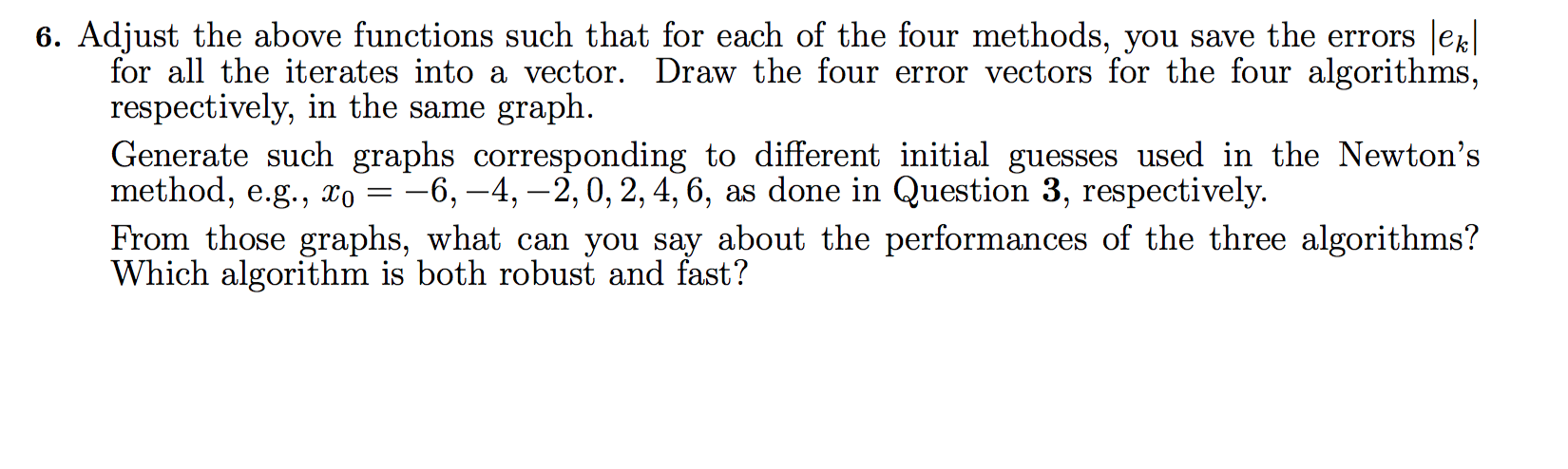
 Can someone please do ALL question #6 by editing this partof the code I put below , and answering the question "whichalgorithm is both robust and fast"? I am not sure how toanswer #6. I am using MATLAB. I can't get good graphs andnot sure why. If possible can you edit the code I put

Can someone please do ALL question #6 by editing this part of the code I put below , and answering the question "which algorithm is both robust and fast"? I am not sure how to answer #6. I am using MATLAB. I can't get good graphs and not sure why. If possible can you edit the code I put above to get what #6. The code I want edited is this part:

clear; clc; a = -8; b = 8; maxIter = 1e6; %max iteration of the function epsilon = 10e-12; %tolerance value

f1 = @(x) exp(2*sin(x))-x; %function gx = @(x) asin(log(sqrt(x))); %alternative g(x) for problem 3 x0 = 2; %initial guess

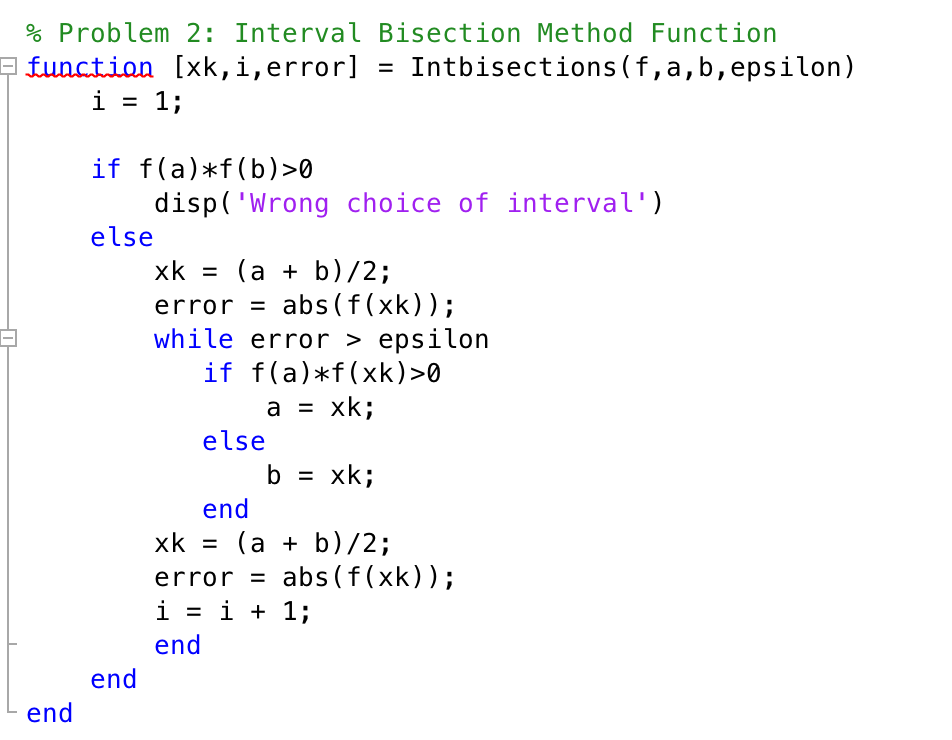
% Problem 2: Calling the Interval Bisection Method Function [xk2,i2,error2] = Intbisections(f1,a,b,epsilon);

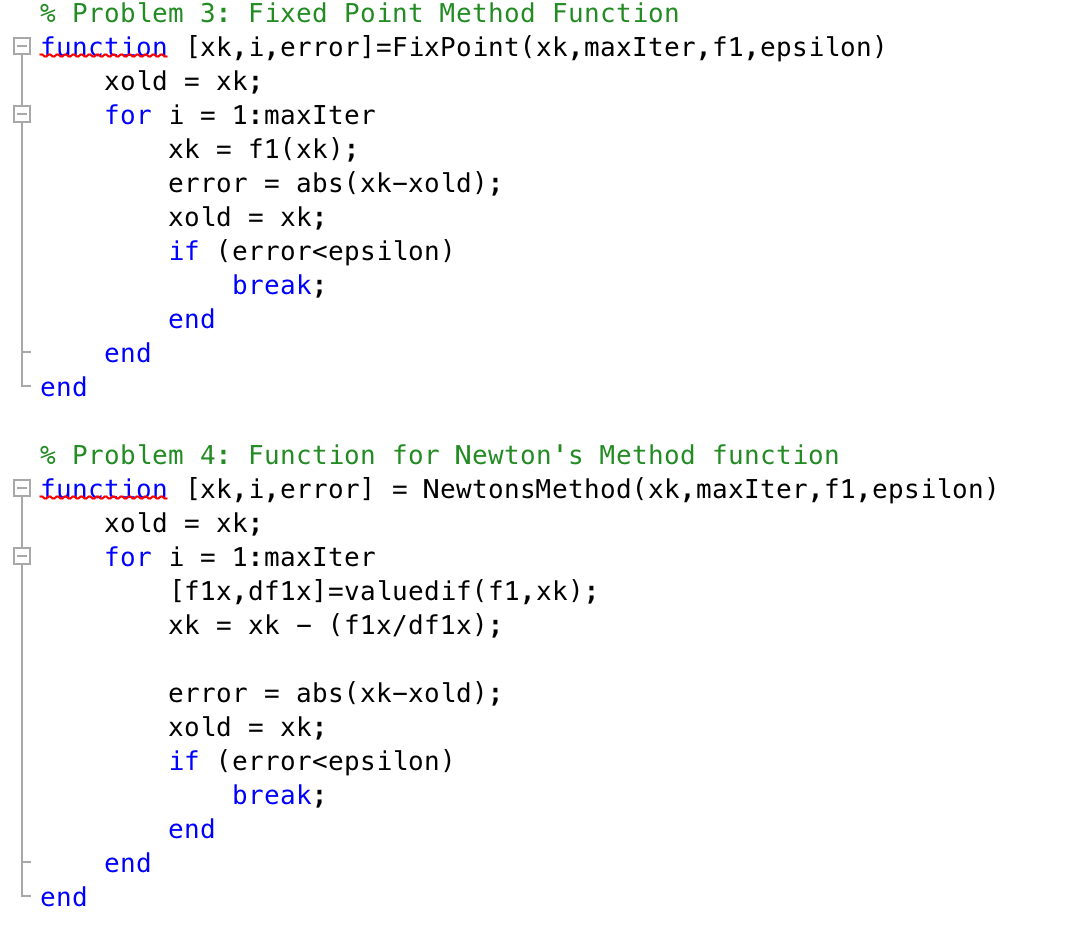
% Problem 3: Calling the Fixed Point Method Function [xk3,i3,error3] = FixPoint(x0,maxIter,gx,epsilon);

% Problem 4: Calling the Newton's Method function Problem 4 [xk4,i4,error4] = NewtonsMethod(x0,maxIter,f1,epsilon);

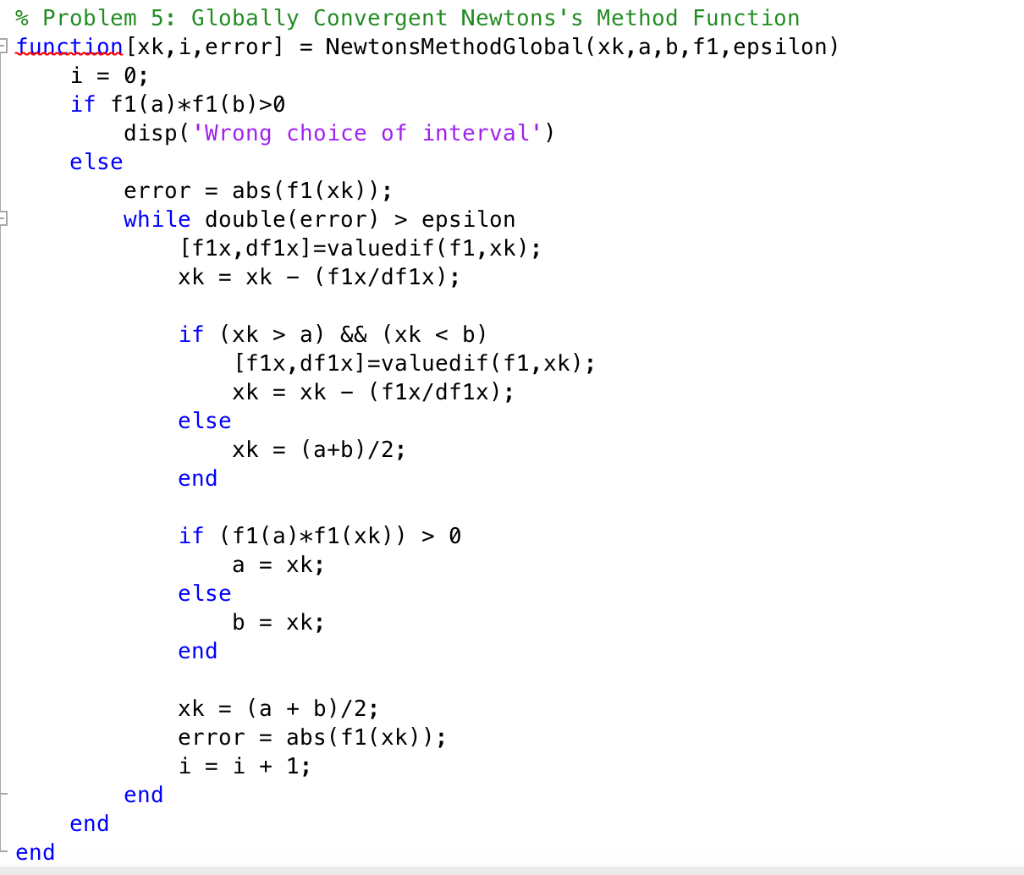
% Problem 5: Calling Globally Convergent Newtons's Method Function [xk5,i5,error5] = NewtonsMethodGlobal(x0,a,b,f1,epsilon);

%saving errors as vectors errorVector = [error2,error3,error4,error5];

%Graphing the error vector x_axis = [1,2,3,4]; %x-axis values semilogy(x_axis,errorVector,'-mo'); %graph of error vector in logarithmic y-axis grid on %logarithmic grid (y-axis only)

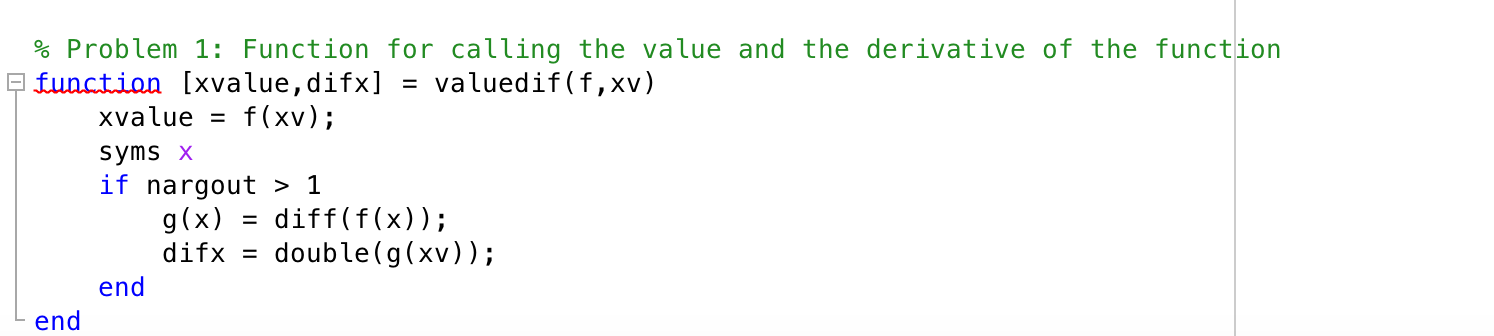
% Problem 1: Function for calling the value and the derivative of the function E function [xvalue,difx] = valuedif(f,xv) f(xv); xvalue = syms x if nargout > 1 g(x) difx = diff(f(x)); double(g(xv)); %3D end end % Problem 2: Interval Bisection Method Function function [xk,i,error] = Intbisections (f, a, b,epsilon) i = 1; if f(a)*f(b)>0 disp('Wrong choice of interval') else (a + b)/2; abs (f (xk)); while error > epsilon if f(a)*f(xk)>0 a = xk; xk = error = else b = xk; %3D end (a + b)/2; error = abs (f(xk)); i = i + 1; xk %| %| end end end % Problem 3: Fixed Point Method Function E function [xk,i,error]=FixPoint(xk,maxIter, f1,epsilon) xk; 1: maxIter xk = f1(xk); error = abs (xk-xold); xk; if (error0 disp('Wrong choice of interval') else error = abs(f1(xk)); while double(error) > epsilon [f1x,df1x]=valuedif(f1,xk); (f1x/df1x); xk = xk - if (xk > a) && (xk 0 a = xk; else b = xk; end xk = (a + b)/2; error = abs(f1(xk)); i = i + 1; end end Lend 6. Adjust the above functions such that for each of the four methods, you save the errors lex| for all the iterates into a vector. Draw the four error vectors for the four algorithms, respectively, in the same graph. Generate such graphs corresponding to different initial guesses used in the Newton's method, e.g., xo = -6, -4, 2, 0, 2, 4, 6, as done in Question 3, respectively. From those graphs, what can you say about the performances of the three algorithms? Which algorithm is both robust and fast? % Problem 1: Function for calling the value and the derivative of the function E function [xvalue,difx] = valuedif(f,xv) f(xv); xvalue = syms x if nargout > 1 g(x) difx = diff(f(x)); double(g(xv)); %3D end end % Problem 2: Interval Bisection Method Function function [xk,i,error] = Intbisections (f, a, b,epsilon) i = 1; if f(a)*f(b)>0 disp('Wrong choice of interval') else (a + b)/2; abs (f (xk)); while error > epsilon if f(a)*f(xk)>0 a = xk; xk = error = else b = xk; %3D end (a + b)/2; error = abs (f(xk)); i = i + 1; xk %| %| end end end % Problem 3: Fixed Point Method Function E function [xk,i,error]=FixPoint(xk,maxIter, f1,epsilon) xk; 1: maxIter xk = f1(xk); error = abs (xk-xold); xk; if (error0 disp('Wrong choice of interval') else error = abs(f1(xk)); while double(error) > epsilon [f1x,df1x]=valuedif(f1,xk); (f1x/df1x); xk = xk - if (xk > a) && (xk 0 a = xk; else b = xk; end xk = (a + b)/2; error = abs(f1(xk)); i = i + 1; end end Lend 6. Adjust the above functions such that for each of the four methods, you save the errors lex| for all the iterates into a vector. Draw the four error vectors for the four algorithms, respectively, in the same graph. Generate such graphs corresponding to different initial guesses used in the Newton's method, e.g., xo = -6, -4, 2, 0, 2, 4, 6, as done in Question 3, respectively. From those graphs, what can you say about the performances of the three algorithms? Which algorithm is both robust and fast

Step by Step Solution

There are 3 Steps involved in it

1 Expert Approved Answer
Step: 1 Unlock blur-text-image
Question Has Been Solved by an Expert!

Get step-by-step solutions from verified subject matter experts

Step: 2 Unlock
Step: 3 Unlock

Students Have Also Explored These Related Databases Questions!