







Question: Can you help me with how to solve core problem and additional challenge problem? Thank you Lab #10-TODAY'S LAB TOPICS: Primitive Data Types, Printf/Scanf functions,
Can you help me with how to solve core problem and additional challenge problem? Thank you
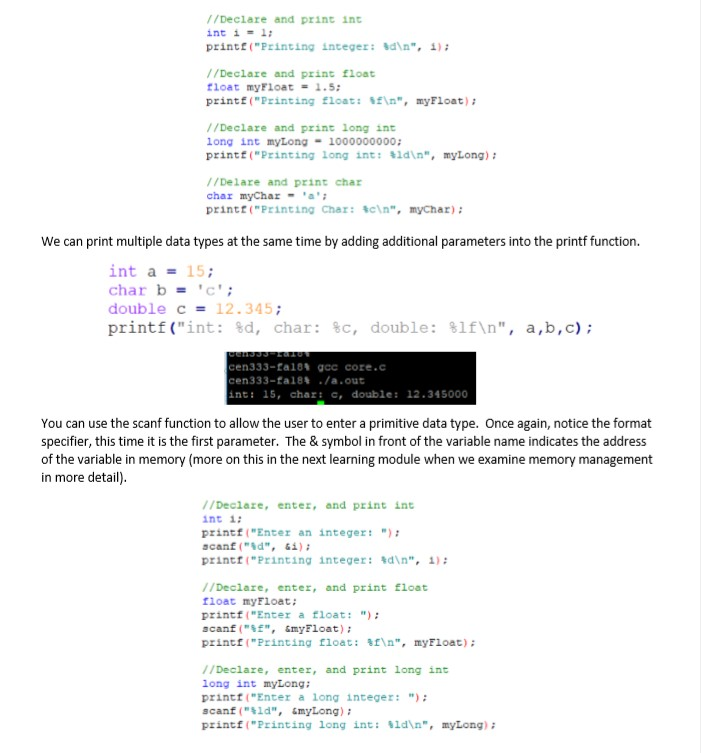


Lab #10-TODAY'S LAB TOPICS: Primitive Data Types, Printf/Scanf functions, data type conversion using promotion and type casting. CORE Problem: Primitive Data Types, Printf/Scanf, and data conversion using promotion Make sure to read the lab carefully. The first part of the lab will provide critical background information on how data types work in C. Most programming languages have a set of primitive data types. These are data types that are built into the programming language, and do not need support for libraries to be defined. Additional data types can be constructed called composite data types that are built by combing primitive data types together in different ways (more on this later) List Primitive Data Types in C Data Type short int unsigned short int unsigned int int long int unsigned long int long long int unsigned long long int signed char unsigned char float double long double Memory (bytes) Range Format Specifien 32,768 to 32,767 0 to 65,535 0 to 4,294,967,295 2,147,483,648 to 2,147,483,647 2,147,483,648 to 2,147,483,647 0 to 4,294,967,295 (2*63) to (2 63)-1 0 to 18,446,744,073,709,551,615 128 to 127 0 to 255 khu Nd kild Nc Nf 12 NLf Printing Primitive Data Types: To print one of these data types to the screen, you can use the printf function. The printf function requires using the format specifier shown in the table above. The example below shows how to declare and print a few different types of primitive variable data types. Notice the use of the format specifier embedded within the string (quotes) in the printf function. The second parameter is the variable that is being printed
Step by Step Solution
There are 3 Steps involved in it

Get step-by-step solutions from verified subject matter experts
 Study Help