







Question: case question 4, 5 CASE 9.2 ENDOWMENTS: TO SPEND NOW OR SAVE FOR A RAINY DAY Journey Center, a drop-in center for teens aged 13
case question 4, 5 
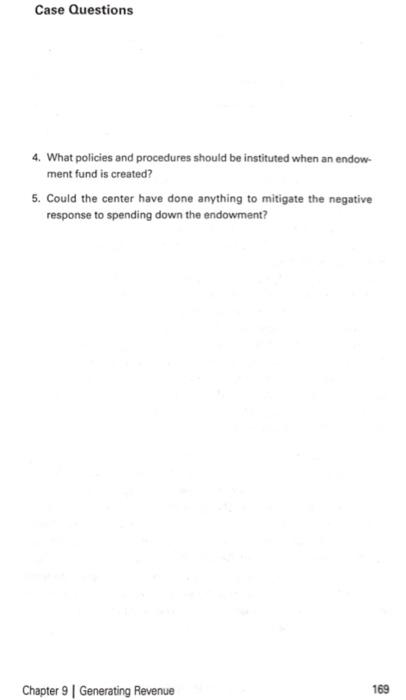
CASE 9.2 ENDOWMENTS: TO SPEND NOW OR SAVE FOR A RAINY DAY Journey Center, a drop-in center for teens aged 13 to 18 years old had been operating in the predominately low-income community of Kingston for almost 10 years. The organization was established by members of a church in the neighboring upscale town of Middleton as a separate 501(c)(3) nonprofit with the mission of giving local kids a safe place after school to spend their free time and receive homework assistance, if needed. The majority of funding for the center came through the support of church parishioners in the form of cash donations and fund-raisers held at the church on behalf of Journey Center. The center's founding board was made up of Kingston community members, some of whom were also parishioners. Journey Center operated out of a rented storefront two blocks away from the local high school. When they first opened the doors, word spread about the center, and before long it was viewed as the "cool" place to hang out. On average, 20 students used the facility every week- day when school was in session. The center was closed on the weekends and during the summer. Brightly painted rooms were filled with a hodgepodge of donated bean bag chairs, board games, and a worn pool table. There were chairs and tables scattered about where students could complete their schoolwork. The program was run by a part-time executive director, Jorge Partida. Jorge enjoyed the lively chaos that the teens brought to the center and prided himself on knowing all of their names. Jorge carefully monitored every penny of the center's annual $300,000 budget. He employed several part-time staff who, along with volunteers, helped deliver tutoring programs and monitored the teens' activities. For their part, church members were also very proud of the center they had helped to build. One spring, parishioners and staff were working on the annual giving campaign for the church when Barb Sandke, a longtime parishioner and major donor to the church and the center said, "You know, I've been thinking..." Chapter 9 | Generating Revenue 165 "Oh, that's never good," kidded Mark, her husband. Everyone smiled. Mark and Barb were a retired couple that did virtu- ally everything together, and most of their spare time was spent on volunteer activities at the church. As a team, they had been quite successful in the real estate market, and in retirement they were more than happy to share their wealth as generous donors to many local causes. Barb swatted Mark's arm and continued. "I'm thinking, we've had such good luck with building our endowment fund here at the church, we should get one going for Journey Center. What if this year we did a special appeal for that along with our regular campaign?" In general, the folks around the table seemed in favor of the idea. "How much do you think we should shoot for?" asked Father James, the church's long-standing rector. "I'm thinking maybe $250,000 with the idea that we will build it to $1 million over time," Barb responded. "Then, they can withdraw a certain amount based on the investment returns from the million-dollar corpus every year. It could eventually be enough to cover a large part of the director's salary every year. That should really help them. What do you all think? Having our church endowment has certainly helped us these past few years," she said. "I know it won't cover much right now, but it's enough to give the center a nice financial cushion that they can rely on in the future," Barb added. "And it's a good way to ensure they stay in business for the long haul," added Mark. After further discussion, the group decided to add the appeal to their regular fund drive. Parishioners responded favorably to the campaign, and many made gifts to the Journey Center fund in addition to making their annual pledge to the church. Behind the scenes, Mark and Barb also marshalled the resources of several well-heeled church friends, getting each to commit gifts of $10,000. "Nobody is going to want to come to dinner anymore, Mark." Barb laughed. "They know you're going to hit them up for the center." By the end of the campaign, the church had raised $270,000 to establish an endowment fund at Journey Center. Father James happily presented 166 CASES IN NONPROFIT MANAGEMENT the check to Journey's board chair, Steve Crawford. "You know, we will keep at this on our end until we reach the million-dollar goal," he assured the entire Journey Center board. And indeed, over the next 2 years, the church added another $85,000 to the fund. As the Journey Center neared its 13th anniversary, the center's board met for a strategic planning retreat. They began with a report from their executive director. Jorge informed the board that attendance at the center had dropped off sharply. "The kids aren't hanging out with us like they used to," he explained. "They all head to the local coffee shop for the free WiFi. That's what's got their attention now," he reported. "I'd like to propose that we make some investments in infrastructure to get these kids back and to perhaps attract even more. We need to set up some computers, maybe even a mini computer lab. We have to make Journey Center relevant again, and then we can really meet our mission" The board launched into a lengthy discussion about the idea. Several board members suggested looking for donated equipment. "I just don't think that gets us anywhere," Jorge countered. "I think we need to do it right, get the kids' attention by making the place really nice. We could use some of the endowment money; it's just sitting there doing nothing for us right now." Sue Shirey, a Journey Center board member and parishioner at the church, raised an objection. "I'm not sure how people at the church will feel about this. When we raised the money, I think everyone thought it was going to be set aside until it reached $1 million, then we would use the annual interest to cover our costs here." "At the rate we are going with that, we'll all be long gone when we hit $1 million. These kids need our help today. If it's our mission to serve these kids, we need to help them now, not wait till it's too late," Jorge stated. Several board members nodded in agreement. "I would only be comfortable with this if we devise a plan to pay back the fund as soon as possible," said Sue. "I was thinking that if we use the money now and start attracting more kids, we could build a better case for support and leverage it to raise more money in the future. Then, hopefully, we could pay back the fund," Jorge said. "Think of it more like an investment than a withdrawal." 167 Chapter 9 | Generating Revenue "OK, I'm convinced," said Casey Ralphs, the board treasurer. "I motion we pull an initial $100,000 from the fund to cover the costs of what Jorge has proposed here," he said. "Then we can reevaluate our posi- tion in 6 months." Hearing no objections, the motion passed. In short order, Jorge's plan was successfully implemented, and the Jour ney Center was once again a lively teen gathering place. In fact, with the computers, staff at the center began a more in-depth tutoring program. Board members were pleased with the success, and at the 6-month review, they voted to take another $50,000 from the endowment fund to start a music program. Despite the initial success of the plan, Sue remained uncomfortable with the idea that they were spending down the endowment with no real plan in place for paying it back. She raised the issue with some parishioners who she knew had donated large sums of money to the original campaign, and it did not take long for the word to get back to Mark and Barb. "I'm dumbfounded," Barb said. "That is not what I had in mind when I said we would build an endowment for them. They missed the whole point." "Not to mention that some of our friends aren't really happy with us right now for twisting their arms to support this." Mark continued. "And, I have no idea if their plans are even sustainable. For all I know, they could be out of business tomorrow, and what would we have to show for it? I don't know why they didn't ask us first." "It's going to make it seriously difficult to get support for them in the future. People feel duped," Barb added. The following week, Jorge received a letter signed by 40 "concerned" parishioners admonishing the Journey Center to be more transparent in their financial matters and calling upon them to leave the remain- ing endowment principal untouched as originally planned and to pro- vide the church with a written plan for repayment of the funds. 168 CASES IN NONPROFIT MANAGEMENT Case Questions 4. What policies and procedures should be instituted when an endow- ment fund is created? 5. Could the center have done anything to mitigate the negative response to spending down the endowment? Chapter 9 | Generating Revenue 169
Step by Step Solution
There are 3 Steps involved in it
1 Expert Approved Answer
Step: 1 Unlock

Question Has Been Solved by an Expert!
Get step-by-step solutions from verified subject matter experts
Step: 2 Unlock
Step: 3 Unlock
 Study Help