







Question: Case study 11.1... Please anwser in your own words do not use other chegg questions, thanks! Also I just need question number 3. lized in
Case study 11.1... Please anwser in your own words do not use other chegg questions, thanks! Also I just need question number 3. 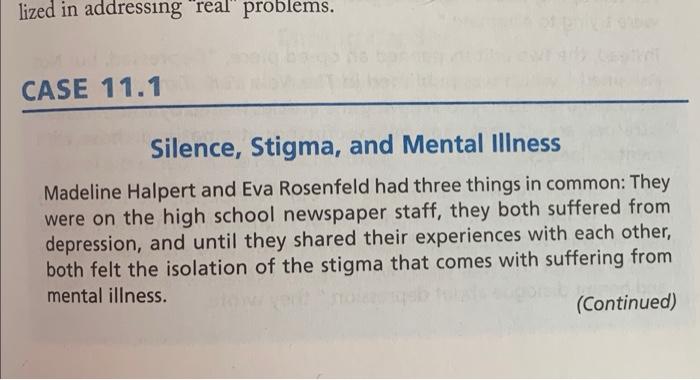
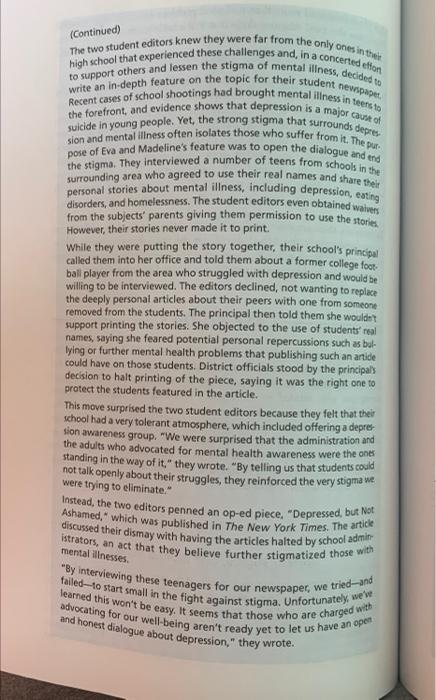
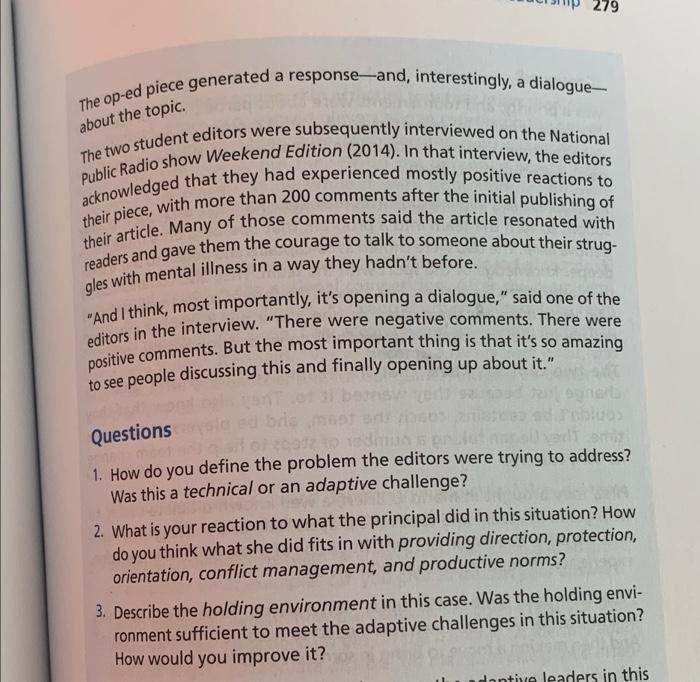
lized in addressing "real" problems. CASE 11.1 Silence, Stigma, and Mental illness Madeline Halpert and Eva Rosenfeld had three things in common: They were on the high school newspaper staff, they both suffered from depression, and until they shared their experiences with each other, both felt the isolation of the stigma that comes with suffering from mental illness. (Continued) (Continued) The two student editors knew they were far from the only ones in the high school that experienced these challenges and, in a concerted effon to support others and lessen the stigma of mental illness, decided to write an in-depth feature on the topic for their student newspaper Recent cases of school shootings had brought mental illness in teens to the forefront, and evidence shows that depression is a major can of sion and mental illness often isolates those who suffer from it. The pur suicide in young people. Yet, the strong stigma that surrounds depres pose of Eva and Madeline's feature was to open the dialogue and end the stigma. They interviewed a number of teens from schools in the surrounding area who agreed to use their real names and share their personal stories about mental illness, including depression, eating disorders, and homelessness. The student editors even obtained walivers from the subjects' parents giving them permission to use the stories However, their stories never made it to print. While they were putting the story together, their school's principal called them into her office and told them about a former college foor ball player from the area who struggled with depression and would be willing to be interviewed. The editors declined, not wanting to replace the deeply personal articles about their peers with one from someone removed from the students. The principal then told them she wouldn't support printing the stories. She objected to the use of students' real names, saying she feared potential personal repercussions such as bul- Tying or further mental health problems that publishing such an artide could have on those students. District officials stood by the principals decision to halt printing of the piece, saying it was the right one to protect the students featured in the article. This move surprised the two student editors because they felt that their school had a very tolerant atmosphere, which included offering a depre sion awareness group. "We were surprised that the administration and the adults who advocated for mental health awareness were the one standing in the way of it." they wrote. "By telling us that students could not talk openly about their struggles, they reinforced the very stigma we were trying to eliminate." Instead, the two editors penned an op-ed piece. "Depressed, but Ashamed," which was published in The New York Times. The article istrators, an act that they believe further stigmatized those with discussed their dismay with having the articles halted by school admin failed-10 start small in the fight against stigma. Unfortunately, wewe "By interviewing these teenagers for our newspaper, we tried-and learned this won't be easy. It seems that those who are charged with advocating for our well-being aren't ready yet to let us have an open mental illnesses and horvest dialogue about depression," they wrote. 279 about the topic. The op-ed piece generated a response-and, interestingly, a dialogue Public Radio show Weekend Edition (2014). In that interview, the editors The two student editors were subsequently interviewed on the National acknowledged that they had experienced mostly positive reactions to their piece, with more than 200 comments after the initial publishing of their article. Many of those comments said the article resonated with readers and gave them the courage to talk to someone about their strug- gles with mental illness in a way they hadn't before. "And I think, most importantly, it's opening a dialogue," said one of the editors in the interview. "There were negative comments. There were positive comments. But the most important thing is that it's so amazing to see people discussing this and finally opening up about it." Questions 2002 etter 1. How do you define the problem the editors were trying to address? Was this a technical or an adaptive challenge? 2. What is your reaction to what the principal did in this situation? How do you think what she did fits in with providing direction, protection, orientation, conflict management, and productive norms? 3. Describe the holding environment in this case. Was the holding envi- ronment sufficient to meet the adaptive challenges in this situation? How would you improve it? dantive leaders in this
Step by Step Solution
There are 3 Steps involved in it
1 Expert Approved Answer
Step: 1 Unlock

Question Has Been Solved by an Expert!
Get step-by-step solutions from verified subject matter experts
Step: 2 Unlock
Step: 3 Unlock
 Study Help