







Question: Case study 11.2 Clusters ustered: Global competition seems to be weakening the benets of being in a cluster OPENED in I845. the Cantoni cotton mill
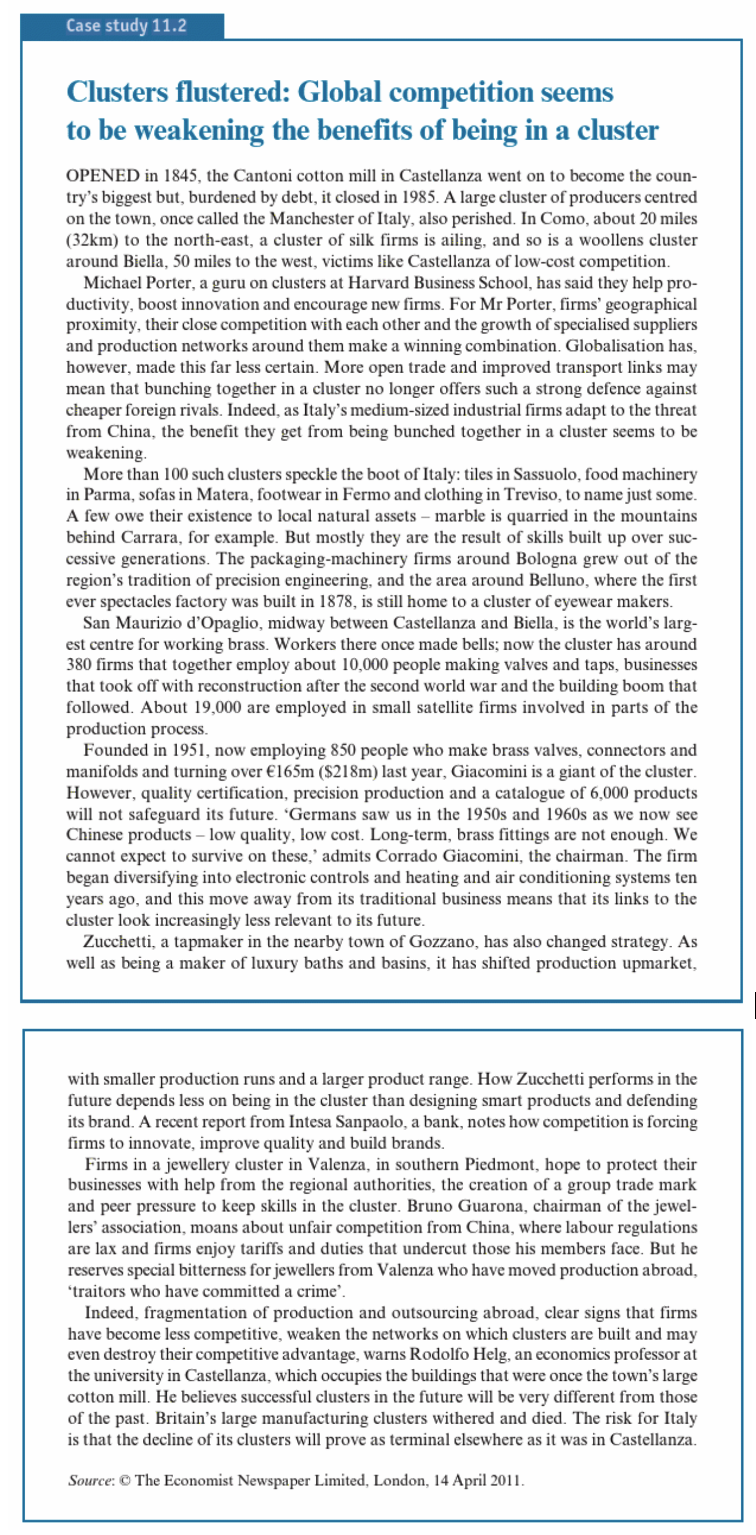
Case study 11.2 Clusters ustered: Global competition seems to be weakening the benets of being in a cluster OPENED in I845. the Cantoni cotton mill in Castellanza went on to become the coun- try's biggest but. burdened by debt. it closed in I985. A large cluster of producers centred on the town. once called the Manchester of Italy. also perished. In Como, about 20 miles {32km} to the north-east. a cluster of silk rms is ailing. and so is a woollcns cluster around Biella, 50 miles to the west. victims like Castellanza of low-cost competition. Michael Porter. a guru on clusters at Harvard Business School. has said they help pro- ductivity. boost innovation and encourage new rms. For Mr Porter. rms' geographical proximity. their close competition with each other and the grth of specialised suppliers and production networks around them make a winning combination. Globalisation has. however. made this far less certain. More open trade and improved transport links may mean that bunching together in a cluster no longer offers such a strong defence against cheaper foreign rivals. Indeed. as Italy's mediumsized industrial rms adapt to the threat from China, the benet they get from being bunched together in a cluster seems to be weakening. More than 100 such clusters speckle the boot of Italy: tiles in Sassuolo, food machinery in Parma, sofas in Matera. footwear in Fenno and clothing in Treviso. to name just some. A few owe their existence to local natural assets marble is quarried in the mountains behind Carrara. for example. But mostly they are the result of skills built up over suc- cessive generations. The packaging-machinery rms around Bologna grew out of the region's tradition of precision engineering. and the area around Belluno. where the rst ever spectacles factory was built in 1878. is still home to a cluster of eyewear makers. San Maurizio d'Opaglio. midway between Castellanza and Biella. is the world's larg- est centre for working brass. Workers there once made bells; now the cluster has around 380 rms that together employ about "3.000 people making valves and taps. businesses that took off with reconstruction after the second world war and the building boom that followed. About 19,000 are employed in small satellite firms involved in parts of the production process. Founded in 195 I. now employing 850 people who make brass valves. connectors and manifolds and turning over 165m (SZIBm) last year. Giacomini is a giant of the cluster. However. quality certication. precision production and a catalogue of 6.000 products will not safeguard its future. 'Germans saw us in the 19503 and 1960s as we now see Chinese products - low quality, low cost. Long-term. brass ttings are not enough. We cannot expect to survive on these.' admits Corrado Giacomini. the chairman. The rm began diversifying into electronic controls and heating and air conditioning systems ten years ago. and this move away from its traditional business means that its links to the cluster look increasingly less relevant to its future. Zucchetti. a tapmaker in the nearby town of Gozzano. has also changed strategy. As well as being a maker of luxury baths and basins. it has shifted production upmarket. with smaller production runs and a larger product range. How Zucchetti performs in the future depends less on being in the cluster than designing smart products and defending its brand. A recent report from Intesa Sanpaolo. a bank. notes how competition is forcing rms to innovate. improve quality and build brands. Firms in a jewellery cluster in Valenza, in southern Piedmont. hope to protect their businesses with help from the regional authorities, the creation of a group trade mark and peer pressure to keep skills in the cluster. Bruno Guarona. chairman ol' the jewel- lers' association. moans about unfair competition from China. where labour regulations are lax and rms enjoy tariffs and duties that undercut those his members face. But he reserves special bitterness for jewellers from Valenza who have moved production abroad. 'traitors who have committed a crime'. Indeed. fragmentation of production and outsourcing abroad. clear signs that rms have become less competitive. weaken the networks on which clusters are built and may even destroy their competitive advantage. warns Rodolfo Helg, an economics professor at the university in Castellanza. which occupies the buildings that were once the town's large cotton mill. He believes successful clusters in the future will be very different from those of the past. Britain's large manufacturing clusters withered and died. The risk for Italy is that the decline of its clusters will prove as terminal elsewhere as it was in Castellanza. Source: ID The Economist Newspaper Limited. London. 14 April 20] l
Step by Step Solution
There are 3 Steps involved in it

Get step-by-step solutions from verified subject matter experts
 Study Help