Question: CASE STUDY 3 Eagle Sales Associates: Evaluating a Sales Team Janet Hunt is a regional sales manager at Eagle Sales Associates, a firm selling manufacturers'
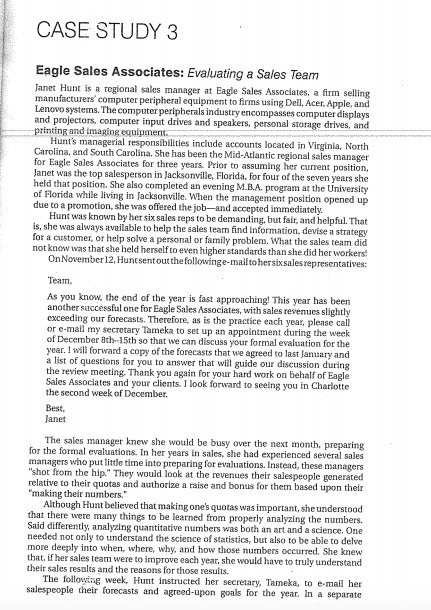
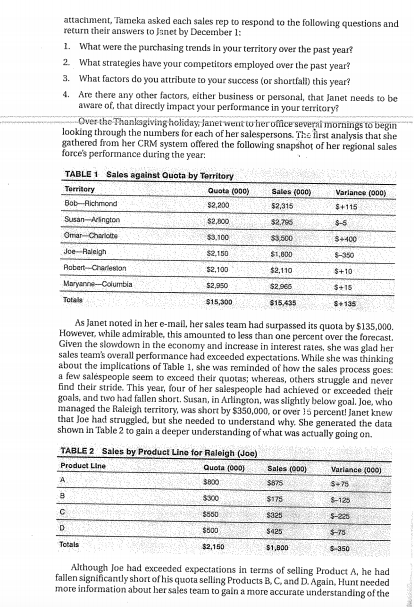
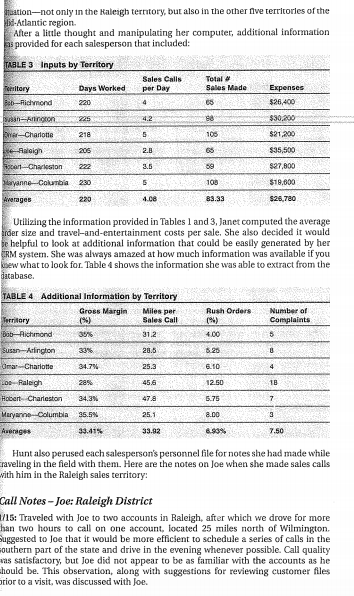
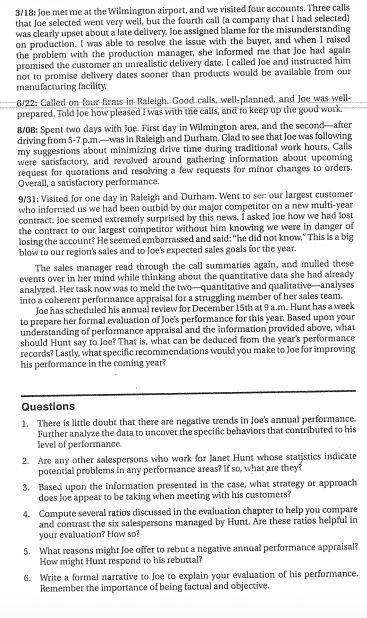
CASE STUDY 3 Eagle Sales Associates: Evaluating a Sales Team Janet Hunt is a regional sales manager at Eagle Sales Associates, a firm selling manufacturers' computer peripheral equipment to firms using Dell, Acer, Apple, and Lenovo systems. The computer peripherals industry encompasses computer displays and projectors, computer input drives and speakers, personal storage drives, and printing and imaging equipment Hunt's managerial responsibilities include accounts located in Virginia, North Carolina, and South Carolina. She has been the Mid-Atlantic regional sales manager for Eagle Sales Associates for three years. Prior to assuming her current position, Janet was the top salesperson in Jacksonville, Florida, for four of the seven years she held that position. She also completed an evening M.B.A. program at the University of Florida while living in Jacksonville. When the management position opened up due to a promotion, she was offered the job-and accepted immediately. Hunt was known by her six sales reps to be demanding, but fair, and helpful. That is, she was always available to help the sales team find information, devise a strategy for a customer, or help solve a personal or family problem. What the sales team did not know was that she held herself to even higher standards than she did her workers! On November 12, Huntsentoutthe followinge-mail to her six sales representatives: "Tean, As you know, the end of the year is fast approaching! This year has been another successful one for Eagle Sales Associates, with sales revenues slightly exceeding our forecasts. Therefore, as is the practice each year, please call or e-mail my secretary Tameka to set up an appointment during the week of December 8th-15th so that we can discuss your formal evaluation for the year. I will forward a copy of the forecasts that we agreed to last January and a list of questions for you to answer that will guide our discussion during the review meeting. Thank you again for your hard work on behalf of Eagle Sales Associates and your clients. I look forward to seeing you in Charlotte the second week of December. Best. Janet The sales manager knew she would be busy over the next month, preparing for the formal evaluations. In her years in sales, she had experienced several sales managers who put little time into preparing for evaluations. Instead, these managers "shot from the hip. They would look at the revenues their salespeople generated relative to their quotas and authorize a raise and bonus for them based upon their "making their numbers." Although Hunt believed that making one's quotas was important, she understood that there were many things to be learned from properly analyzing the numbers. Said differently analyzing quantitative numbers was both an art and a science. One needed not only to understand the science of statistics, but also to be able to delve more deeply into when, where, why, and how those numbers occurred. She knew that, if her sales team were to improve each year, she would have to truly understand their sales results and the reasons for those results. The followine week, Hunt instructed her secretary, Tameka, to e-mail her salespeople their forecasts and agreed-upon goals for the year. In a separate attachment, Tomeka asked ench sales rep to respond to the following questions and return their answers to Janet by December 1: 1. What were the purchasing trends in your territory over the past year? 2. What strategies have your competitors employed over the past year? 3. What factors do you attribute to your success (or shortfall) this year? 4. Are there any other factors, either business or personal, that Janet needs to be aware of that directly impact your performance in your territory? Over the Thanksgiving holiday, Janet went to her office several mornings to begin looking through the numbers for each of her salespersons. The first analysis that she gathered from her CRM system offered the following snapshot of her regional sales force's performance during the year: TABLE 1 Sales against Quota by Territory Territory Quota (000) Sales (000) Variance (000) Bob Richmond $2.200 Susandlington $2.00 $2795 52.315 Omar Charlotte $3.100 $3,500 $400 Joe Raleigh $2.150 $1,000 $-350 Robert Charlesto 32.100 $2.110 Maryanne Columbia 52.950 $2.866 Totalis $15,300 $15.4355 135 As Janet noted in her e-mail, her sales team had surpassed its quota by $135,000 However, while admirable, this amounted to less than one percent over the forecast. Given the slowdown in the economy and increase in interest rates, she was glad her sales team's overall performance had exceeded expectations. While she was thinking about the implications of Table 1, she was reminded of how the sales process goes a few salespeople seem to exceed their quotas; whereas, others struggle and never find their stride. This year, four of her salespeople had achieved or exceeded their goals, and two had fallen short. Susan, in Arlington, was slightly below goal. Joe, who managed the Raleigh territory, was short by $350,000, or over 15 percent Janet knew that Joe had struggled, but she needed to understand why. She generated the data shown in Table 2 to gain a deeper understanding of what was actually going on. TABLE 2 Sales by Product Line for Raleigh (Joe) Product Line Quota (000) $800 Variance (000) Sales (000) $875 37 $75 3300 $550 -25 $325 $4257 $2,150 $1,800 350 Although Joe had exceeded expectations in terms of selling Product A, he had fallen significantly short of his quota selling Products B, C, and D. Again, Hunt needed more information about her sales team to gain a more accurate understanding of the luation not only in the Kalenghterntory, but also in the other five territories of the Atlantic region. After a little thought and manipulating her computer, additional information es provided for each salesperson that included: TABLE 3 Inputs by Territory Sales Calls per Da Total Sales Made Days Worked Expenses itory Richmond 3:26.400 $30,200 2200 ign $350 978 $10.000 Suryanne-Columbia Averages 2 230 20 $26,760 Utilizing the information provided in Tables 1 and 3, Janet computed the average der size and travel and entertainment costs per sale. She also decided it would be helpful to look at additional information that could be easily generated by her CRM system. She was always amazed at how much information was available if you Wow what to look for. Table & shows the information she was able to extract from the database Rush Orders TABLE 4 Additional Information by Territory Gross Margin Miles per Territory Sales Call bob-Richmond 33% un-Arlington Number of Complaints dear Charlotte e-Raleigh Holbert Charleston Maryane Columbia 34.3% 35.5% Averages 33.41% Hunt also perused each salesperson's personnel file for notes she had made while raveling in the field with them. Here are the notes on Joe when she made sales calls with him in the Raleigh sales territory: Call Notes - Joe: Raleigh District 1/15: Traveled with Joe to two accounts in Raleigh, after which we drove for more han two hours to call on one account, located 25 miles north of Wilmington, Suggested to Joe that it would be more efficient to schedule a series of calls in the outhern part of the state and drive in the evening whenever possible. Call quality was satisfactory, but Joe did not appear to be as familiar with the accounts as he thould be. This observation, along with suggestions for reviewing customer files srior to a visit was discussed with Joe. 3/18: Joe met me at the Wilmington airport, and we visited four accounts. Three calls that Joe selected went very well, but the fourth call la company that I had selected) was clearly upset about a late delivery. Joe assigned blame for the misunderstanding on production. I was able to resolve the issue with the buyer, and when I raised the problem with the production manager, she informed me that Joe had again promised the customer an unrealistic delivery date. I called Joe and instructed him not to promise delivery dates sooner than products would be available from our manufacturing facility 6/22: Called-on four firms in Raleigh. Good calls, well-planned, and Joe was well- prepared. Told Joe how pleased was with the calls, and to keep up the good work 8/08: Spent two days with Joe. First day in Wilmington area, and the second after driving from 5-7 p.m-was in Raleigh and Durham. Glad to see that Joe was following my suggestions about minimizing drive time during traditional work hours, Calls were satisfactory, and revolved around gathering information about upcoming request for quotations and resolving a few requests for minor changes to orders Overall, a satisfactory performance. 9/31: Visited for one day in Raleigh and Durham. Went to see our largest customer who informed us we had been outbid by our major competitor on a new multi-year contract. Joe seemed extremely surprised by this news. I asked Joe how we had lost the contract to our largest competitor without him knowing we were in danger of losing the account? He seemed embarrassed and said: "he did not know." This is a big blow to our region's sales and to Joe's expected sales goals for the year. The sales manager read through the call summaries again, and mulled these events over in her mind while thinking about the quantitative data she had already analyzed. Her task now was to meld the two quantitative and qualitative analyses into a coherent performance appraisal for a struggling member of her sales team. Joe has scheduled his annual review for December 15th at 9am. Hunt has a week to prepare her formal evaluation of Joe's performance for this year. Based upon your understanding of performance appraisal and the information provided above, what should Hunt say to Joe? That is what can be deduced from the year's performance records? Lastly, what specific recommendations would you make to Joe for improving his performance in the coming year? Questions 1. There is little doubt that there are negative trends in Joe's annual performance. Further analyze the data to uncover the specific behaviors that contributed to his level of performance 2. Are any other salespersons who work for Janet Hunt whose statistics indicate potential problems in any performance areas? If so, what are they 3. Based upon the information presented in the case, what strategy or approach does Joe appear to be taking when meeting with his customers? 4. Compute several ratios discussed in the evaluation chapter to help you compare and contrast the six salespersons managed by Hunt. Are these ratios helpful in your evaluation? How so? 5. What reasons might Joe offer to rebut a negative annual performance appraisal? How might Hunt respond to his rebuttal? 6. Write a formal narrative to Joe to explain your evaluation of his performance. Remember the importance of being factual and objective









 Study Help