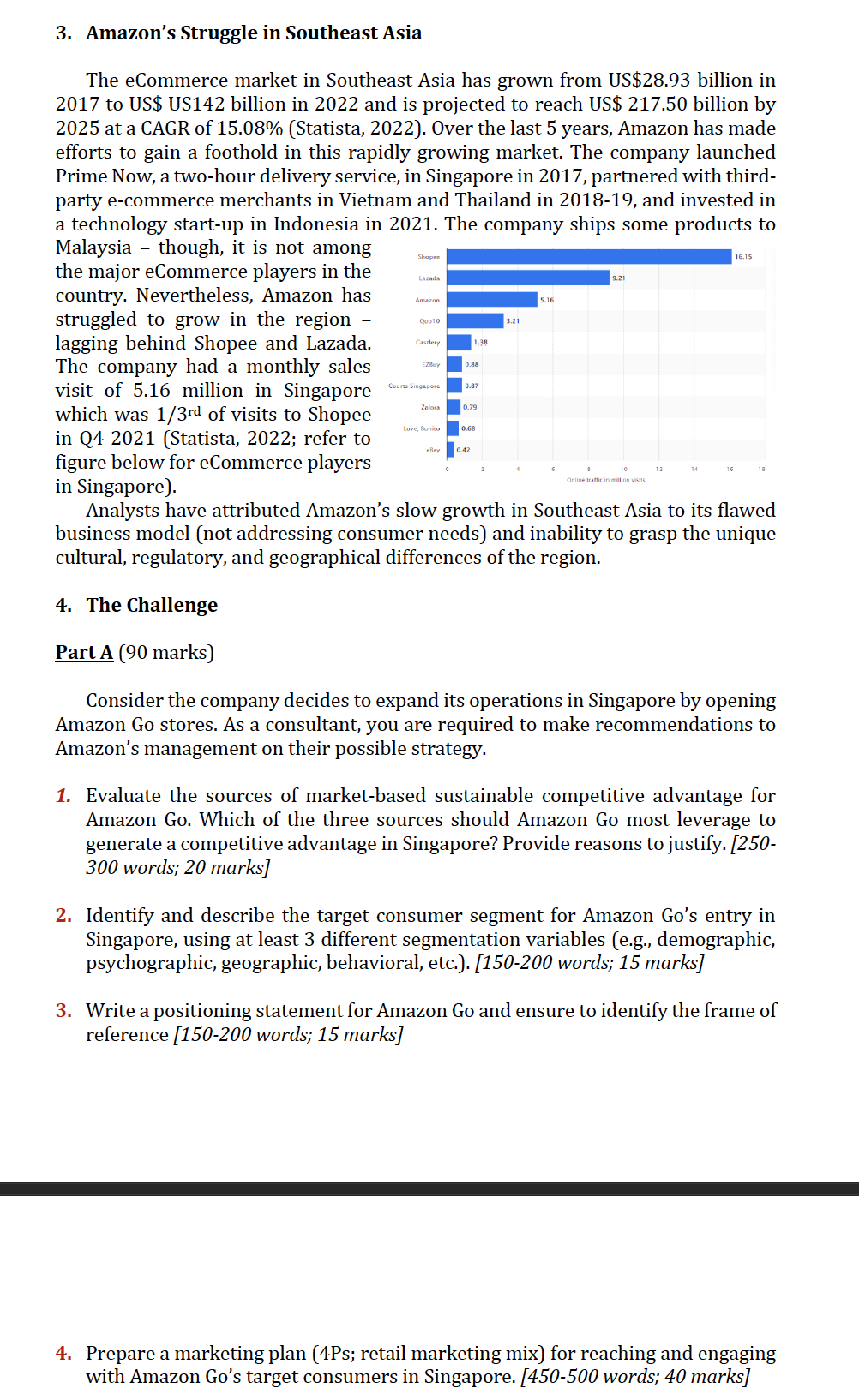
Case Study: Amazon Go's Entry into Singapore Market 1. Amazon: Emergence of Online Retail Giant Jeff Bezos started Amazon as an online bookstore based out of Seattle in 1994. Bezos set up the company based on what he termed as a regret minimization framework i.e., "in X years, will I regret not doing this?". In its initial years, Amazon's business model was simple - access products at wholesale prices and sell them cheaper online than those available in physical stores. Furthermore, Amazon focused on the strategic location of its warehouses, innovative technology (especially, robotics), inventory management, and collaboration with delivery companies to create an efficient online shopping experience for its consumers. In 2001, the company realized its first profit of US$5.0 million and started to expand its product offerings, introduce its own brand/ private label products, and enter the international markets. By 2015, Amazon became the biggest online retailer, and, by the next year, it garnered more than half of the online retail sales in the United States. In 2016, Amazon decided to open its first offline retail store in Seattle - Amazon Go using an omnichannel approach. 2. Combining Online and Offline Retail The company opened the Amazon Go grocery store in Seattle for beta-testing in December 2016 (https://www.youtube.com/watch?v=NrmMk1Myrxc). A typical Amazon Go outlet is planned to be 1800 sq. ft. in size and, unlike traditional stores, does not have any cashiers. Using a unique electronic payment system, Amazon Go provides its consumers with a 'just walk-out' shopping experience that allows them to pick a product and walk out. Consumers need to have an Amazon Prime account, a smartphone, and an Amazon app. As the consumers enter a store, they simply scan the app, pick products without the need to scan individual items and leave the store without queueing at the cashier. The shopping technology uses sensors to automatically debit the price of the purchased product from the consumer's Amazon Prime account before they leave the store. Amazon Go marked the company's entry into the highly competitive brick-and- mortar grocery retail market in the United States - including retailers such as Walmart and Target. Since its launch, Amazon Go has complemented its mixed online and offline retail model with the launch of private-labeled brands in the grocery and household goods categories. Furthermore, the company has focused on leveraging technology (i.e., cameras, sensors, machine learning, computer vision, and AI), enabling a frictionless customer experience, and ensuring supply chain efficiency. The company's unique selling proposition for Amazon Go is no lines, no checkout, just grab & go! In addition to its innovative shopping technology, Amazon Go focuses on consumer convenience and providing good-quality products at affordable prices. The retailer has traditionally targeted consumers in the age bracket of 20-30 years - through brand-building, innovative public relations, and digital marketing. For example, around its launch, Amazon Go installed 'community banana stands' across Seattle that distributed 4,500 free bananas to emphasize its fresh food appeal, gain free press coverage, and connect with health-conscious consumers. Simultaneously, the retailer launched video teasers, partnered with digital celebrities, and conducted buzz marketing to highlight the innovative shopping technology. Amazon Go currently has 20 stores across 4 cities in the U.S. and 15 stores in the U.K (Forbes, 2021). 3. Amazon's Struggle in Southeast Asia The eCommerce market in Southeast Asia has grown from US$28.93 billion in 2017 to US$ US142 billion in 2022 and is projected to reach US$ 217.50 billion by 2025 at a CAGR of 15.08% (Statista, 2022). Over the last 5 years, Amazon has made efforts to gain a foothold in this rapidly growing market. The company launched Prime Now, a two-hour delivery service, in Singapore in 2017, partnered with third- party e-commerce merchants in Vietnam and Thailand in 2018-19, and invested in a technology start-up in Indonesia in 2021. The company ships some products to Malaysia - 16.15 Shopee Lazada 9.21 Amazon Qoo10 3.21 Castlery EZBuy though, it is not among the major eCommerce players in the country. Nevertheless, Amazon has struggled to grow in the region lagging behind Shopee and Lazada. The company had a monthly sales visit of 5.16 million in Singapore which was 1/3rd of visits to Shopee in Q4 2021 (Statista, 2022; refer to figure below for eCommerce players in Singapore). Courts Singapore Zalora 0.68 10 12 14 Online traffic in million visits Analysts have attributed Amazon's slow growth in Southeast Asia to its flawed business model (not addressing consumer needs) and inability to grasp the unique cultural, regulatory, and geographical differences of the region. 4. The Challenge Part A (90 marks) Consider the company decides to expand its operations in Singapore by opening Amazon Go stores. As a consultant, you are required to make recommendations to Amazon's management on their possible strategy. 1. Evaluate the sources of market-based sustainable competitive advantage for Amazon Go. Which of the three sources should Amazon Go most leverage to generate a competitive advantage in Singapore? Provide reasons to justify. [250- 300 words; 20 marks] 2. Identify and describe the target consumer segment for Amazon Go's entry in Singapore, using at least 3 different segmentation variables (e.g., demographic, psychographic, geographic, behavioral, etc.). [150-200 words; 15 marks] 3. Write a positioning statement for Amazon Go and ensure to identify the frame of reference [150-200 words; 15 marks] 4. Prepare a marketing plan (4Ps; retail marketing mix) for reaching and engaging with Amazon Go's target consumers in Singapore. [450-500 words; 40 marks] 1.38 0.88 0.79




