





Question: Case Study - Business Ethics Please answer the following questions within 2 pages. No plagiarism. Introduction - what is the context or background of the

Case Study - Business Ethics Please answer the following questions within 2 pages. No plagiarism. Introduction - what is the context or background of the case? What is the key problem/pressure/issue in the case? Who are the main actors in the case? What are the main fraudulent activities in the case? What are the solutions/results in the case? Bibliography - 3-4 outsides sources suggested How could this fraud have been prevented? List as many controls as you can.

Mortgage Fraud
Case Study - Business Ethics Please answer the

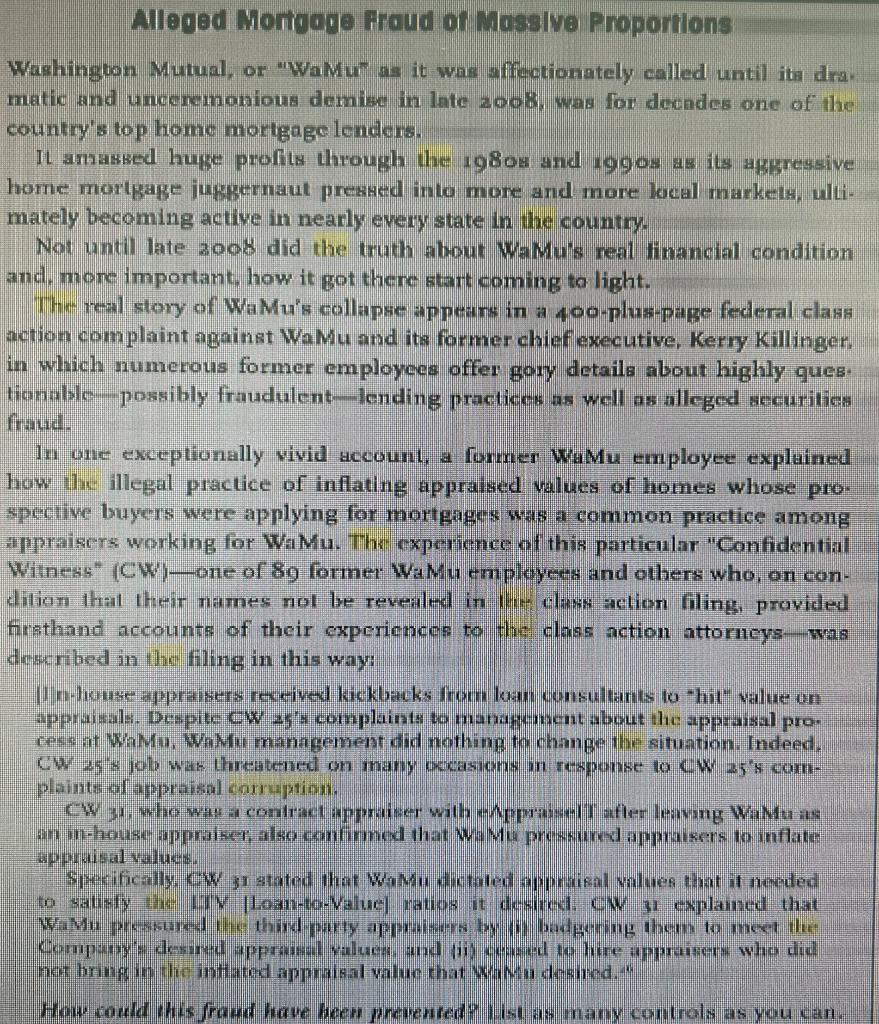
Alleged Mortgage Proud of Massive Proportions Washington Mutual, or "WaMu as it was affectionately called until ita dra matic and unceremonious demise in late 2008, wag for decades one of the country's top homc mortgage lenders. Il amassed huge profily through the 1980s and 1990s as its aggressive home mortgage juggernaut pressed into more and more local markets, ulli. mately becoming active in nearly every state in the country. Not until late 2008 did the truth about Wamu's real financial condition and, more important, how it got there start coming to light. The real story of WaMu's collapse appears in a 400-plus-page federal class action complaint against WaMu and its former chief executive, Kerry Killinger. in which numerous former employees offer gory details about highly ques. tionable---possibly fraudulent-londing practices as well as alleged securities In one exceptionally vivid account, a former WaMu employee explained how the illegal practice of inflating appraised values of homes whose pro- spective buyers were applying for mortgages was a common practice among appraisers working for WaMu. The experience of this particular "Confidential Witness" (CW)-one of 89 former WaMu employees and others who, on con- dition that their names not be revealed in the class action filing, provided firsthand accounts of their experiences to the class action attorneys-was described in the filing in this way: Min-house appraisers roeived kickbacks Irom loan consultants to "hit" value on appraisals. Despite CW 25': complaints to management about the appraisal pro. cess at WaMu. WaMu management did nothing to change the situation. Indeed. CW 25's job was threatened on many occasions in response to CW 35's com- plaints of appraisal corruption. CW 31, who was a contract appraiser with eAppraise IT afler leaving WaMu as an in-house appraiser, also confirmed that waMu pressured appraisers to inflate appraisal values. Specifically. CW stated that Wamu dictated appraisal values that it needed to satisfy the UV Loan-to-Value) ratios it desired. CW 31 explained that WaMu pressured the third-parly appraisers bym badgering them to meet the Company's desired apprunal values and timed to hure appraisers who did not bring in the intiated appraisal value that WiMu desmed. How could this fraud have been prevented? List as many controls as you can

Step by Step Solution

There are 3 Steps involved in it

1 Expert Approved Answer
Step: 1 Unlock blur-text-image

Question Has Been Solved by an Expert!

Get step-by-step solutions from verified subject matter experts

Step: 2 Unlock
Step: 3 Unlock

Students Have Also Explored These Related General Management Questions!