







Question: Case study - management You don't need to put background all you need to put is Case Analysis, Solutions, and Recommendations. Following Structure: 1. Case

Case study - management
You don't need to put background all you need to put is Case Analysis, Solutions, and Recommendations.
Following Structure:
1. Case Analysis: Analyses the case identifying the key issues and/or problems. Identifies problems using evidence from the case plus theories and concepts
2. Linking theory and practice to the solution: Develops a solution to the issues or problems. Justifies the solution with evidence, management theory, approaches, concepts and/or models.
3. Recommends specific strategies to accomplish the proposed solution.
Length: Words: 1,500 words, excluding the reference list.
please help me analyses the case. Thank you
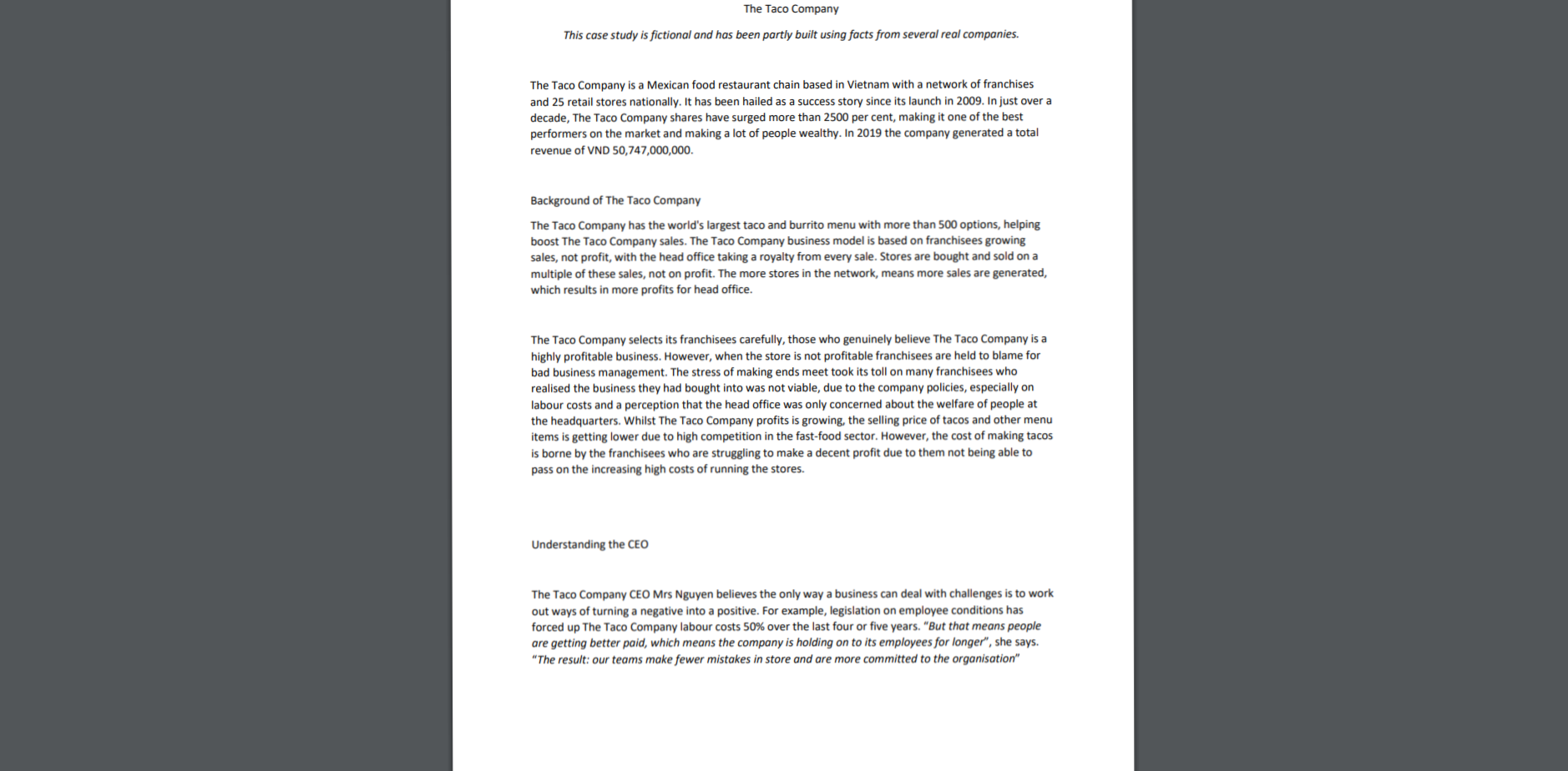
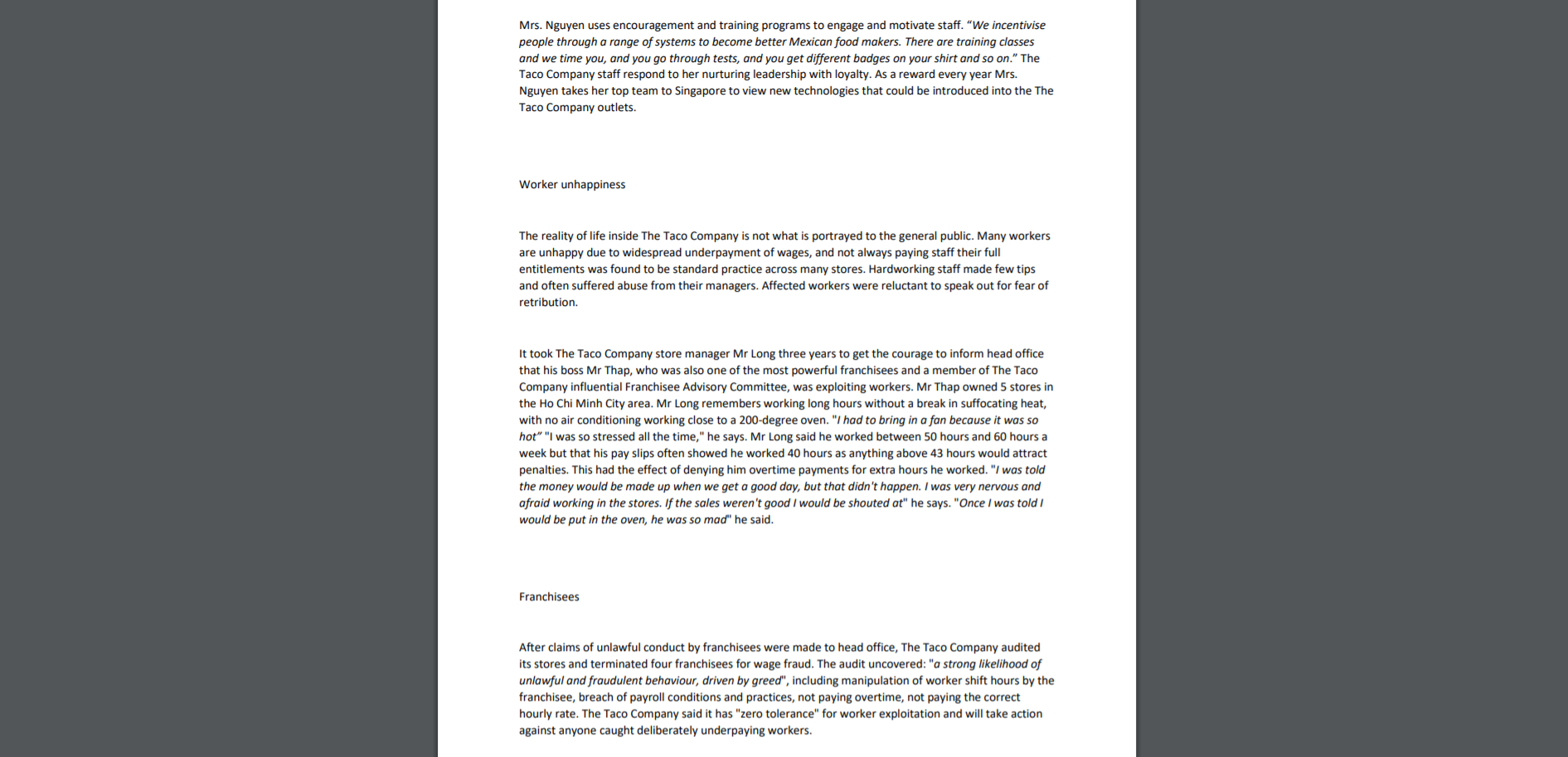
The Taco Company This case study is fictional and has been partly built using facts from several real companies. The Taco Company is a Mexican food restaurant chain based in Vietnam with a network of franchises and 25 retail stores nationally. It has been hailed as a success story since its launch in 2009. In just over a decade, The Taco Company shares have surged more than 2500 per cent, making it one of the best performers on the market and making a lot of people wealthy. In 2019 the company generated a total revenue of VND 50,747,000,000. Background of The Taco Company The Taco Company has the world's largest taco and burrito menu with more than 500 options, helping boost The Taco Company sales. The Taco Company business model is based on franchisees growing sales, not profit, with the head office taking a royalty from every sale. Stores are bought and sold on a multiple of these sales, not on profit. The more stores in the network, means more sales are generated, which results in more profits for head office. The Taco Company selects its franchisees carefully, those who genuinely believe The Taco Company is a highly profitable business. However, when the store is not profitable franchisees are held to blame for bad business management. The stress of making ends meet took its toll on many franchisees who realised the business they had bought into was not viable, due to the company policies, especially on labour costs and a perception that the head office was only concerned about the welfare of people at the headquarters. Whilst The Taco Company profits is growing, the selling price of tacos and other menu items is getting lower due to high competition in the fast-food sector. However, the cost of making tacos is borne by the franchisees who are struggling to make a decent profit due to them not being able to pass on the increasing high costs of running the stores. Understanding the CEO The Taco Company CEO Mrs Nguyen believes the only way a business can deal with challenges is to work out ways of turning a negative into a positive. For example, legislation on employee conditions has forced up The Taco Company labour costs 50% over the last four or five years. But that means people are getting better paid, which means the company is holding on to its employees for longer", she says. "The result: our teams make fewer mistakes in store and are more committed to the organisation" Mrs. Nguyen uses encouragement and training programs to engage and motivate staff. "We incentivise people through a range of systems to become better Mexican food makers. There are training classes and we time you, and you go through tests, and you get different badges on your shirt and so on." The Taco Company staff respond to her nurturing leadership with loyalty. As a reward every year Mrs. Nguyen takes her top team to Singapore to view new technologies that could be introduced into the The Taco Company outlets. Worker unhappiness The reality of life inside The Taco Company is not what is portrayed to the general public. Many workers are unhappy due to widespread underpayment of wages, and not always paying staff their full entitlements was found to be standard practice across many stores. Hardworking staff made few tips and often suffered abuse from their managers. Affected workers were reluctant to speak out for fear of retribution. It took The Taco Company store manager Mr Long three years to get the courage to inform head office that his boss Mr Thap, who was also one of the most powerful franchisees and a member of The Taco Company influential Franchisee Advisory Committee, was exploiting workers. Mr Thap owned 5 stores in the Ho Chi Minh City area. Mr Long remembers working long hours without a break in suffocating heat, with no air conditioning working close to a 200-degree oven. "I had to bring in a fan because it was so hot" "I was so stressed all the time," he says. Mr Long said he worked between 50 hours and 60 hours a week but that his pay slips often showed he worked 40 hours as anything above 43 hours would attract penalties. This had the effect of denying him overtime payments for extra hours he worked. "I was told the money would be made up when we get a good day, but that didn't happen. I was very nervous and afraid working in the stores. If the sales weren't good I would be shouted at" he says. "Once I was told I would be put in the oven, he was so mad" he said. Franchisees After claims of unlawful conduct by franchisees were made to head office, The Taco Company audited its stores and terminated four franchisees for wage fraud. The audit uncovered: "a strong likelihood of unlawful and fraudulent behaviour, driven by greed", including manipulation of worker shift hours by the franchisee, breach of payroll conditions and practices, not paying overtime, not paying the correct hourly rate. The Taco Company said it has "zero tolerance" for worker exploitation and will take action against anyone caught deliberately underpaying workers. Why were some franchisees acting like this? As competition intensified with other rival food chains, a number of franchisees describe the head office system as "dictatorial" with its ongoing demands to make record profits. Franchisees reported being very stressed losing hundreds of millions of Vietnam Dong. They weren't making money unless they were cutting costs. Franchisees were being asked to pay more and more ongoing fees, while retail prices remained the unchanged - all of which put pressure on staff and franchisees. Mr Long reported Mr Thap to head office shortly after he quit his job in April 2019. The long hours, poor pay, and heat exhaustion finally got to him. He never heard back from The Taco Company and never received back payStep by Step Solution
There are 3 Steps involved in it

Get step-by-step solutions from verified subject matter experts
 Study Help