







Question: Certain solid substances, known as hydrated compounds, have well - defined molecular ratios of water to some other species, which often is a salt. For
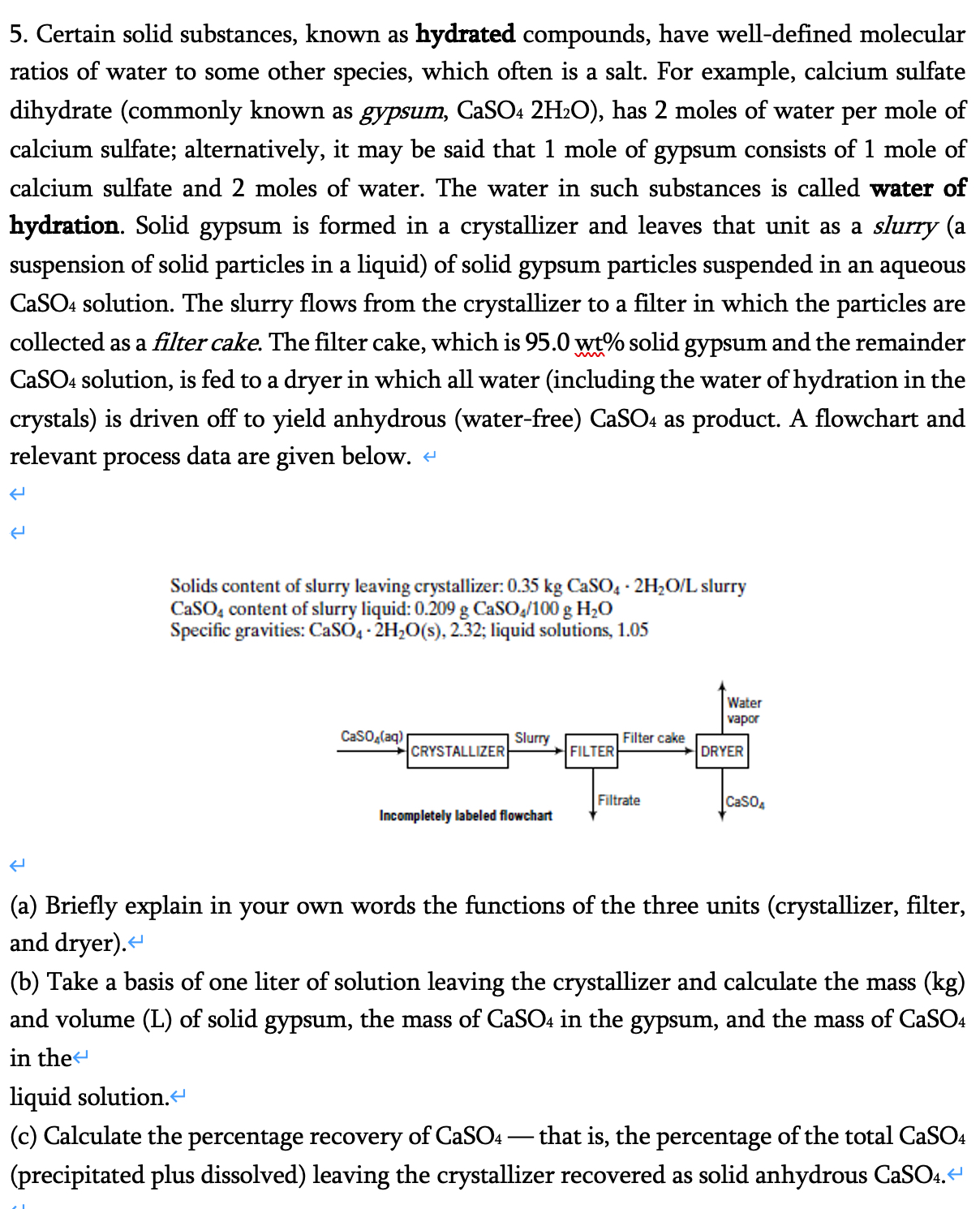
Certain solid substances, known as hydrated compounds, have welldefined molecular ratios of water to some other species, which often is a salt. For example, calcium sulfate dihydrate commonly known as gypsum, has moles of water per mole of calcium sulfate; alternatively, it may be said that mole of gypsum consists of mole of calcium sulfate and moles of water. The water in such substances is called water of hydration. Solid gypsum is formed in a crystallizer and leaves that unit as a slurry a suspension of solid particles in a liquid of solid gypsum particles suspended in an aqueous solution. The slurry flows from the crystallizer to a filter in which the particles are collected as a filter cake. The filter cake, which is solid gypsum and the remainder solution, is fed to a dryer in which all water including the water of hydration in the crystals is driven off to yield anhydrous waterfree as product. A flowchart and relevant process data are given below.
Solids content of slurry leaving crystallizer: slurry
content of slurry liquid: gCaS
Specific gravities: s; liquid solutions,
a Briefly explain in your own words the functions of the three units crystallizer filter, and dryer
b Take a basis of one liter of solution leaving the crystallizer and calculate the mass and volume L of solid gypsum, the mass of in the gypsum, and the mass of in the
liquid solution.
c Calculate the percentage recovery of that is the percentage of the total precipitated plus dissolved leaving the crystallizer recovered as solid anhydrous
Step by Step Solution
There are 3 Steps involved in it
1 Expert Approved Answer
Step: 1 Unlock

Question Has Been Solved by an Expert!
Get step-by-step solutions from verified subject matter experts
Step: 2 Unlock
Step: 3 Unlock
 Study Help