





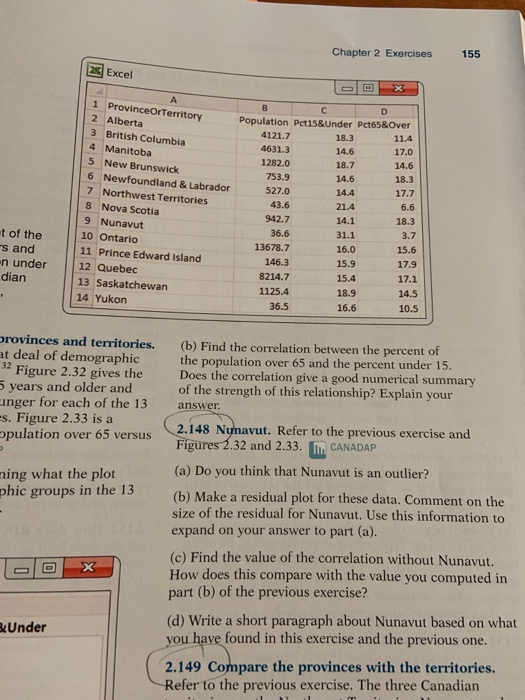
Question: Chapter 2 Exercises 155 x Excel 1 Province OrTerritory 2 Alberta 3 British Columbia 4 Manitoba 5 New Brunswick 6 Newfoundland & Labrador 7 Northwest
Chapter 2 Exercises 155 x Excel 1 Province
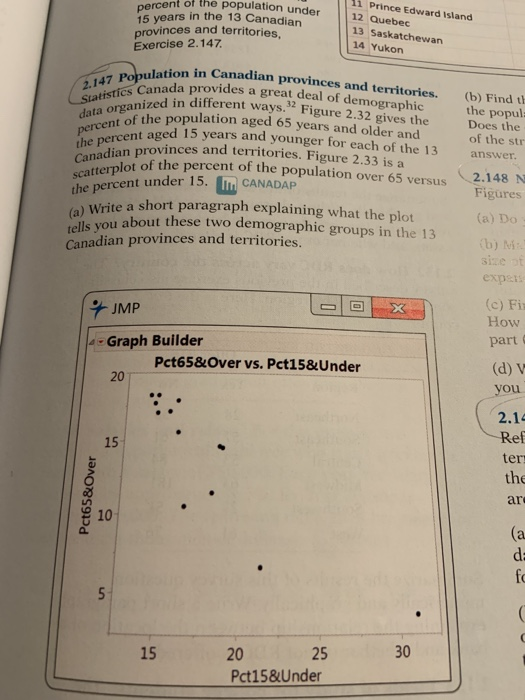
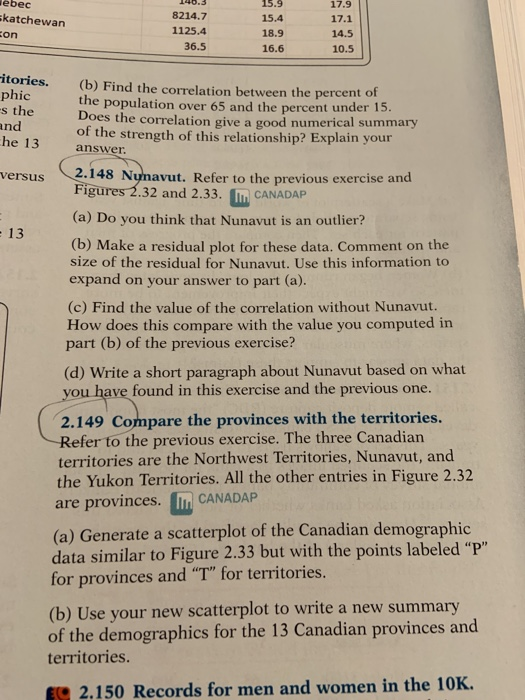
Chapter 2 Exercises 155 x Excel 1 Province OrTerritory 2 Alberta 3 British Columbia 4 Manitoba 5 New Brunswick 6 Newfoundland & Labrador 7 Northwest Territories 8 Nova Scotia 9 Nunavut 10 Ontario 11 Prince Edward Island 12 Quebec 13 Saskatchewan 14 Yukon 21.4 Population Pct15&Under Pct65& Over 4121.7 18.3 11.4 4631.3 14.6 17.0 1282.0 18.7 14.6 753.9 14.6 18.3 527.0 14.4 17.7 43.6 6.6 942.7 14.1 18.3 36.6 31.1 3.7 13678.7 16.0 15.6 146.3 15.9 17.9 8214.7 15.4 17.1 1125.4 18.9 14.5 36.5 16.6 10.5 t of the s and en under dian provinces and territories. at deal of demographic 12 Figure 2.32 gives the 5 years and older and anger for each of the 13 Es. Figure 2.33 is a opulation over 65 versus ming what the plot phic groups in the 13 (b) Find the correlation between the percent of the population over 65 and the percent under 15. Does the correlation give a good numerical summary of the strength of this relationship? Explain your answer. 2.148 Nunavut. Refer to the previous exercise and Figures 2.32 and 2.33. I CANADAP (a) Do you think that Nunavut is an outlier? (b) Make a residual plot for these data. Comment on the size of the residual for Nunavut. Use this information to expand on your answer to part (a). (c) Find the value of the correlation without Nunavut. How does this compare with the value you computed in part (b) of the previous exercise? BxUnder (d) Write a short paragraph about Nunavut based on what you have found in this exercise and the previous one. 2.149 Compare the provinces with the territories. Refer to the previous exercise. The three Canadian ercent of the population under 15 years in the 13 Canadian provinces and territories li Prince Edward Island 12 Quebec 13 Saskatchewan 14 Yukon Exercise 2.147. (b) Find th 2.147 Population Statistics Canada pr data organized in di percent of the the percent aged Canadian provin scatterplot of the lation in Canadian provinces and territories. Canada provides a great deal of demographic ved in different ways. Figure 2.32 gives the of the population aged 65 years and older and went aged 15 years and younger for each of the 13 an provinces and territories. Figure 2.33 is a of of the percent of the population over 65 versus the percent under 15. M CANADAP te a short paragraph explaining what the plot you about these two demographic groups in the 13 Canadian provinces and territories. (a) Write a sho the popul: Does the of the str answer. 2.148 N Figures (a) Do (b) Me sitet exper: (c) Fiz How JMP --Graph Builder Pct65& Over vs. Pct15&Under 20 part (d) V you 2.14 Ref ter the Pct65&Over ar 15 30 2025 Pct15&Under ebec skatchewan 146.3 8214.7 1125.4 36.5 15.9 15.4 18.9 16.6 17.9 17.1 14.5 10.5 con itories. phic es the and he 13 (b) Find the correlation between the percent of the population over 65 and the percent under 15. Does the correlation give a good numerical summary of the strength of this relationship? Explain your answer. 2.148 Nunavut. Refer to the previous exercise and Figures 2.32 and 2.33. I CANADAP (a) Do you think that Nunavut is an outlier? versus - 13 (6) Make a residual plot for these data. Comment on the size of the residual for Nunavut. Use this information to expand on your answer to part (a). (c) Find the value of the correlation without Nunavut. How does this compare with the value you computed in part (b) of the previous exercise? (d) Write a short paragraph about Nunavut based on what you have found in this exercise and the previous one. 2.149 Compare the provinces with the territories. Refer to the previous exercise. The three Canadian territories are the Northwest Territories, Nunavut, and the Yukon Territories. All the other entries in Figure 2.32 are provinces. I CANADAP (a) Generate a scatterplot of the Canadian demographic data similar to Figure 2.33 but with the points labeled "P" for provinces and "T" for territories. (b) Use your new scatterplot to write a new summary of the demographics for the 13 Canadian provinces and territories. ES 2.150 Records for men and women in the 10K. Chapter 2 Exercises 155 x Excel 1 Province OrTerritory 2 Alberta 3 British Columbia 4 Manitoba 5 New Brunswick 6 Newfoundland & Labrador 7 Northwest Territories 8 Nova Scotia 9 Nunavut 10 Ontario 11 Prince Edward Island 12 Quebec 13 Saskatchewan 14 Yukon 21.4 Population Pct15&Under Pct65& Over 4121.7 18.3 11.4 4631.3 14.6 17.0 1282.0 18.7 14.6 753.9 14.6 18.3 527.0 14.4 17.7 43.6 6.6 942.7 14.1 18.3 36.6 31.1 3.7 13678.7 16.0 15.6 146.3 15.9 17.9 8214.7 15.4 17.1 1125.4 18.9 14.5 36.5 16.6 10.5 t of the s and en under dian provinces and territories. at deal of demographic 12 Figure 2.32 gives the 5 years and older and anger for each of the 13 Es. Figure 2.33 is a opulation over 65 versus ming what the plot phic groups in the 13 (b) Find the correlation between the percent of the population over 65 and the percent under 15. Does the correlation give a good numerical summary of the strength of this relationship? Explain your answer. 2.148 Nunavut. Refer to the previous exercise and Figures 2.32 and 2.33. I CANADAP (a) Do you think that Nunavut is an outlier? (b) Make a residual plot for these data. Comment on the size of the residual for Nunavut. Use this information to expand on your answer to part (a). (c) Find the value of the correlation without Nunavut. How does this compare with the value you computed in part (b) of the previous exercise? BxUnder (d) Write a short paragraph about Nunavut based on what you have found in this exercise and the previous one. 2.149 Compare the provinces with the territories. Refer to the previous exercise. The three Canadian ercent of the population under 15 years in the 13 Canadian provinces and territories li Prince Edward Island 12 Quebec 13 Saskatchewan 14 Yukon Exercise 2.147. (b) Find th 2.147 Population Statistics Canada pr data organized in di percent of the the percent aged Canadian provin scatterplot of the lation in Canadian provinces and territories. Canada provides a great deal of demographic ved in different ways. Figure 2.32 gives the of the population aged 65 years and older and went aged 15 years and younger for each of the 13 an provinces and territories. Figure 2.33 is a of of the percent of the population over 65 versus the percent under 15. M CANADAP te a short paragraph explaining what the plot you about these two demographic groups in the 13 Canadian provinces and territories. (a) Write a sho the popul: Does the of the str answer. 2.148 N Figures (a) Do (b) Me sitet exper: (c) Fiz How JMP --Graph Builder Pct65& Over vs. Pct15&Under 20 part (d) V you 2.14 Ref ter the Pct65&Over ar 15 30 2025 Pct15&Under ebec skatchewan 146.3 8214.7 1125.4 36.5 15.9 15.4 18.9 16.6 17.9 17.1 14.5 10.5 con itories. phic es the and he 13 (b) Find the correlation between the percent of the population over 65 and the percent under 15. Does the correlation give a good numerical summary of the strength of this relationship? Explain your answer. 2.148 Nunavut. Refer to the previous exercise and Figures 2.32 and 2.33. I CANADAP (a) Do you think that Nunavut is an outlier? versus - 13 (6) Make a residual plot for these data. Comment on the size of the residual for Nunavut. Use this information to expand on your answer to part (a). (c) Find the value of the correlation without Nunavut. How does this compare with the value you computed in part (b) of the previous exercise? (d) Write a short paragraph about Nunavut based on what you have found in this exercise and the previous one. 2.149 Compare the provinces with the territories. Refer to the previous exercise. The three Canadian territories are the Northwest Territories, Nunavut, and the Yukon Territories. All the other entries in Figure 2.32 are provinces. I CANADAP (a) Generate a scatterplot of the Canadian demographic data similar to Figure 2.33 but with the points labeled "P" for provinces and "T" for territories. (b) Use your new scatterplot to write a new summary of the demographics for the 13 Canadian provinces and territories. ES 2.150 Records for men and women in the 10K
Step by Step Solution

There are 3 Steps involved in it

1 Expert Approved Answer
Step: 1 Unlock blur-text-image

Question Has Been Solved by an Expert!

Get step-by-step solutions from verified subject matter experts

Step: 2 Unlock
Step: 3 Unlock

Students Have Also Explored These Related General Management Questions!