





Question: COM 132: Organizational Communication Case Study Analysis 5: Integrity and Ethical Standards of Organizational Communication The Case of the Italian Shoes (taken from Elsenberg E.
COM 132: Organizational Communication Case Study

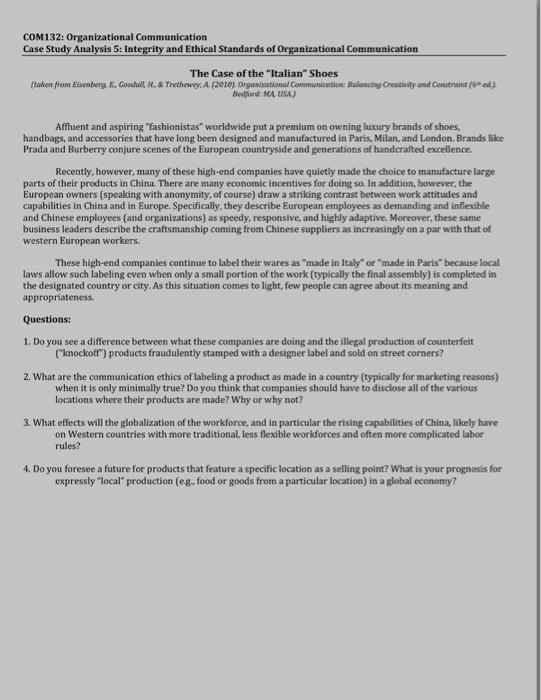
COM 132: Organizational Communication Case Study Analysis 5: Integrity and Ethical Standards of Organizational Communication The Case of the "Italian" Shoes (taken from Elsenberg E. Goodall, H. a Trethaway.A.(2010). Organizational Communication: Balancing Creativity and Construint (6*ed) Bedforul MA USA) Affluent and aspiring fashionistas" worldwide put a premium on owning luxury brands of shoes, handbags, and accessories that have long been designed and manufactured in Paris, Milan, and London. Brands like Prada and Burberry conjure scenes of the European countryside and generations of handcrafted excellence. Recently, however, many of these high-end companies have quietly made the choice to manufacture large parts of their products in China. There are many economic incentives for doing so. In addition, however, the European owners (speaking with anonymity, of course) draw a striking contrast between work attitudes and capabilities in China and in Europe. Specifically, they describe European employees as demanding and inflexible and Chinese employees and organizations) as speedy, responsive, and highly adaptive. Moreover, these same business leaders describe the craftsmanship coming from Chinese suppliers as increasingly on a par with that of western European workers. These high-end companies continue to label their wares as "made in Italy" or "made in Paris because local laws allow such labeling even when only a small portion of the work (typically the final assembly) is completed in the designated country or city. As this situation comes to light, few people can agree about its meaning and appropriateness. Questions: 1. Do you see a difference between what these companies are doing and the illegal production of counterfeit ("knockoft") products fraudulently stamped with a designer label and sold on street corners? 2. What are the communication ethics of labeling a product as made in a country (typically for marketing reasons) when it is only minimally true? Do you think that companies should have to disclose all of the various locations where their products are made? Why or why not? 3. What effects will the globalization of the workforce, and in particular the rising capabilities of China, likely have on Western countries with more traditional, less flexible workforces and often more complicated labor rules? 4. Do you foresee a future for products that feature a specific location as a selling point? What is your prognosis for expressly local production (eg. food or goods from a particular location) in a global economy

Step by Step Solution

There are 3 Steps involved in it

1 Expert Approved Answer
Step: 1 Unlock blur-text-image

Question Has Been Solved by an Expert!

Get step-by-step solutions from verified subject matter experts

Step: 2 Unlock
Step: 3 Unlock

Students Have Also Explored These Related General Management Questions!