







Question: Comments & Recommendations are requested to be written for the following Case Study Please find attachments below (what is needed and the case study) Case
Comments & Recommendations are requested to be written for the following Case Study
Please find attachments below (what is needed and the case study)
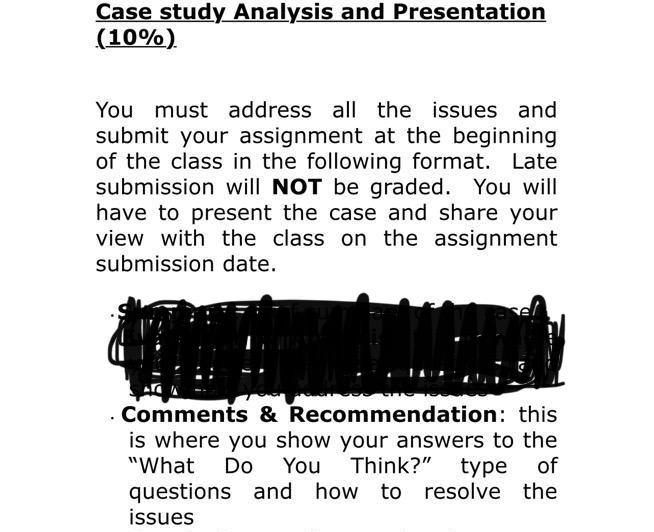
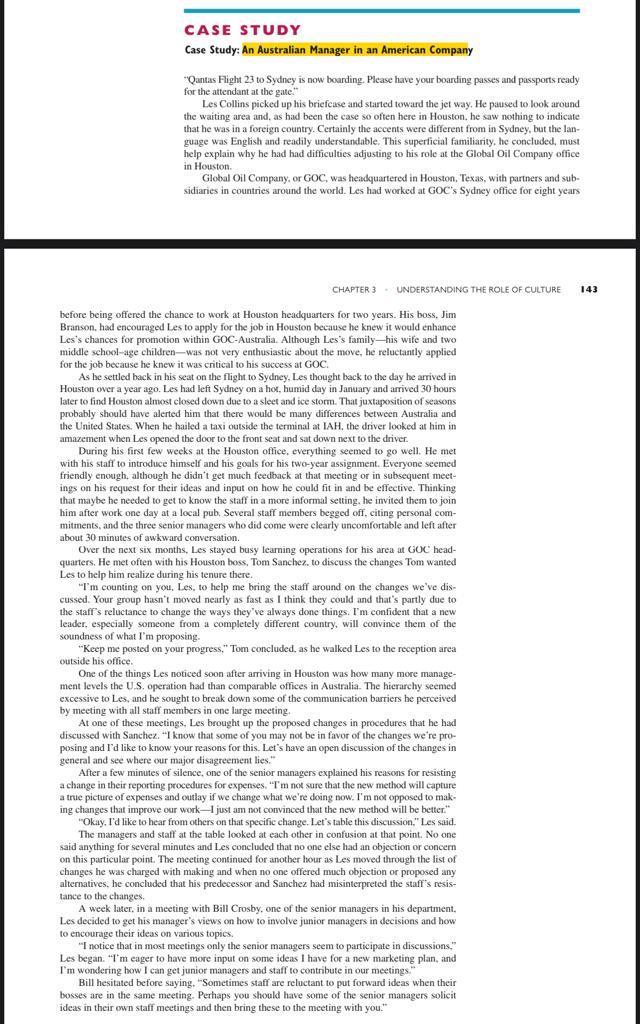
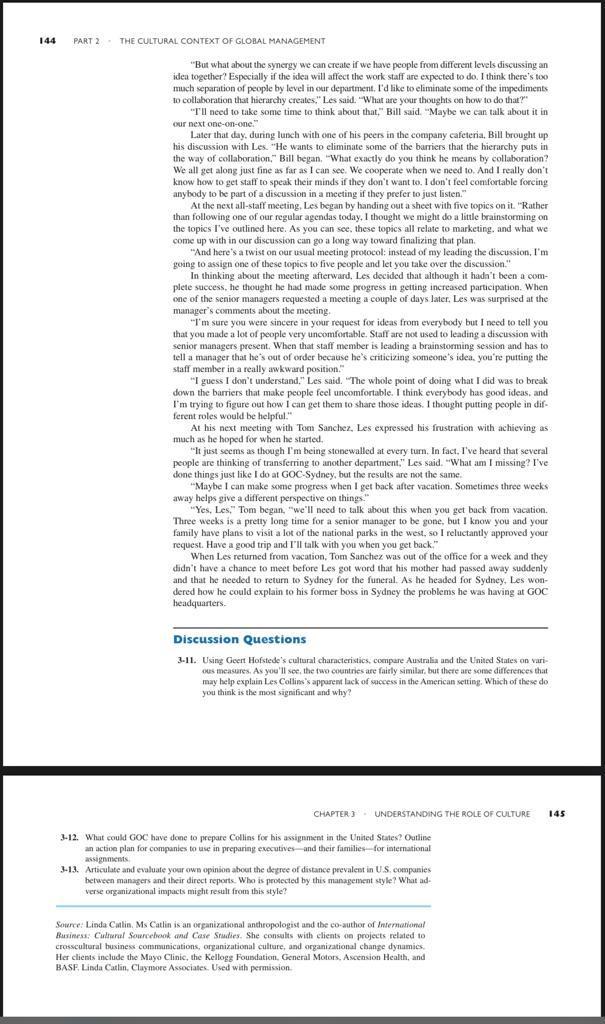
Case study Analysis and Presentation (10%) You must address all the issues and submit your assignment at the beginning of the class in the following format. Late submission will NOT be graded. You will have to present the case and share your view with the class on the assignment submission date. Comments \& Recommendation: this is where you show your answers to the "What Do You Think?" type of questions and how to resolve the issues Case Study: An Australian Manager in an American Company 'Qantas Flight 23 to Sydney is now boarding. Please have your boarding passes and passports ready for the attendant at the gate. Les Collins picked up his briefease and started toward the jet way. He paused to look around the waiting area and, as had been the case so often here in Houston. he saw nothing to indicate that he was in a foreign country. Certainly the accents were different from in Sydney, but the language was English and readily understandable. This superficial familiarity, he concluded, must help explain why he had had difficulties adjusting to his role at the Global Oil Company office in Houston. Global Oil Company, or GOC, was headquartered in Houston. Texas, with partners and subsidiaries in countries around the world. Les had worked at GOC's Sydney office for eight years before being offered the chance to work at Houston headquarters for two years. His boss, Jim Branson, had encouraged Les to apply for the job in Houston because he knew it would enhance Les's chances for promotion within GOC-Australia. Although Les's family -his wife and two middle school-age children - was not very enthusiastic about the move, he reluctantly applied for the job because he knew it was critical to his success at GOC. As be settled back in his seat on the flight to Sydncy, Les thought back to the day he arrived in Houston over a year ago. Les had left Sydney on a hot, humid day in January and arrived 30 hours later to find Houston almost closed down due to a sleet and ice storm. That juxtaposition of seasons probably should have alerted him that there would be many differences between Australia and the United States. When he hailed a taxi outside the terminal at IAH, the driver looked at him in amazement when Les opened the door to the front seat and sat down next to the driver. During his first few weeks at the Houston office, everything seemed to go well. He met with his staff to introduce himself and his goals for his two-year assignment. Everyone seemed friendly enough, although he didn't get much feedback at that meeting or in subsequent meetings on his request for their ideas and input on how he could fit in and be effective. Thinking that maybe he needed to get to know the staff in a more informal setting, he invited them to join him after work one day at a local pub. Several staft members begged off, citing personal commitments, and the three senior managers who did come were clearly uncomfortable and left after about 30 minutes of awkward conversation. Over the next six months, Les stayed busy learning operations for his area at GOC headquarters. He met often with his Houston boss, Tom Sanchez. to discuss the changes Tom wanted Les to help him realize during his tenure there. "I'm counting on you, Les, to help me bring the staff around on the changes we've discussed. Your group hasn't moved nearly as fast as I think they could and that's partly due to the staff's reluctance to change the ways they've always done things. I' m confident that a new leader, especially someone from a completely different country, will convince them of the soundness of what I'm proposing. "Keep me posted on your progress," Tom concluded, as he walked Les to the reception area outside his office. One of the things Les noticed soon after arriving in Houston was how many more management levels the U.S. operation had than comparable offices in Australia. The hierarchy seemed excessive to Les, and he sought to break down some of the communication barriers be perceived by meeting with all staff members in one large meeting. At one of these meetings, Les brought up the proposed changes in procedures that he had discussed with Sanchez. "I know that some of you may not be in favor of the changes we're proposing and l'd like to know your reasons for this. Let's have an open discussion of the changes in general and see where our major disagreement lies." After a few minutes of silence, one of the senior managers explained his reasons for resisting a change in their reporting procedures for expenses. "I'm not sure that the new method will capture a true picture of expenses and oullay if we change what we're doing now. I'm not opposed to making changes that improve our work-1 just am not convinced that the new method will be better." "Okay, Td like to hear from others on that specific change. Let's table this discussion," Les said. The managers and staff at the table looked at each other in confusion at that point. No one said anything for several minutes and Les concluded that no one else had an objection or concern on this particular point. The meeting continued for another hour as Les moved through the list of changes he was charged with making and when no one offered much objection or proposed any alternatives, he concluded that his predecessor and Sanchez had misinterpreted the staff's resistance to the changes. A week later, in a meeting with Bill Crosby, one of the senior managers in his department. Les decided to get his manager's views on how to involve junior managers in decisions and how to encourage their ideas on various topics. "I notice that in most meetings only the senior managers seem to participate in discussions," Les began. "I'm eager to have more input on some ideas I have for a new marketing plan, and I'm wondering how I can get junior managers and staff to contribute in our meetings." Bill hesitated before saying. "Sometimes staff are reluctant to put forward ideas when their bosses are in the same meeting. Perhaps you should have some of the senior managers solicit ideas in their own staff meetings and then bring these to the meeting with you." 14 PART 2 - THE CULTURAL CONTEXT OF GLOBAL MANAGEMENT "But what about the synergy we can create if we have people from differeat levels discussing an idea together? Especially if the idea will affect the work staff are expected to do. I think there's too much separation of people by level in our department, I'd hike to elaminate sorne of the immediments to collaboration that hicrarchy creates," Les said. "What are your thoughts on how to do that?" "I'U need to take some time to think about that," Bill said. "Maybe we can talk about it in our next one-ont-one. Later that day, duning lunch with one of his peen in the company cafetenia, Bill brought up has discussion with Les. "He wants to eliminate some of the barricrs that the hierarchy pats in the way of collaboration, " Bill began, "What exactly do you think he means by collaboration? We all get along just fine as far as I can see. We cooperate when we need to. And I really don't know how to get staff to speak their minds if they don't want to, 1 don't feel confortable forcing anybody to be part of a discussion in a meeting if they prefer to just listen." At the next all-staff meeting. Les began by handing out a sheet with five topics on it. Rather than following one of our regular agendas today, 1 thought we might do a little brainstorming on the topics I've outlined here. As you can see. these topics all relate to marketing. and what we come up with in our discussion can go a long way toward finalizing that plan. "And here's a twist on our usual meeting protocol: instead of my leading the discussion, I'm goang to assign one of these topies to five people and let you take over the discussion." In thinking about the meeting afterward, Les decided that although it hada't been a complete saccess, he thought be had made some progress in gettang increased participation. When manager's comments about the nseting. "I'm sure yow were sincere in your request for ideas from everybody but I need to tell you that you made a lot of people very uncomfortable. Staff are not used to leading a discussion with senior managers present. When that staff member is leading a branstorming session and bas to staff member in a really arwkward position." "I guess I don't understand," Les said. "The whole point of doing what I did was to break down the barriers that make people feel uncomfortable. I think everybody has good ideas. and I'm trying to figure out how I can get them to share those ideas. I thought puating people in different roles would be helpful. At his next mecting with Toen Sanchez, Les expressed his frustration with achieving as much as he hoped for when he started. "It just secms as though I'm being stonewalled at every turn. In fact, T ve heard that several people are thinking of transferring to another department," Les.said. "What am I missing? I've done things just like I do at GOC-Sydney, but the results are not the same. "Maybe 1 can make some progress when I get back after vacation. Sometimes three weeks away helps give a different perspective on things. "Yes, Les," Tom began, "we"ll need to talk about this when you get back from vacation. Three weeks is a pretty long time for a senior manager to be gone, but I know you and your family have plans to visit a lot of the national parks in the west, so I reluctantly approved yoxr request. Have a good trip and I'll talk with you when you get back." When Les returned from vacation. Tom Sanchez was out of the office for a week and they dida't have a chance to meet before Les got word that his mother had passed away suddenly. and that he ficeded to return to Sydney for the funcral. As he headed for Sydney, Les woabeadquarters. Discussion Questions 3.11. Using Geert Hofstede's cultural characteristics, coempare Australia and the United Stafes on various measures. As you'll see, the two countries are fairly similar, but thete are sonme differences that may help explain Les Collin's appurem lack of saccess in the American setting. Whach of these do you thisk is the most significant and why? CHAPTER 3 - UNDERSTANDING THE ROLE OF CULTURE 3-12. What could GOC have done to prepare Collins for bis assignment in the Unated States? Oatline an action plan for companies to use in preparing evecutives and their families for iaternational arsignnments. 3-13. Articulate and evaluate yoar own opinion aboat the dezree of distance peevalent in US Sompanies between managers and their direct reports. Who is peotected by this management style? What adverse organisational impacts might result from this style? Soterec: Linda Caklin. Ms Catlin is an organizational anthropologisf and tbe co-author of Intemational Rusimess: Cultaraf Sourcehook and Case Srudies. She consalts with clients on projects related to crosseultural buxiness communications, organizational culture, and organizational change dynamies. Her clients include the Mayo Clinic, the Kellogg Fousdation, General Motors, Ascension Health, and BASF, Linda Catin, Claymore Associates. Used with permarssion
Step by Step Solution
There are 3 Steps involved in it
1 Expert Approved Answer
Step: 1 Unlock

Question Has Been Solved by an Expert!
Get step-by-step solutions from verified subject matter experts
Step: 2 Unlock
Step: 3 Unlock
 Study Help