







Question: Compounding frequency and time value Personal Finance Problem You plan to invest $2,000 in an individual retirement arrangement (IRA) today at a nominal annual rate
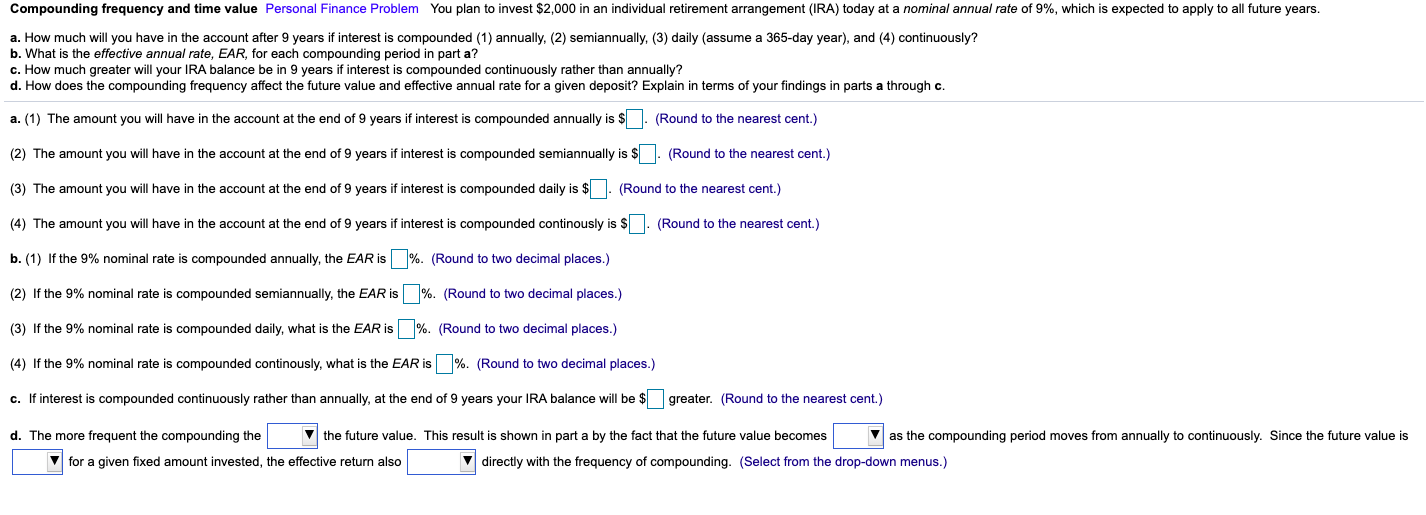
Compounding frequency and time value Personal Finance Problem You plan to invest $2,000 in an individual retirement arrangement (IRA) today at a nominal annual rate of 9%, which is expected to apply to all future years. a. How much will you have in the account after 9 years if interest is compounded (1) annually, (2) semiannually, (3) daily (assume a 365-day year), and (4) continuously? b. What is the effective annual rate, EAR, for each compounding period in part a? c. How much greater will your IRA balance be in 9 years if interest is compounded continuously rather than annually? d. How does the compounding frequency affect the future value and effective annual rate for a given deposit? Explain in terms of your findings in parts a through c. a. (1) The amount you will have in the account at the end of 9 years if interest is compounded annually is $. (Round to the nearest cent.) (2) The amount you will have in the account at the end of 9 years if interest is compounded semiannually is $. (Round to the nearest cent.) (3) The amount you will have in the account at the end of 9 years if interest is compounded daily is $ (Round to the nearest cent.) (4) The amount you will have in the account at the end of 9 years if interest is compounded continously is $. (Round to the nearest cent.) b. (1) If the 9% nominal rate is compounded annually, the EAR is %. (Round to two decimal places.) (2) If the 9% nominal rate is compounded semiannually, the EAR is%. (Round to two decimal places.) (3) If the 9% nominal rate is compounded daily, what is the EAR is %. (Round to two decimal places.) (4) If the 9% nominal rate is compounded continously, what is the EAR is %. (Round to two decimal places.) c. If interest is compounded continuously rather than annually, at the end of 9 years your IRA balance will be $_greater. (Round to the nearest cent.) d. The more frequent the compounding the the future value. This result shown in part a by the fact that the future value becomes V as the compounding period moves from annually to continuously. Since the future value is for a giv fixed amount invested, the effective return also directly with the frequency of compounding. (Select from the drop-down menus.)
Step by Step Solution
There are 3 Steps involved in it

Get step-by-step solutions from verified subject matter experts
 Study Help