







Question: compute system Question 1 Consider a 9-bit floating-point representation based on the IEEE floating-point format, with one sign bit, four exponent bits (k = 4),
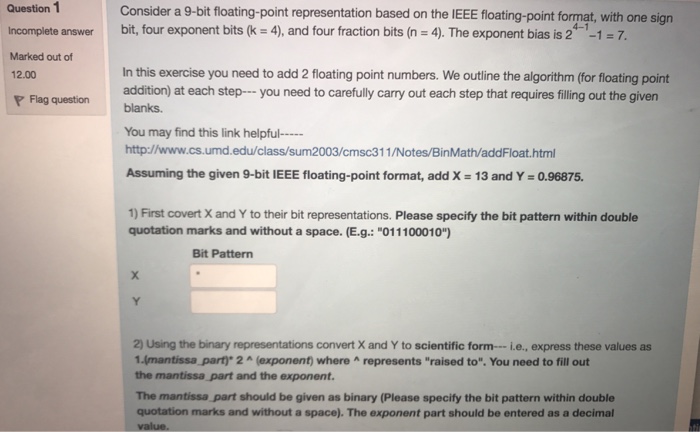
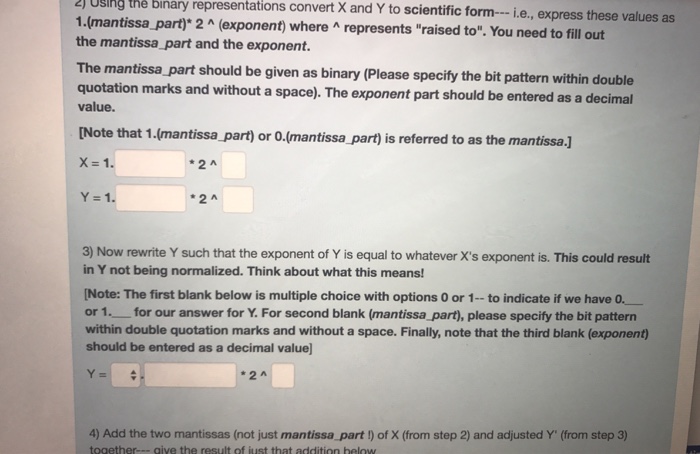
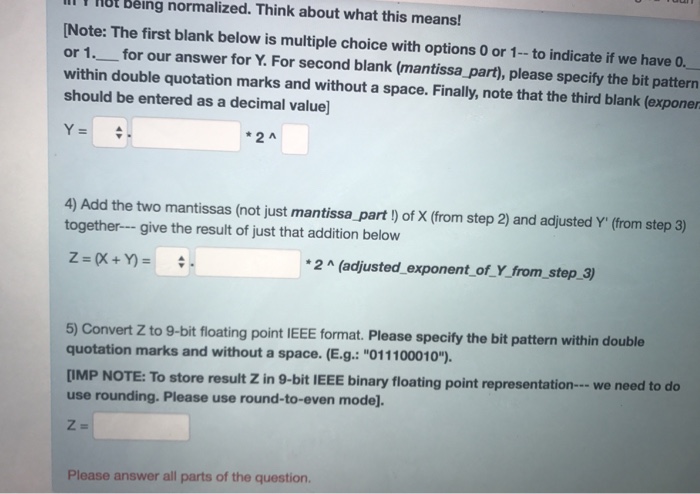
Question 1 Consider a 9-bit floating-point representation based on the IEEE floating-point format, with one sign bit, four exponent bits (k = 4), and four fraction bits (n = 4). The exponent bias is 24-1-1-7. incomplete answer Marked out of 12.00 In this exercise you need to add 2 floating point numbers. We outline the algorithm (for floating point Flag quetion addition) at each step- you need to carefully carry out each step that requires iling out the given You may find this link helpful http://www.cs.umd.edu/class/sum2003/cmsc311/Notes/BinMath/addFloat.html Assuming the given 9-bit IEEE floating-point format, add X = 13 and Y = 0.96875. 1) First covert X and Y to their bit representations. Please specity the bit pattern within double quotation marks and without a space. (E.g.:"011100010") Bit Pattern 2) Using the binary representations convert X and Y to scientific form-i.e., express these values as 1.(mantissa part)" 2 (exponent) where A represents "raised to". You need to fill out the mantissa part and the exponent. The mantissa part should be given as binary (Please specify the bit pattern within double quotation marks and without a space). The exponent part should be entered as a decimal
Step by Step Solution
There are 3 Steps involved in it

Get step-by-step solutions from verified subject matter experts
 Study Help