







Question: Consider a function shown below: f(t)={(0,0=3):} (a) Obtain the Laplace transformation of the function given (HINT: when L[f(t)]=F(s) , the Laplace transform of the
Consider a function shown below:\
f(t)={(0,0=3):}\ (a) Obtain the Laplace transformation of the function given (HINT: when
L[f(t)]=F(s), the Laplace transform of the function with a time shift of
Tis given by\
{(
:L[f(t-T)*1(t-T)]=F(s)e^(-sT))}\ (b) Continue (a). Apply the Initial Value Theorem to
F(s)and confirm
f(0)=0.\ (c) Continue (a). Apply the Final Value Theorem to
F(s)and confirm
f(\\\\infty )=1. HINT: You may use L'Hospital's rule:
\\\\lim_(x->c)(f(x))/(g(x))=\\\\lim_(x->c)(f^(')(x))/(g^(')(x)).
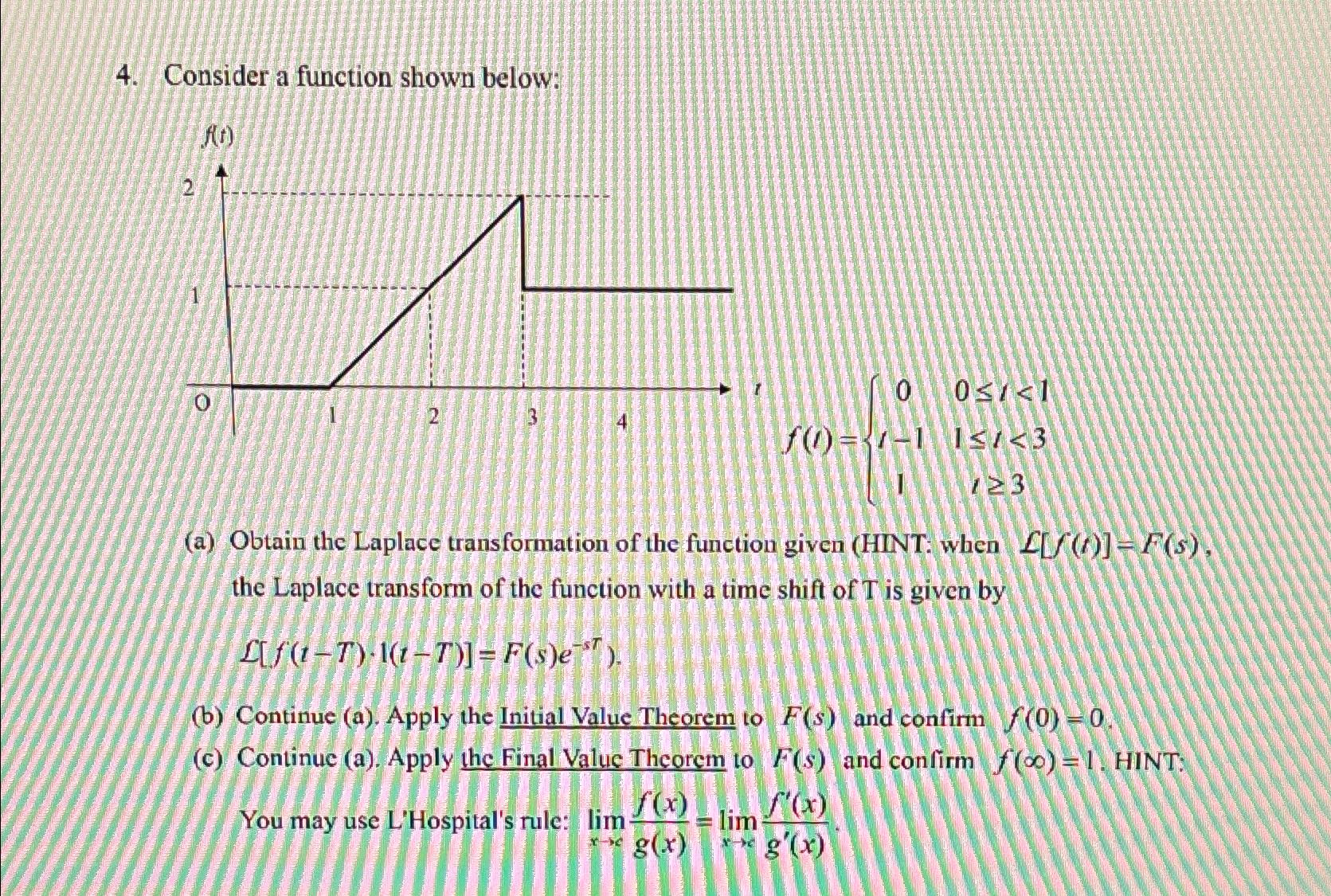
4. Consider a function shown below: f(t)=0t110t
Step by Step Solution
There are 3 Steps involved in it
1 Expert Approved Answer
Step: 1 Unlock

Question Has Been Solved by an Expert!
Get step-by-step solutions from verified subject matter experts
Step: 2 Unlock
Step: 3 Unlock
 Study Help