







Question: Consider a hypothetical 32-bit microprocessor having 4-byte instructions composed of opcode in the first two bytes and operand address field (direct) in the remaining bytes.
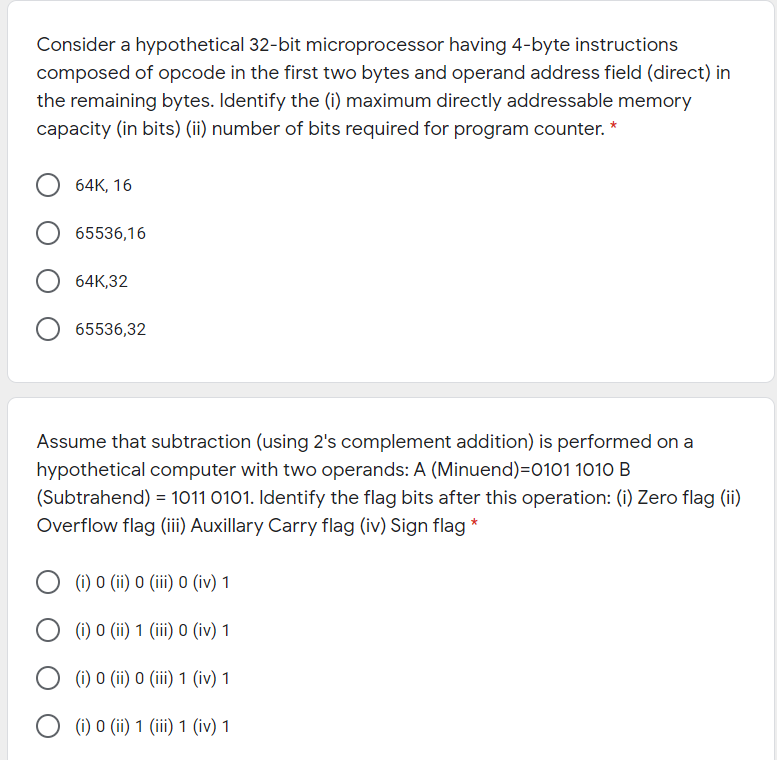
Consider a hypothetical 32-bit microprocessor having 4-byte instructions composed of opcode in the first two bytes and operand address field (direct) in the remaining bytes. Identify the (i) maximum directly addressable memory capacity (in bits) (ii) number of bits required for program counter. * 64K, 16 65536,16 64K,32 65536,32 Assume that subtraction (using 2's complement addition) is performed on a hypothetical computer with two operands: A (Minuend)=0101 1010 B (Subtrahend) = 1011 0101. Identify the flag bits after this operation: (i) Zero flag (ii) Overflow flag (iii) Auxillary Carry flag (iv) Sign flag * (i) O (ii) 0 (iii) 0 (iv) 1 (i) O (ii) 1 (iii) 0 (iv) 1 (i) O (ii) 0 (iii) 1 (iv) 1 (i) O (ii) 1 (iii) 1 (iv) 1
Step by Step Solution
There are 3 Steps involved in it

Get step-by-step solutions from verified subject matter experts
 Study Help