







Question: Consider a situation where N consumers interact with a monopolist in a market. Half of these consumers (y = 0.5) have low demand, 01
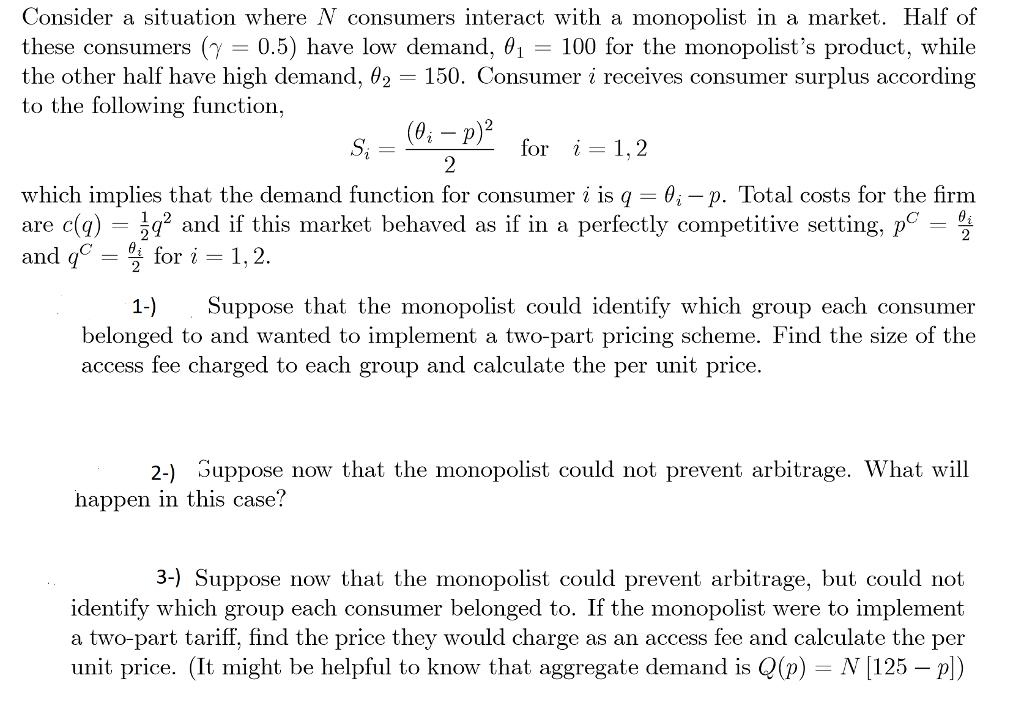
Consider a situation where N consumers interact with a monopolist in a market. Half of these consumers (y = 0.5) have low demand, 01 100 for the monopolist's product, while 150. Consumer i receives consumer surplus according the other half have high demand, 02 to the following function, = = (Oi - p) Si = for i=1,2 2 which implies that the demand function for consumer i is q = 0; - p. Total costs for the firm are c(q) q2 and if this market behaved as if in a perfectly competitive setting, p = and q for i = 1,2. = ; = 2 1-) Suppose that the monopolist could identify which group each consumer belonged to and wanted to implement a two-part pricing scheme. Find the size of the access fee charged to each group and calculate the per unit price. 2-) Suppose now that the monopolist could not prevent arbitrage. What will happen in this case? 3-) Suppose now that the monopolist could prevent arbitrage, but could not identify which group each consumer belonged to. If the monopolist were to implement a two-part tariff, find the price they would charge as an access fee and calculate the per unit price. (It might be helpful to know that aggregate demand is Q(p) = N [125 p])
Step by Step Solution
There are 3 Steps involved in it
For the situation where N consumers interact with a monopolist we can address each part of your question step by step 1 Monopolist Can Identify Each Group and Implements Twopart Pricing Scheme When th... View full answer

Get step-by-step solutions from verified subject matter experts
Document Format (2 attachments)

66428effeee64_979150.pdf
180 KBs PDF File

66428effeee64_979150.docx
120 KBs Word File
 Study Help