







Question: Consider a two-level memory hierarchy, M1 and M2 with access time t1 and t2 , costs per byte c1 and c2 , and capacities s1
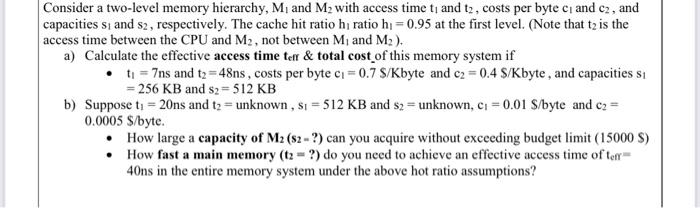
Consider a two-level memory hierarchy, M and M2 with access time t, and t2, costs per byte ci and c2, and capacities si and 2, respectively. The cache hit ratio hi ratio hi=0.95 at the first level. (Note that tz is the access time between the CPU and M2, not between M and M). a) Calculate the effective access time ter & total cost of this memory system if t1 = 7ns and t2 = 48ns, costs per byte ci = 0.7 S/Kbyte and c2 = 0.4 S/Kbyte, and capacities si = 256 KB and s2 = 512 KB b) Suppose t; = 20ns and t2 = unknown, si = 512 KB and s2 = unknown, c = 0.01 S/byte and C2 = 0.0005 $/byte. How large a capacity of M2 (82-?) can you acquire without exceeding budget limit (15000 How fast a main memory (t2 = ?) do you need to achieve an effective access time of te Ons in the entire memory system under the above hot ratio assumptions
Step by Step Solution
There are 3 Steps involved in it

Get step-by-step solutions from verified subject matter experts
 Study Help