







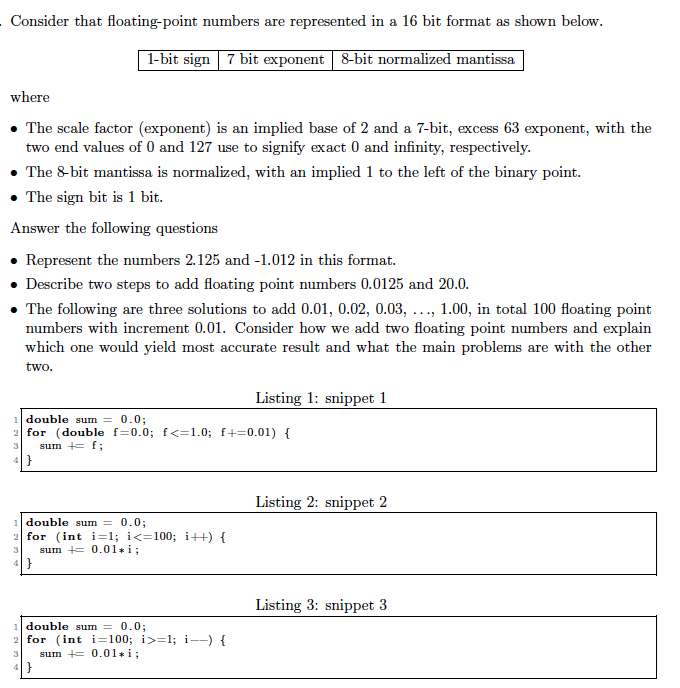
Question: Consider that floating - point numbers are represented in a 1 6 bit format as shown below. where - The scale factor ( exponent )
Consider that floatingpoint numbers are represented in a bit format as shown below.
where
The scale factor exponent is an implied base of and a bit, excess exponent, with the two end values of and use to signify exact and infinity, respectively.
The bit mantissa is normalized, with an implied to the left of the binary point.
The sign bit is bit.
Answer the following questions
Represent the numbers and in this format.
Describe two steps to add floating point numbers and
The following are three solutions to add ldots in total floating point numbers with increment Consider how we add two floating point numbers and explain which one would yield most accurate result and what the main problems are with the other two.
Listing : snippet
double sum ;
for double f;f;f
sum f;
Listing : snippet
double sum ;
for int i; i; i
sum ; ;
Listing : snippet
double sum ;
for int i ; i; i
sum i;
Step by Step Solution
There are 3 Steps involved in it
1 Expert Approved Answer
Step: 1 Unlock

Question Has Been Solved by an Expert!
Get step-by-step solutions from verified subject matter experts
Step: 2 Unlock
Step: 3 Unlock
 Study Help