







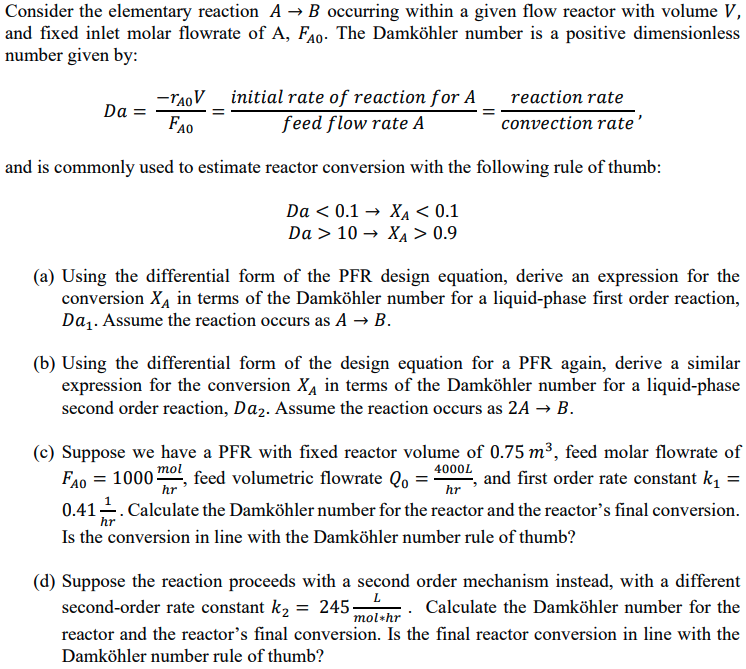
Question: Consider the elementary reaction A B occurring within a given flow reactor with volume V , and fixed inlet molar flowrate of A , F
Consider the elementary reaction occurring within a given flow reactor with volume
and fixed inlet molar flowrate of The Damkhler number is a positive dimensionless
number given by:
and is commonly used to estimate reactor conversion with the following rule of thumb:
a Using the differential form of the PFR design equation, derive an expression for the
conversion in terms of the Damkhler number for a liquidphase first order reaction,
Assume the reaction occurs as
b Using the differential form of the design equation for a PFR again, derive a similar
expression for the conversion in terms of the Damkhler number for a liquidphase
second order reaction, Assume the reaction occurs as
c Suppose we have a PFR with fixed reactor volume of feed molar flowrate of
feed volumetric flowrate and first order rate constant
Calculate the Damkhler number for the reactor and the reactor's final conversion.
Is the conversion in line with the Damkhler number rule of thumb?
d Suppose the reaction proceeds with a second order mechanism instead, with a different
secondorder rate constant Calculate the Damkhler number for the
reactor and the reactor's final conversion. Is the final reactor conversion in line with the
Damkhler number rule of thumb?
Step by Step Solution
There are 3 Steps involved in it
1 Expert Approved Answer
Step: 1 Unlock

Question Has Been Solved by an Expert!
Get step-by-step solutions from verified subject matter experts
Step: 2 Unlock
Step: 3 Unlock
 Study Help