







Question: Consider the liquid level control system shown in the diagram below. Height h of liquid Water (constant density) in the tank (cross-sectional area A=0.25m2 )
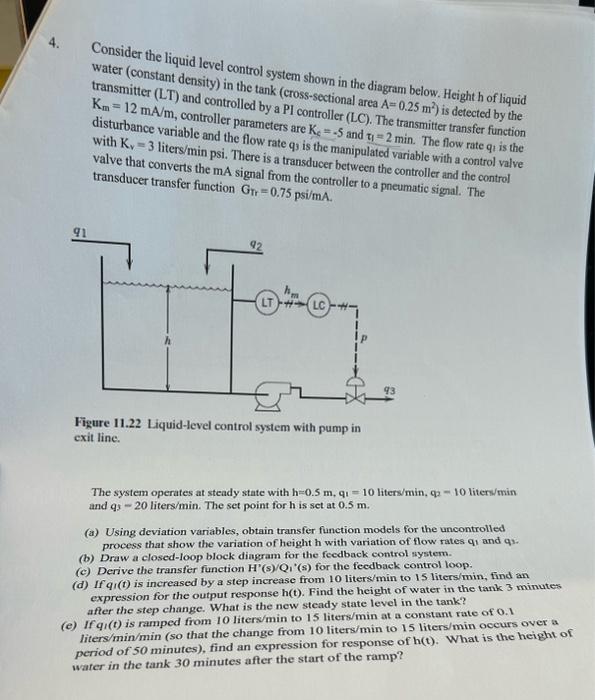
Consider the liquid level control system shown in the diagram below. Height h of liquid Water (constant density) in the tank (cross-sectional area A=0.25m2 ) is detected by the transmitter (LT) and controlled by a PI controller (LC). The transmitter transfer function Km=12mA/m, controller parameters are Kc=5 and =2min. The flow rate q1 is the disturbance variable and the flow rate q3 is the manipulated variable with a control valve with Kv=3 liters/min psi. There is a transducer between the controller and the control transducer converts the mA signal from the controller to a pneumatic signal. The Figure 11.22 Liquid-level control system with pump in exit line. The system operates at steady state with h=0.5m,q1=10 liters /min,q210 liters/min and qq=20 liters /min. The set point for h is set at 0.5m. (a) Using deviation variables, obtain transfer function models for the uncontrolled process that show the variation of height h with variation of flow rates q1 and qs. (b) Draw a closed-loop block diagram for the feedback control nystem. (c) Derive the transfer function H(s)/Q1(s) for the feedback control loop. (d) If q1(t) is increased by a step increase from 10 liters/min to 15 liters/min, find an expression for the output response h(t). Find the height of water in the tank 3 minutes after the step change. What is the new steady state level in the tank? (e) If q1(t) is ramped from 10 liters/min to 15 liters/min at a constant rate of 0.1 liters/min/min (so that the change from 10 liters/min to 15 liters/min occurs over a period of 50 minutes), find an expression for response of h(t). What is the height of water in the tank 30 minutes after the start of the ramp? Consider the liquid level control system shown in the diagram below. Height h of liquid Water (constant density) in the tank (cross-sectional area A=0.25m2 ) is detected by the transmitter (LT) and controlled by a PI controller (LC). The transmitter transfer function Km=12mA/m, controller parameters are Kc=5 and =2min. The flow rate q1 is the disturbance variable and the flow rate q3 is the manipulated variable with a control valve with Kv=3 liters/min psi. There is a transducer between the controller and the control transducer converts the mA signal from the controller to a pneumatic signal. The Figure 11.22 Liquid-level control system with pump in exit line. The system operates at steady state with h=0.5m,q1=10 liters /min,q210 liters/min and qq=20 liters /min. The set point for h is set at 0.5m. (a) Using deviation variables, obtain transfer function models for the uncontrolled process that show the variation of height h with variation of flow rates q1 and qs. (b) Draw a closed-loop block diagram for the feedback control nystem. (c) Derive the transfer function H(s)/Q1(s) for the feedback control loop. (d) If q1(t) is increased by a step increase from 10 liters/min to 15 liters/min, find an expression for the output response h(t). Find the height of water in the tank 3 minutes after the step change. What is the new steady state level in the tank? (e) If q1(t) is ramped from 10 liters/min to 15 liters/min at a constant rate of 0.1 liters/min/min (so that the change from 10 liters/min to 15 liters/min occurs over a period of 50 minutes), find an expression for response of h(t). What is the height of water in the tank 30 minutes after the start of the ramp
Step by Step Solution
There are 3 Steps involved in it

Get step-by-step solutions from verified subject matter experts
 Study Help