







Question: - Consider the partial differential equation and boundary conditions provided below: au k at dx2 Assuming the initial and boundary conditions are: -(0,t) = B.
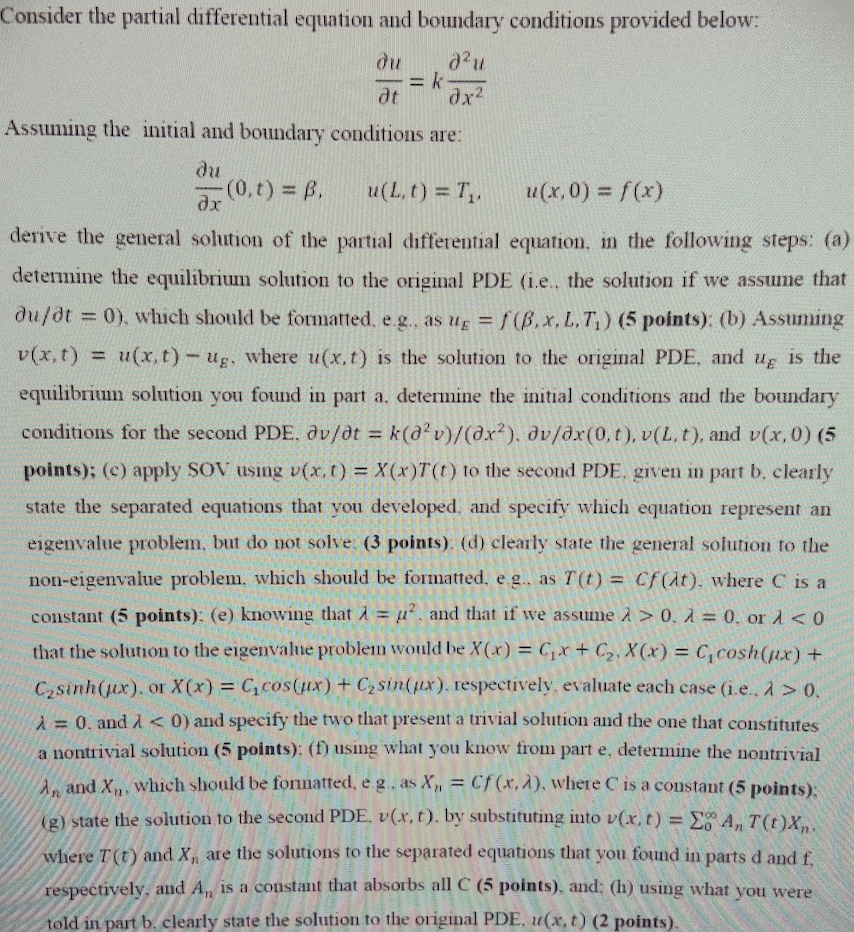
- Consider the partial differential equation and boundary conditions provided below: au k at dx2 Assuming the initial and boundary conditions are: -(0,t) = B. u(L, 1) = 1(x,0) = f(x) derive the general solution of the partial differential equation, in the following steps: (a) determine the equilibrium solution to the original PDE (ie, the solution if we assume that du/dt = 0), which should be formatted, e.g., as ug = f(x.L.T) (5 points): (b) Assuming v(x, t) = u(x,t) - ug, where u(x, t) is the solution to the original PDE, and ug is the equilibrium solution you found in part a, determine the initial conditions and the boundary conditions for the second PDE, dv/dt = k(@v)/(x), dv/8x(0,0), v(L.t), and v(x, 0) (5 points); (c) apply SOV using v(x,0) = X(X)T(t) to the second PDE, given in part b. clearly state the separated equations that you developed, and specify which equation represent an eigenvalue problem, but do not solve: (3 points), (d) clearly state the general solution to the non-eigenvalue problem, which should be formatted, eg., as T(t) = Cf(at), where is a constant (5 points): (e) knowing that i = u?, and that if we assume 2 > 0,2 = 0. or 1 0. i= 0 and 1 0,2 = 0. or 1 0. i= 0 and 1
Step by Step Solution
There are 3 Steps involved in it

Get step-by-step solutions from verified subject matter experts
 Study Help