







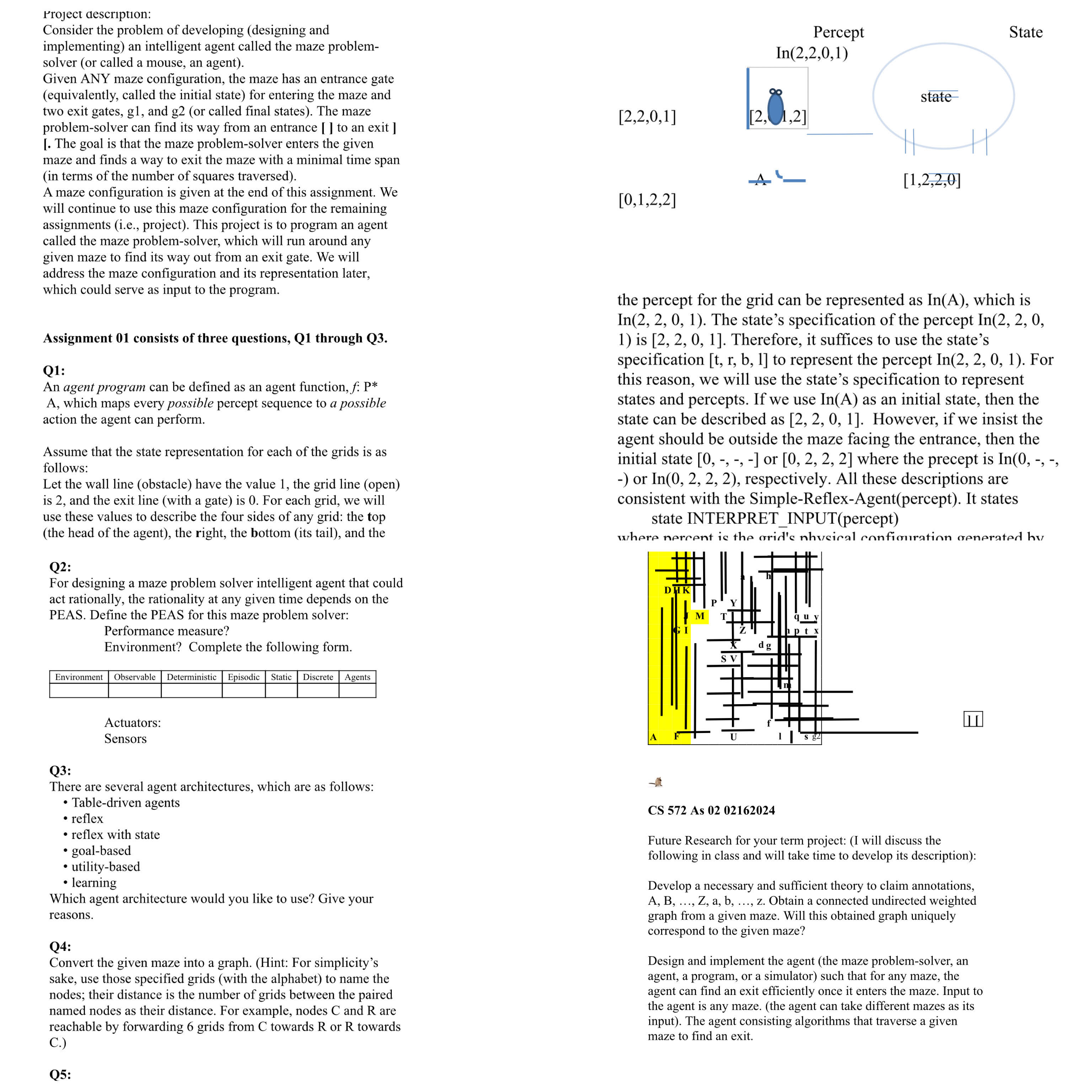
Question: Consider the problem of developing ( designing and implementing ) an intelligent agent called the maze problem - solver ( or called a mouse, an
Consider the problem of developing designing and implementing an intelligent agent called the maze problemsolver or called a mouse, an agentGiven ANY maze configuration, the maze has an entrance gate equivalently called the initial state for entering the maze and two exit gates, g and gor called final states The maze problemsolver can find its way from an entrance to an exit The goal is that the maze problemsolver enters the given maze and finds a way to exit the maze with a minimal time span in terms of the number of squares traversed A maze configuration is given at the end of this assignment. We will continue to use this maze configuration for the remaining assignments ie project This project is to program an agent called the maze problemsolver, which will run around any given maze to find its way out from an exit gate. We will address the maze configuration and its representation later, which couldserve as input to the program. Q:An agent program can be defined as an agent function, f: P A which maps every possible percept sequence to a possible action the agent can perform.Assume that the state representation for each of the grids is as follows: Let the wall line obstacle have the value the grid line open is and the exit line with a gate is For each grid, we will use these values to describe the four sides of any grid: the top the head of the agent the right, the bottom its tail and the left. At any grid, a corresponding percept can be represented at Int r b l to form a state t r b l This also coincides with the fact that the head of the agent is pointing to the top of a grid, and the agent's tail is pointing at the bottom of the grid square. The specification of a percept and its state is a onetoone correspondence. For example, if the agent enters the entrance gate, the agent is in the first grid, say Athe percept for the grid can be represented as InA which is In The states specification of the percept In is Therefore, it suffices to use the states specification t r b l to represent the percept In For this reason, we will use the states specification to represent states and percepts. If we use InA as an initial state, then the state can be described as However, if we insist the agent should be outside the maze facing the entrance, then the initial state or where the precept is In or In respectively. All these descriptions are consistent with the SimpleReflexAgentpercept It states state INTERPRETINPUTpercept where percept is the grid's physical configuration generated by the agent sensor It means that the image is converted into a program variable, state, using the function INTERPRETINPUT. The agent has three actions: rightTurn, leftTurn, and forward. The rightTurn R within a grid is defined as follows: rightTurnIn Inbrings the first to last; in fact. In can be omitted This means the agent is first in a grid heading in a direction. The rightturn action enables the agent to remain in the same grid, but the agent turns right, heading in a new direction that is perpendicular to the initial direction. Pictorially,Using the states specifications, it is rightTurn or Rhe leftTurnL within a grid is defined as follows:
leftTurnIn Inbrings the last component to be first
This means the leftTurn action enables the agent to remain in the same grid but in a new direction of the agent that is perpendicular to the previous initial direction and faces to the left side of the initial direction.Using the states specifications, it is leftTurn or L The forward F for two adjacent grids is defined as follows:For the following pictorial example, we can describe the agent forwards from one grid to another grid with different percepts. This first parameter describes that the agent is in the first grip and then goes into the other grip with two walls and two grid lines. We use forward action to describe the following: forwardIn InUsing the states specifications, it is forward or F Using the above description, givedescribe your proposed percepts and actions. Warning:the later assignments will be based on your previous work! Therefore, a good and detailed work would help you with the rest of your entire project ie assignmentsa How many different configurations of grids are in the given maze?b How many different actions are based on the given maze?c Specify its state description corresponding to each of the distinct grids.
Step by Step Solution
There are 3 Steps involved in it
1 Expert Approved Answer
Step: 1 Unlock

Question Has Been Solved by an Expert!
Get step-by-step solutions from verified subject matter experts
Step: 2 Unlock
Step: 3 Unlock
 Study Help