







Question: Consider two different machines (A and B) that could be used at a workstation. Machine A has a mean effective process time (t e )
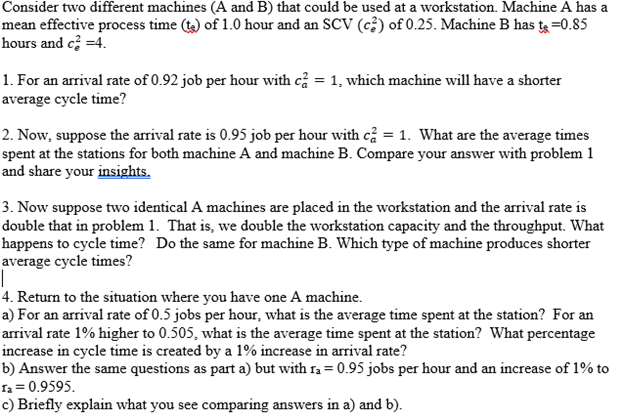
Consider two different machines (A and B) that could be used at a workstation. Machine A has a mean effective process time (te) of 1.0 hour and an SCV (ce2) of 0.25. Machine B has te =0.85 hours and ce2 =4.
1. For an arrival rate of 0.92 job per hour with ca2=1, which machine will have a shorter average cycle time?
2. Now, suppose the arrival rate is 0.95 job per hour with ca2=1. What are the average times spent at the stations for both machine A and machine B. Compare your answer with problem 1 and share your insights.
3. Now suppose two identical A machines are placed in the workstation and the arrival rate is double that in problem 1. That is, we double the workstation capacity and the throughput. What happens to cycle time? Do the same for machine B. Which type of machine produces shorter average cycle times?
4. Return to the situation where you have one A machine.
a) For an arrival rate of 0.5 jobs per hour, what is the average time spent at the station? For an arrival rate 1% higher to 0.505, what is the average time spent at the station? What percentage increase in cycle time is created by a 1% increase in arrival rate?
b) Answer the same questions as part a) but with ra = 0.95 jobs per hour and an increase of 1% to ra = 0.9595.
c) Briefly explain what you see comparing answers in a) and b).
Consider two different machines (A and B) that could be used at a workstation Machine A has a mean effective process time (ts) of 1.0 hour and an SCV (c) of 0.25. Machine B has ts=0.85 hours and c: =4. 1. For an arrival rate of 0.92 job per hour with c = 1, which machine will have a shorter average cycle time? 2. Now, suppose the arrival rate is 0.95 job per hour with c = 1. What are the average times spent at the stations for both machine A and machine B. Compare your answer with problem 1 and share your insights. 3. Now suppose two identical A machines are placed in the workstation and the arrival rate is double that in problem 1. That is, we double the workstation capacity and the throughput. What happens to cycle time? Do the same for machine B. Which type of machine produces shorter average cycle times? 4. Return to the situation where you have one A machine. a) For an arrival rate of 0.5 jobs per hour, what is the average time spent at the station? For an arrival rate 1% higher to 0.505, what is the average time spent at the station? What percentage increase in cycle time is created by a 1% increase in arrival rate? b) Answer the same questions as part a) but with ra = 0.95 jobs per hour and an increase of 1% to Ia=0.9595. c) Briefly explain what you see comparing answers in a) and b)Step by Step Solution
There are 3 Steps involved in it

Get step-by-step solutions from verified subject matter experts
 Study Help