







Question: convert the graph to table like second pic Solve the following transportation problem optimally 3 500 1 3 2 6 000 35 9 400 12
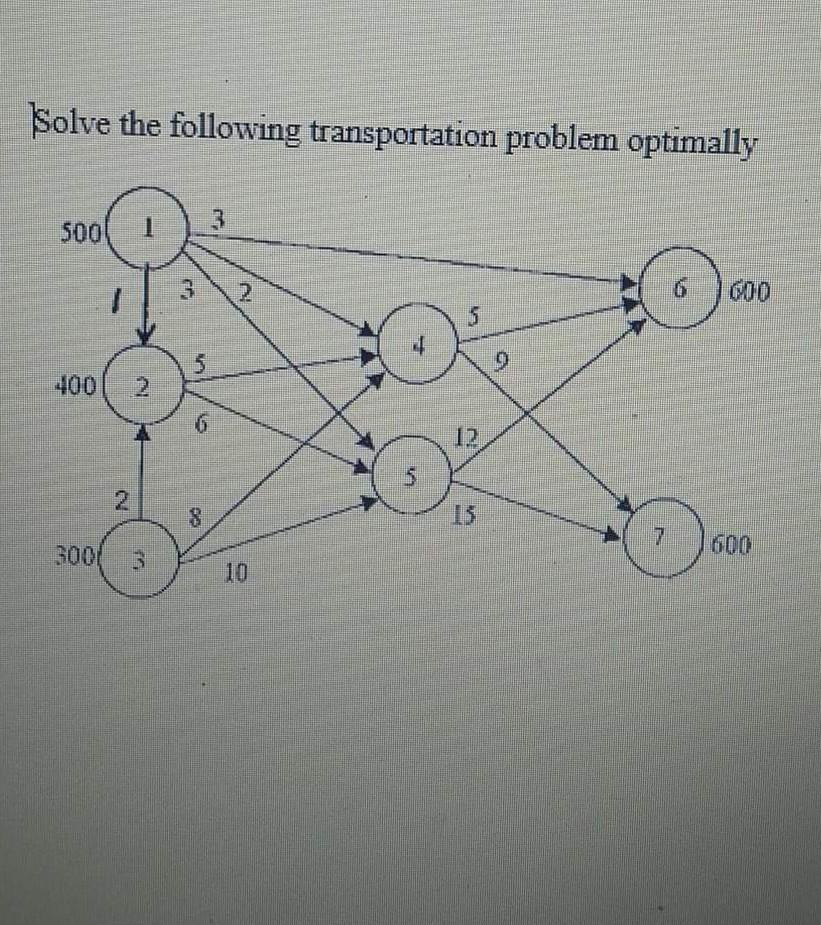
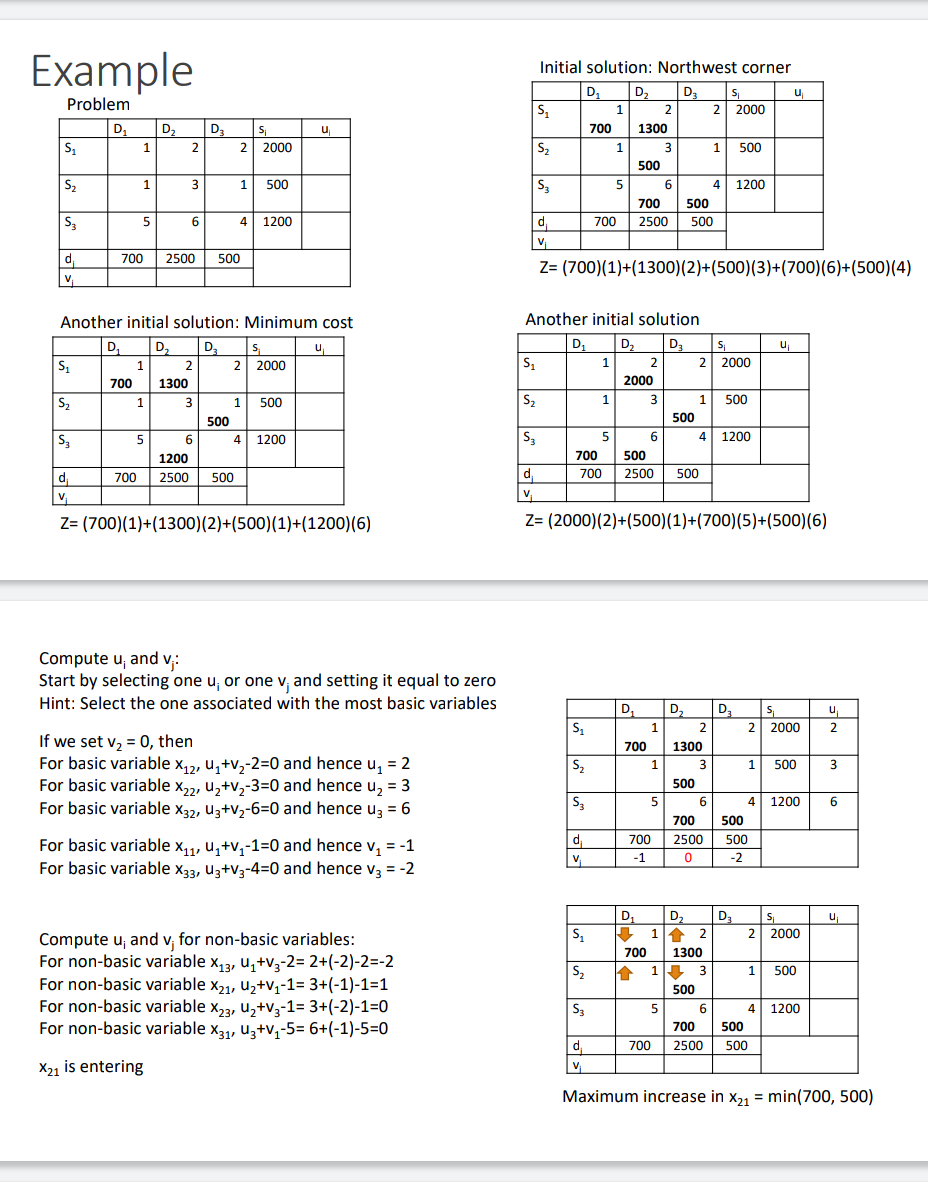
convert the graph to table like second pic
Solve the following transportation problem optimally 3 500 1 3 2 6 000 35 9 400 12 5 7 300 600 3 10 Example Problem D S D2 D u S 2000 1 2 2 Initial solution: Northwest corner D D D3 S u S, 1 2 2 2000 700 1300 SZ 1 3 1 500 500 sz 5 6 41200 700 500 d 700 2500 500 S2 1 3 1 500 S 5 6 4 1200 d 700 2500 500 Z= (700)(1)+(1300)(2)+(500)(3)+(700)(6)+(500)(4) u Another initial solution: Minimum cost D D D S u S 1 2 2 2000 700 1300 S2 1 3 1 500 500 S. 5 6 4 1200 1200 d 700 2500 500 V Z= (700)(1)+(1300) (2)+(500)(1)+(1200)(6) Another initial solution D D2 DE S S, 1 2 2 2000 2000 S2 1 3 1 500 500 Sz 5 6 41200 700 500 d 700 2500 V 500 Z= (2000) (2)+(500)(1)+(700)(5)+(500)(6) Compute u; and vi: Start by selecting one u; or one v, and setting it equal to zero Hint: Select the one associated with the most basic variables D S 2000 u 2 Si 2 D. 1 700 1 S 1 500 3 D 2 1300 3 500 6 700 2500 If we set V2 = 0, then For basic variable X12, U4+v2-2=0 and hence uz = 2 For basic variable X22, Uz+V2-3=0 and hence uz = 3 For basic variable X32, Uz+V2-6=0 and hence uz = 6 For basic variable X11, U,+V7-1=0 and hence vz = -1 For basic variable X33, Uz+V3-4=0 and hence V3 = -2 S 5 4 1200 6 os 700 -1 500 500 -2 0 u S, S2 Compute u; and v, for non-basic variables: For non-basic variable X13, U4+V3-2= 2+(-2)-2=-2 For non-basic variable X21, uz+V7-1= 3+(-1)-1=1 For non-basic variable X23, Uz+V2-1= 3+(-2)-1=0 For non-basic variable X31, uz+v7-5= 6+(-1)-5=0 D. D2 D S 1 1 2 2 2000 700 1300 11 3 1 500 500 5 6 4 1200 700 500 700 2500 500 S3 d v X21 is entering Maximum increase in X21 = min(700, 500)Step by Step Solution
There are 3 Steps involved in it
1 Expert Approved Answer
Step: 1 Unlock

Question Has Been Solved by an Expert!
Get step-by-step solutions from verified subject matter experts
Step: 2 Unlock
Step: 3 Unlock
 Study Help