Question: correct them if wrong pleas Question 1 (10 points): Answer the following multiple choice questions. There is only one correct answer 1. Which of the

correct them if wrong pleas correct them if wrong pleas Question 1 (10
correct them if wrong pleas Question 1 (10
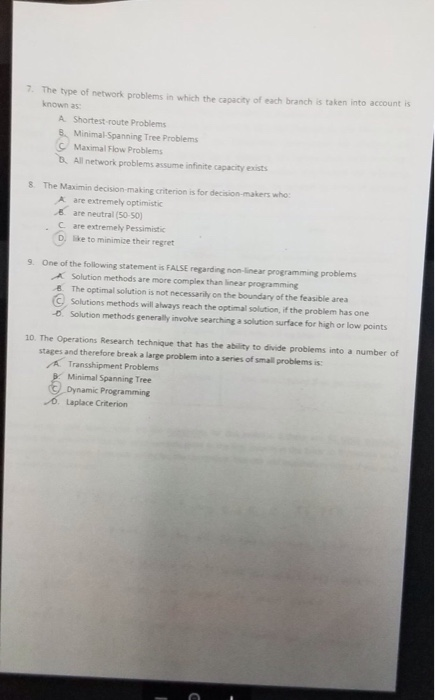
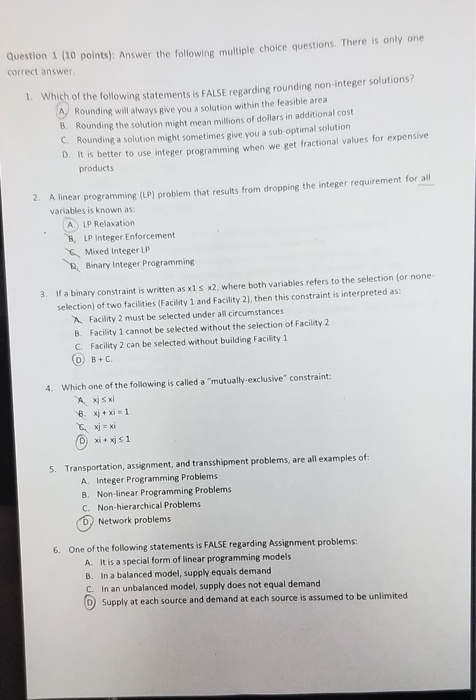
Question 1 (10 points): Answer the following multiple choice questions. There is only one correct answer 1. Which of the following statements is FALSE regarding rounding non-integer solutions? A Rounding will always give you a solution within the feasible area B. Rounding the solution might mean millions of dollars in additional cost C. Rounding a solution might sometimes give you a sub-optimal solution Dit is better to use integer programming when we get fractional values for expensive products A linear programming (LP) problem that results from dropping the integer requirement for all variables is known as: A LP Relaxation B LP Integer Enforcement Mixed Integer LP Binary Integer Programming 3. If a binary constraint is written as xls x2, where both variables refers to the selection (or none selection) of two facilities (Facility 1 and Facility 2), then this constraint is interpreted as: Facility 2 must be selected under all circumstances B. Facility 1 cannot be selected without the selection of Facility 2 C. Facility 2 can be selected without building Facility 1 D B+C 4. Which one of the following is called a "mutually exclusive constraint: AXSX 8. xj+xi - 1 Xi = xi Dxi+ xj 61 5. Transportation, assignment, and transshipment problems, are all examples of: A. Integer Programming Problems B. Non-linear Programming Problems C. Non-hierarchical Problems D) Network problems 6. One of the following statements is FALSE regarding Assignment problems: A. It is a special form of linear programming models B. In a balanced model, supply equals demand C. In an unbalanced model, supply does not equal demand (D) Supply at each source and demand at each source is assumed to be unlimited branch s taken into account is The type of network problems w ith a known as A Shortest route Problems B. Minimal Spanning Tree Problems C Maximal Flow Problems All network problems assume infinite capacity exists 8 for de kers who The Maximin decision making criterion A are extremely optimistic are neutral (50-50) C are extremely Pessimistic D e to minimice their recret 9 One of the following statement is FALSE regarding non-linear programming problems A Solution methods are more complex than linear programming 8 The optimal solution is not necessarily on the boundary of the feasible area C Solutions methods will always reach the optimal solution, if the problem has one - Solution methods generally involve searching a solution surface for high or low points 10. The Operations Research technique that has the ability to divide problems into a number of stages and therefore break a large problem into a series of small problems is Transshipment Problems Minimal Spanning Tree Dynamic Programming Laplace Criterion Question 1 (10 points): Answer the following multiple choice questions. There is only one correct answer 1. Which of the following statements is FALSE regarding rounding non-integer solutions? A Rounding will always give you a solution within the feasible area B. Rounding the solution might mean millions of dollars in additional cost C. Rounding a solution might sometimes give you a sub-optimal solution Dit is better to use integer programming when we get fractional values for expensive products A linear programming (LP) problem that results from dropping the integer requirement for all variables is known as: A LP Relaxation B LP Integer Enforcement Mixed Integer LP Binary Integer Programming 3. If a binary constraint is written as xls x2, where both variables refers to the selection (or none selection) of two facilities (Facility 1 and Facility 2), then this constraint is interpreted as: Facility 2 must be selected under all circumstances B. Facility 1 cannot be selected without the selection of Facility 2 C. Facility 2 can be selected without building Facility 1 D B+C 4. Which one of the following is called a "mutually exclusive constraint: AXSX 8. xj+xi - 1 Xi = xi Dxi+ xj 61 5. Transportation, assignment, and transshipment problems, are all examples of: A. Integer Programming Problems B. Non-linear Programming Problems C. Non-hierarchical Problems D) Network problems 6. One of the following statements is FALSE regarding Assignment problems: A. It is a special form of linear programming models B. In a balanced model, supply equals demand C. In an unbalanced model, supply does not equal demand (D) Supply at each source and demand at each source is assumed to be unlimited branch s taken into account is The type of network problems w ith a known as A Shortest route Problems B. Minimal Spanning Tree Problems C Maximal Flow Problems All network problems assume infinite capacity exists 8 for de kers who The Maximin decision making criterion A are extremely optimistic are neutral (50-50) C are extremely Pessimistic D e to minimice their recret 9 One of the following statement is FALSE regarding non-linear programming problems A Solution methods are more complex than linear programming 8 The optimal solution is not necessarily on the boundary of the feasible area C Solutions methods will always reach the optimal solution, if the problem has one - Solution methods generally involve searching a solution surface for high or low points 10. The Operations Research technique that has the ability to divide problems into a number of stages and therefore break a large problem into a series of small problems is Transshipment Problems Minimal Spanning Tree Dynamic Programming Laplace Criterion

Step by Step Solution

There are 3 Steps involved in it

1 Expert Approved Answer
Step: 1 Unlock blur-text-image

Question Has Been Solved by an Expert!

Get step-by-step solutions from verified subject matter experts

Step: 2 Unlock
Step: 3 Unlock

Students Have Also Explored These Related General Management Questions!