







Question: Crafting and Executing strategy 22e Case 19 Mattel Incorporated in 2018: Can Ynon Kreiz save the toys? According to the case 1. What are the
Crafting and Executing strategy 22e
Case 19 Mattel Incorporated in 2018: Can Ynon Kreiz save the toys?
According to the case
1. What are the characteristics of Mattel target segments? Use 7O's -6W1H framework to profile the target segment and extended segment.
2. Use McKinsey's value chain model to list out Mattel value chain activities, which activities add competitive advantage to Mattle?
3. Use a competitive strength grid to assess Mattel's competitive strength against its primary rivals
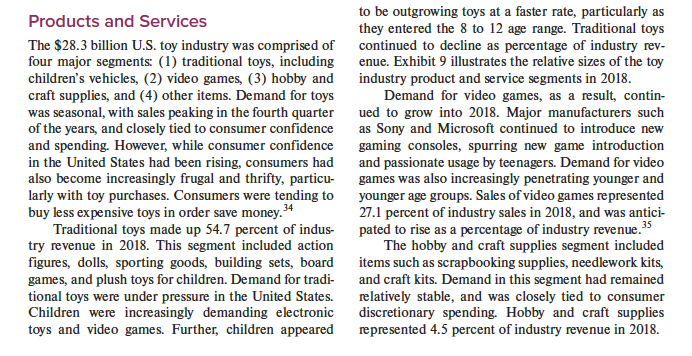
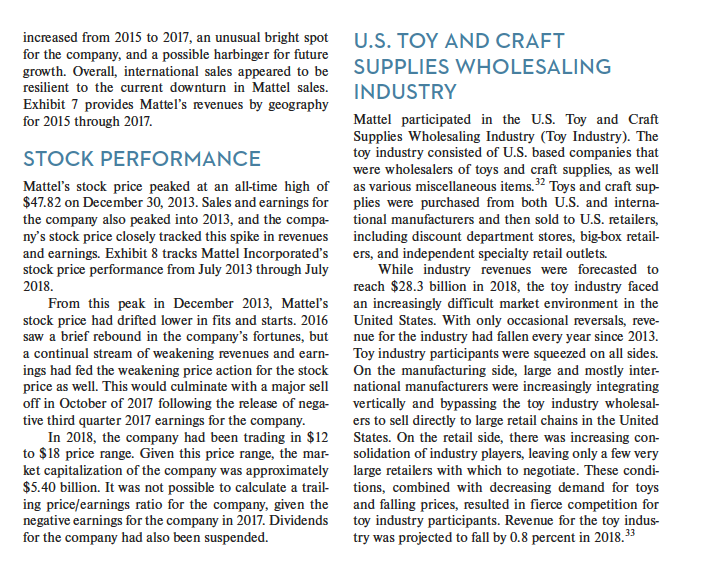
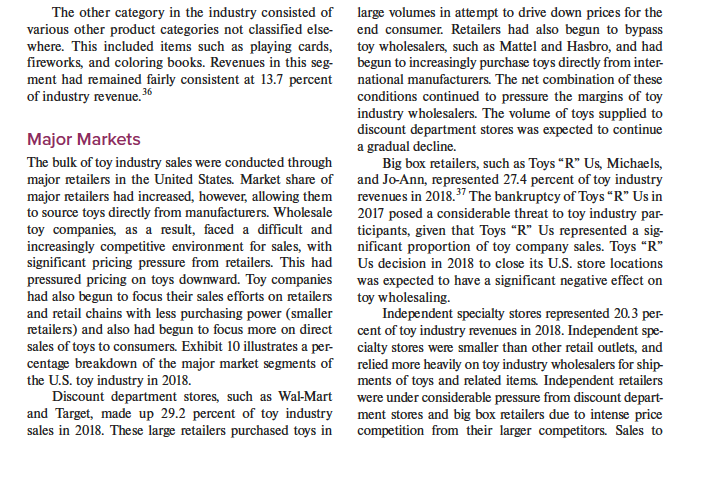
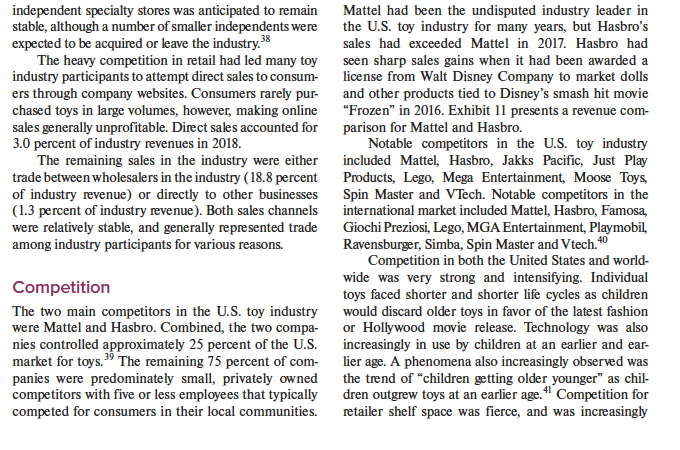
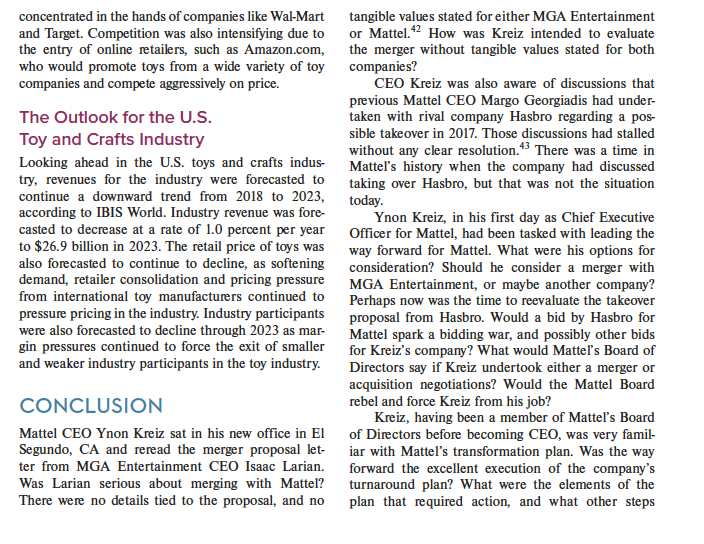
two products were picture frames and dollhouse furni- ture crafted from scraps of picture frame. Their first hit toy was the "Uke-A-Doodle," a toy ukulele, released in 1947. Mattel was formally incorporated in 1948 with their headquarters based in Los Angeles, California. In 1955, Mattel began advertising their toys on a popular television show, the Mickey Mouse Club, which revolutionized the way in which toys were mar- keted to children. Mattel released a number of new toys on the television show. In 1959, Ruth Handler created an innovative design for a new type of doll, and named it after her own daughter, Barbara. The introduction of the Barbie doll became a smash hit and propelled Mattel to the top of the toy industry. Mattel would go on to sell over one billion Barbie dolls, making Barbie the largest selling and most profitable toy in Mattel's toy lineup. The Barbie doll was followed in 1960 with the Chatty Cathy, a talking doll that would change the toy industry and lead to many imitators. Hot Wheels die-cast vehicles were rolled out in 1968. Hot Wheels toys influenced the lives of sev- eral generations of children, leading the company to estimate that at least 41 million children had grown up alongside the Hot Wheels brand. After a long and successful career with Mattel, Ruth and Elliott Handler left Mattel in 1975. Mattel was an early entrant into the electronic games market, introducing an electronic handheld game in 1977. Initial success with the handheld game led to the IntelliVision home video entertainment sys- tem and a spin-off corporation, Mattel Electronics. This early venture into electronics did not last, how- ever, as declining sales and mounting losses forced Mattel into abandoning the electronics initiative. Mattel took a $394 million loss in 1983 and debated a bankruptcy filing. Mattel reevaluated their diversi- fication strategy as a result and closed or divested all non-toy related subsidiaries in the wake of the losses. The He-Man and the Masters of the Universe line of action figures was the next best seller for the com- pany beginning in 1982. The company estimated sales of the He-Man line at $400 million in 1985. However, the success was short lived and sales dropped, con- tributing to a loss of $115 million in 1987. Mattel began a revived working relationship with the Disney Company in 1988. This combination revived Mattel, leading to hit products based on Disney characters like Mickey Mouse and characters from the top-grossing Disney animated movie Toy Story. Mattel purchased Fisher-Price in 1993, merged with Tyco Toys in 1997, and acquired the parent company for the American Girl Brand in 1998. The company also acquired the Learning Company, a U.S. based educational software company, in the fall of 1998. The Learning Company, a merger financed with Mattel stock, was acquired for $3.5 billion. One of the Learning Company's more popular software offerings was the "Where in the World is Carmen Sandiego?" series. Losses from the Learning Company acquisi- tion were almost immediate. In addition to inflated sales forecasts for the unit, Mattel had bought the Learning Company just as children were switching from games and learning toys on CD-ROM to down- loading them from the Internet. Unfortunately, the Learning Company was delivering their products primarily on CD-ROM at that time. In addition to the ouster of then CEO Jill Barad, Mattel booked a $430 million loss in 2000. New CEO Robert Eckert moved swiftly in 2000 to restructure Mattel. He dumped the Learning Company along with other software-related assets and began a restructuring plan for the company, with the goal of achieving $200 million in immediate cost savings. Eckert also reduced the company's dividend and cut about 10 percent of the workforce. Although painful, the company had better luck that year with licensing agreements. In 2000, Mattel retained the master licensing rights to market and sell Harry Potter toys, collectibles and games, and also agreed with Disney to market Disney Princess dolls. As part of CEO Eckert's restructuring efforts, the company announced in April 2001 that Mattel would close its last U.S. manufacturing site and move the operations to Mexico. 10 This plant closure was part of the continuing cost-cutting efforts at the com- pany, and closed Mattel's final U.S. plant in Murray, Kentucky. The plant had been operational since 1973 and employed 980 manufacturing and distribution workers. Mattel had been an early adopter of over- seas manufacturing, and had been making toys in Mexico for 25 years and in Asia for 30 years at the time of this final U.S. plant closure. 11 By 2007, approximately 65 percent of Mattel's toys were made in China. This included five wholly owned Mattel factories as well as numerous contrac- tor and subcontractor facilities. Mattel had also devel- oped, over time, a reputation for quality and safety in their manufacturing practices. Nevertheless, in May to June 2007, Mattel discovered toys manufactured worse, sales during the fourth quarter of 2016 failed with lead-tainted paint during routine safety checks at to meet expectations, and Mattel had to cut prices to a number of contractor facilities in China. The subse- salvage the all-important holiday season." quent investigation into the tainted toys led to a crisis In the wake of the holiday 2016 debacle, Margo for Mattel, with a large public outcry, regulatory scru- Georgiadis was named CEO of Mattel in February tiny and the recall of over 19 million Mattel-branded of 2017. From February 2017 to April 2018, toys. While a major setback for the company, Mattel Mattel's stock price dropped by 50 percent, and was noted for handling the recalls swiftly and effec- Ms. Georgiadis was unable to reverse the continued tively. 14 Mattel also moved swiftly to diversify their slide in Mattel's sales and earnings.20 In November manufacturing facilities to other countries in order to of 2017, Hasbro made a takeover offer for Mattel, an avoid supply disruptions and other risks. offer that Mattel's board rejected.2Ms. Georgiadis Mattel gradually recovered from the lead paint then left Mattel abruptly in April 2018. Former stu- crisis, and revenue growth for the company resumed dio executive Ynon Kreiz, a member of Mattel's in 2010. Then, in 2012, sales of Barbie dolls began to board of directors since June of 2017, was named the drop. Gross sales for the Barbie doll line exceeded incoming CEO. Kreiz began his tenure as CEO of $1.2 billion in 2012, and the drop in Barbie sales was Mattel on April 26, 2018. balanced by strong sales in other Mattel toy lines, particularly the Disney Princess doll line. The release VISION, MISSION, AND of the Disney movie Frozen" provided a sharp boost to Mattel's Disney line of dolls and related products STRATEGIC GOALS in 2013, and this somewhat countered the slump in Mattel Inc. had no formal mission or vision the core Barbie brand. Net sales for Mattel Inc. over- statement. The company stated that the Mattel all peaked in 2013 at $6.48 billion, despite the Barbie Incorporated family of companies was "a worldwide sales slump. leader in the design, manufacture, and marketing By the third quarter of 2014, however, sales of the of toys and family products."22 The company also Barbie brand had dropped 21 percent from the previ- emphasized the power of play, stating that play was ous year. 16 What was wrong with Barbie? Analysts essential for creating future generations of thinkers, acknowledged that Barbie was still one of the top makers, and doers. Mattel had been named one of doll brands in the world, but noted that girls were the world's most ethical companies by Ethnisphere increasingly drawn to other, more innovative dolls Magazine in 2013, and was also ranked Number 2 and games that ran on tablets, computers, and smart- on Corporate Responsibility Magazine's 100 Best phones." Further, while Barbie's core demographic Corporate Citizens" list.23 used to be between the ages of 3 and 9, the market In her report to Mattel shareholders in early for Barbie now appeared to be between the ages of 2018, CEO Margo Georgiadis had outlined five stra- 3 and 6. Children were maturing faster than ever in tegic pillars to transform the company and return it the 21st century. There had also been longstanding to growth: complaints about a lack of diversity in the Barbie doll line, particularly given the changing demographics of 1. Building Mattel's core brands into connected the U.S. child population." 360-degree play systems and experiences, Other Mattel lines then began to join the Barbie 2. Accelerating emerging markets growth with digi- sales slump, including the popular American Girl tal first solutions, brand, Hot Wheels, and Fisher Price infant toys. 3. Focusing and strengthening the company's inno- Overall net sales for Mattel dropped by $400 million vation pipeline, in 2014. In January 2015, Mattel CEO Bryan Stockton 4. Reshaping the company's operations, and was replaced by Christopher Sinclair, a longstand- ing director on Mattel's board of directors. In 2016, 5. Reigniting Mattel's culture and team.24 Disney moved their license to the Princess line of Ms. Georgiadis noted a number of changes in dolls, including their blockbuster "Frozen" toys, to Mattel's executive ranks in her report, including the Mattel rival Hasbro. The loss of the Disney license appointment of Ynon Kreiz to Mattel's Board of had a negative impact on Mattel. Making matters Directors in June 2017. Georgiadis also noted that the organizational structure of Mattel had been flat- Manufacturing for the company was conducted tened and simplified to accelerate decision making through both company-owned facilities and by con- within the company. tract through third-party manufacturers. Mattel had Ms. Georgiadis introduced incoming CEO Kreiz company-owned manufacturing facilities in Canada, on Mattel's April 26, 2018 call with analysts. On the China, Indonesia, Malaysia, Mexico, and Thailand. call, CEO Kreiz said: Manufacture of core products for the company was We have a lot to do to reach our objectives. But I'm very generally conducted by company-owned facilities in confident that we have the right plan and the right team order to improve flexibility and to lower manufactur- in place .... We are already making strong progress ing costs.28 Non-core toy products were produced against our strategic pillars. My immediate focus (for by third-party contract manufacturers. Mattel also Mattel) includes the following priorities: implementing purchased some toys from unrelated companies for our Structural Simplification to restore profitability, resale through Mattel sales channels. stabilizing revenue, reinvigorating our concept to drive Creativity and innovation was a critical issue creativity, which I believe is essential to our success; and for companies like Mattel in the toy industry. Mattel strengthening our collaboration with our partners." invested heavily in refreshing, redesigning, and Incoming CEO Kreiz also articulated his longer- extending their existing toy lines, as well as develop- range vision for Mattel during the call with analysts: ing brand new toy product lines for their company. Product design and development was conducted in The big picture opportunity is to transform Mattel to an house by a group of professional toy designers and IT (information technology) driven high-performing toy engineers. In 2017, the company spent approximately company, that is more efficient, more profitable, and has a higher growth trajectory. We have very strong assets, $225 million on product design and development. including some of the world's best and greatest toy brands. Mattel's toy business was highly seasonal. Sales We have a very good team and a very good strategy that I built into the fourth quarter of the year and end of feel very good about. So our focus now is to deliver on our year holidays. A significant portion of purchasing transformation plan and maximize value for the company by Mattel's customers occurred during the third and and for our shareholders. This is not going to be easy. fourth quarters of the year.?" It was critical that Mattel There's no denying that we faced significant challenges manufacture enough of the right toys in advance over the last few years and there are still headwinds in cer- of the fourth quarter to meet this surge in demand. tain key areas of the business. But I feel confident about Conversely, not manufacturing unpopular toys was where we sit and what we have to do to take it on.26 also important to avoid stocking unpopular items. It was difficult for the company to match supply and COMPANY OPERATIONS demand with significant lead times for production early in the year. This seasonality in demand also Mattel Inc. had their worldwide headquarters in El meant increased need by Mattel for working capital Segundo, California, just south of the Los Angeles earlier in the year in order to meet the anticipated International Airport (LAX). As of December 2017, surge in production to meet yearend demand for toys. the company employed 28,000 people on a world- wide basis. The corporate headquarters consisted of MATTEL PRODUCTS two main buildings in El Segundo, with additional leased buildings in the immediate area for company Mattel's brands and products were organized into four operations. Mattel also had another major facility main categories: (1) Mattel Girls and Boys Brands, in East Aurora, New York, that was used for North (2) Fisher-Price Brands, (3) American Girl Brands, American operations and support. and (4) Construction and Arts & Crafts Brands. Each Mattel's American Girl operations were based in category had a multitude of products as part of their Middleton, Wisconsin, with a headquarters facility, a portfolio: warehouse, and distribution facilities in the immediate Middleton, Wisconsin area. Mattel also had retail and 1. Mattel Girls & Boys Brands. This category included related office space in 20 additional cities around the the Barbie doll and related accessories, Monster United States, and 40 countries around the world. 27 High, DC Super Hero Girls, Enchantimals, Mattel sold their products in 150 nations. and Polly Pocket brand lines. Wheeled toy lines included Hot Wheels, Matchbox, and CARS. Additional brand lines were DC Comics, WWE Wrestling, Minecraft, Toy Story, and additional games and puzzles. 2. Fisher-Price Brands. The core Fisher-Price brands included Fisher-Price, Little People, Baby Gear, Laugh & Learn, and Imaginext. Additional brand lines included Thomas & Friends, Shimmer & Shine, Mickey Mouse Clubhouse, and Power Wheels. 3. American Girl Brands. American Girl brands and products included American Girl, Truly Me, Girl of the Year, BeForever, Bitty Baby, and Wellie Wishers. 4. Construction and Arts & Crafts Brands. These brand lines included MEGA BLOKS and RoseArt. 3o MATTEL CUSTOMERS Mattel sold their products throughout the world. Mattel toys and related products were sold directly to discount retailers, freestanding toy stores, depart- ment stores, chain stores, and wholesalers. Mattel also had several small retail stores near to their corporate headquarters and distribution centers. American Girl products were sold directly to con- sumers through their own retail stores and also to retailers. Mattel also sold some of their products online through company subsidiaries. In 2017, three customers of Mattel accounted for 37 percent of company sales. These three cus- tomers were Wal-Mart, Toys"R" Us, and Target. Exhibit 1 presents a sales breakdown of Mattel's Major Customers for 2015 through 2017. The bank- ruptcy of Toys"R" Us had already damaged Mattel sales, and the pending plan to close some or all of the Toys R Us locations in the United States was anticipated to further damage Mattel sales in 2018. MATTEL MARKETING Marketing toys to children and their parents was an advertising intensive activity. Mattel spent heavily on marketing and promotional activities. Marketing activity was seasonal, with a peak during the fourth quarter of the year. Mattel advertised through TV and radio commercials, magazines, and newspa- pers. Promotional activity for the company included in-store displays, major events focusing on Mattel branded products, and marketing tie-ins with various consumer products companies. During 2017, Mattel spent $642.3 million, or 13.2 percent of company net sales, on advertising and promotion. Of particular importance to Mattel was the rise of social media and the Internet as a marketing and promotional channel. Children and their parents were increasingly accessing information about toys on social media websites. Mattel had carefully devel- oped their Facebook presence, and had cultivated 14 million followers for their Barbie page. Mattel also had a strong presence on YouTube for Barbie, with 3.8 million subscribers. KEY EXECUTIVES Ynon Kreiz was new the Chairman and CEO of Mattel. Kreiz, 53, was born and raised in Israel. He earned a BA in Economics and Management in 1991 from Tel Aviv University. After moving to Los Angeles, Kreiz earned an MBA from UCLA in 1993. In 1996, Kreiz moved to London to launch Fox Kids Europe, a Pay-TV children's television network. He served as Chairman and CEO of Fox Kids Europe from 1997 to 2002. Fox Kids Europe was acquired by the Walt Disney Company in 2001. After a stint at a venture capital firm, Kreiz served as Chairman and CEO of Endemol from 2008 to 2011. Endemol was a European-based global television and digital production company. Then in 2013, Kreiz became Chairman and CEO of Maker Studios in Los Angeles. Maker Studios produced Products and Services to be outgrowing toys at a faster rate, particularly as they entered the 8 to 12 age range. Traditional toys The $28.3 billion U.S. toy industry was comprised of continued to decline as percentage of industry rev- four major segments: (1) traditional toys, including enue. Exhibit 9 illustrates the relative sizes of the toy children's vehicles, (2) video games, (3) hobby and industry product and service segments in 2018. craft supplies, and (4) other items. Demand for toys Demand for video games, as a result, contin- was seasonal, with sales peaking in the fourth quarter ued to grow into 2018. Major manufacturers such of the years, and closely tied to consumer confidence as Sony and Microsoft continued to introduce new and spending. However, while consumer confidence gaming consoles, spurring new game introduction in the United States had been rising, consumers had and passionate usage by teenagers. Demand for video also become increasingly frugal and thrifty, particu- games was also increasingly penetrating younger and larly with toy purchases. Consumers were tending to younger age groups. Sales of video games represented buy less expensive toys in order save money. 34 27.1 percent of industry sales in 2018, and was antici- Traditional toys made up 54.7 percent of indus- pated to rise as a percentage of industry revenue. try revenue in 2018. This segment included action The hobby and craft supplies segment included figures, dolls, sporting goods, building sets, board items such as scrapbooking supplies, needlework kits, games, and plush toys for children. Demand for tradi- and craft kits. Demand in this segment had remained tional toys were under pressure in the United States. relatively stable, and was closely tied to consumer Children were increasingly demanding electronic discretionary spending. Hobby and craft supplies toys and video games. Further, children appeared represented 4.5 percent of industry revenue in 2018. 35 increased from 2015 to 2017, an unusual bright spot U.S. TOY AND CRAFT for the company, and a possible harbinger for future growth. Overall, international sales appeared to be SUPPLIES WHOLESALING resilient to the current downturn in Mattel sales. INDUSTRY Exhibit 7 provides Mattel's revenues by geography for 2015 through 2017. Mattel participated in the U.S. Toy and Craft Supplies Wholesaling Industry (Toy Industry). The STOCK PERFORMANCE toy industry consisted of U.S. based companies that were wholesalers of toys and craft supplies, as well Mattel's stock price peaked at an all-time high of as various miscellaneous items.2 Toys and craft sup- $47.82 on December 30, 2013. Sales and earnings for plies were purchased from both U.S. and interna- the company also peaked into 2013, and the compa- tional manufacturers and then sold to U.S. retailers, ny's stock price closely tracked this spike in revenues including discount department stores, big-box retail- and earnings. Exhibit 8 tracks Mattel Incorporated's ers, and independent specialty retail outlets. stock price performance from July 2013 through July While industry revenues were forecasted to 2018. reach $28.3 billion in 2018, the toy industry faced From this peak in December 2013, Mattel's an increasingly difficult market environment in the stock price had drifted lower in fits and starts. 2016 United States. With only occasional reversals, reve- saw a brief rebound in the company's fortunes, but nue for the industry had fallen every year since 2013. a continual stream of weakening revenues and earn- Toy industry participants were squeezed on all sides. ings had fed the weakening price action for the stock On the manufacturing side, large and mostly inter- price as well. This would culminate with a major sell national manufacturers were increasingly integrating off in October of 2017 following the release of nega- vertically and bypassing the toy industry wholesal- tive third quarter 2017 earnings for the company. ers to sell directly to large retail chains in the United In 2018, the company had been trading in $12 States. On the retail side, there was increasing con- to $18 price range. Given this price range, the mar- solidation of industry players, leaving only a few very ket capitalization of the company was approximately large retailers with which to negotiate. These condi- $5.40 billion. It was not possible to calculate a trail- tions, combined with decreasing demand for toys ing price/earnings ratio for the company, given the and falling prices, resulted in fierce competition for negative earnings for the company in 2017. Dividends toy industry participants. Revenue for the toy indus- for the company had also been suspended. try was projected to fall by 0.8 percent in 2018.33 The other category in the industry consisted of large volumes in attempt to drive down prices for the various other product categories not classified else- end consumer. Retailers had also begun to bypass where. This included items such as playing cards, toy wholesalers, such as Mattel and Hasbro, and had fireworks, and coloring books. Revenues in this seg- begun to increasingly purchase toys directly from inter- ment had remained fairly consistent at 13.7 percent national manufacturers. The net combination of these of industry revenue. conditions continued to pressure the margins of toy industry wholesalers. The volume of toys supplied to discount department stores was expected to continue Major Markets a gradual decline. The bulk of toy industry sales were conducted through Big box retailers, such as Toys R Us, Michaels, major retailers in the United States. Market share of and Jo-Ann, represented 27.4 percent of toy industry major retailers had increased, however, allowing them revenues in 2018. The bankruptcy of Toys R Us in to source toys directly from manufacturers. Wholesale 2017 posed a considerable threat to toy industry par- toy companies, as a result, faced a difficult and ticipants, given that Toys R Us represented a sig- increasingly competitive environment for sales, with nificant proportion of toy company sales. Toys R significant pricing pressure from retailers. This had Us decision in 2018 to close its U.S. store locations pressured pricing on toys downward. Toy companies was expected to have a significant negative effect on had also begun to focus their sales efforts on retailers toy wholesaling. and retail chains with less purchasing power (smaller Independent specialty stores represented 20.3 per- retailers) and also had begun to focus more on direct cent of toy industry revenues in 2018. Independent spe- sales of toys to consumers. Exhibit 10 illustrates a per- cialty stores were smaller than other retail outlets, and centage breakdown of the major market segments of relied more heavily on toy industry wholesalers for ship- the U.S. toy industry in 2018. ments of toys and related items. Independent retailers Discount department stores, such as Wal-Mart were under considerable pressure from discount depart- and Target, made up 29.2 percent of toy industry ment stores and big box retailers due to intense price sales in 2018. These large retailers purchased toys in competition from their larger competitors. Sales to independent specialty stores was anticipated to remain Mattel had been the undisputed industry leader in stable, although a number of smaller independents were the U.S. toy industry for many years, but Hasbro's expected to be acquired or leave the industry. 38 sales had exceeded Mattel in 2017. Hasbro had The heavy competition in retail had led many toy seen sharp sales gains when it had been awarded a industry participants to attempt direct sales to consum- license from Walt Disney Company to market dolls ers through company websites. Consumers rarely pur- and other products tied to Disney's smash hit movie chased toys in large volumes, however, making online "Frozen" in 2016. Exhibit 11 presents a revenue com- sales generally unprofitable. Direct sales accounted for parison for Mattel and Hasbro. 3.0 percent of industry revenues in 2018. Notable competitors in the U.S. toy industry The remaining sales in the industry were either included Mattel, Hasbro, Jakks Pacific, Just Play trade between wholesalers in the industry (18.8 percent Products, Lego, Mega Entertainment, Moose Toys, of industry revenue) or directly to other businesses Spin Master and VTech. Notable competitors in the (1.3 percent of industry revenue). Both sales channels international market included Mattel, Hasbro, Famosa, were relatively stable, and generally represented trade Giochi Preziosi, Lego, MGA Entertainment, Playmobil, among industry participants for various reasons. Ravensburger, Simba, Spin Master and Vtech.40 Competition in both the United States and world- Competition wide was very strong and intensifying. Individual toys faced shorter and shorter life cycles as children The two main competitors in the U.S. toy industry would discard older toys in favor of the latest fashion were Mattel and Hasbro. Combined, the two compa- or Hollywood movie release. Technology was also nies controlled approximately 25 percent of the U.S. increasingly in use by children at an earlier and ear- market for toys. The remaining 75 percent of com- lier age. A phenomena also increasingly observed was panies were predominately small, privately owned the trend of "children getting older younger" as chil- competitors with five or less employees that typically dren outgrew toys at an earlier age. Competition for competed for consumers in their local communities. retailer shelf space was fierce, and was increasingly concentrated in the hands of companies like Wal-Mart tangible values stated for either MGA Entertainment and Target. Competition was also intensifying due to or Mattel.42 How was Kreiz intended to evaluate the entry of online retailers, such as Amazon.com, the merger without tangible values stated for both who would promote toys from a wide variety of toy companies? companies and compete aggressively on price. CEO Kreiz was also aware of discussions that previous Mattel CEO Margo Georgiadis had under- The Outlook for the U.S. taken with rival company Hasbro regarding a pos- Toy and Crafts Industry sible takeover in 2017. Those discussions had stalled without any clear resolution.43 There was a time in Looking ahead in the U.S. toys and crafts indus- Mattel's history when the company had discussed try, revenues for the industry were forecasted to taking over Hasbro, but that was not the situation continue a downward trend from 2018 to 2023, today. according to IBIS World. Industry revenue was fore- Ynon Kreiz, in his first day as Chief Executive casted to decrease at a rate of 1.0 percent per year Officer for Mattel, had been tasked with leading the to $26.9 billion in 2023. The retail price of toys was way forward for Mattel. What were his options for also forecasted to continue to decline, as softening consideration? Should he consider a merger with demand, retailer consolidation and pricing pressure MGA Entertainment, or maybe another company? from international toy manufacturers continued to Perhaps now was the time to reevaluate the takeover pressure pricing in the industry. Industry participants proposal from Hasbro. Would a bid by Hasbro for were also forecasted to decline through 2023 as mar- Mattel spark a bidding war, and possibly other bids gin pressures continued to force the exit of smaller for Kreiz's company? What would Mattel's Board of and weaker industry participants in the toy industry. Directors say if Kreiz undertook either a merger or acquisition negotiations? Would the Mattel Board CONCLUSION rebel and force Kreiz from his job? Kreiz, having been a member of Mattel's Board Mattel CEO Ynon Kreiz sat in his new office in El of Directors before becoming CEO, was very famil- Segundo, CA and reread the merger proposal let- iar with Mattel's transformation plan. Was the way ter from MGA Entertainment CEO Isaac Larian. forward the excellent execution of the company's Was Larian serious about merging with Mattel? turnaround plan? What were the elements of the There were no details tied to the proposal, and no plan that required action, and what other stepsStep by Step Solution
There are 3 Steps involved in it
1 Expert Approved Answer
Step: 1 Unlock

Question Has Been Solved by an Expert!
Get step-by-step solutions from verified subject matter experts
Step: 2 Unlock
Step: 3 Unlock
 Study Help