







Question: Create flowchart for C,B,A (Found in Grading) Correction on B: Turn ON 2 lights on PORTB while 2 lights on PORTC are OFF, then PORTB
Create flowchart for C,B,A (Found in "Grading")
Correction on B: Turn ON 2 lights on PORTB while 2 lights on PORTC are OFF, then PORTB lights OFF while the PORTC lights are on and repeat.
Grading
1. To achieve a C grade, make two PORTB LEDs (two least significant bits on PORTB) blink at roughly a one-second on/off rate.
2. For the B grade, alternately blink the two LEDs on PORTB, then two LEDs on PORTC (again, least significant bits) on a continuous basis.
3. To achieve an A grade, alternately blink the PORTB and PORTC lights as specified for the B grade, but design the system so that the blinking will speed up gradually until it appears the lights are on solidly. Once the lights have reached an apparently solid-on state, gradually decrease the speed at which the lights alternate. This process should repeat itself continuously
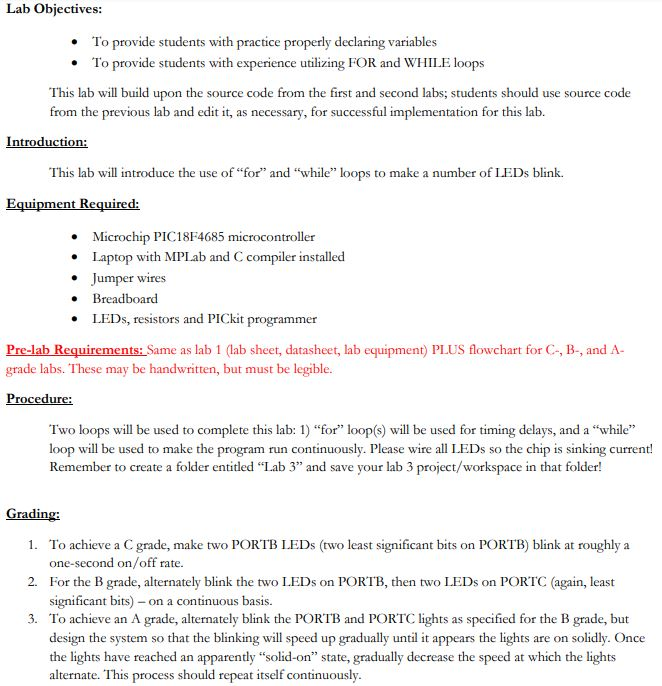
Lab Objectives: To provide students with practice properly declaring variables To provide students with experience utilizing FOR and WHILE loops This lab will build upon the source code from the first and second labs; students should use source code from the previous lab and edit it, as necessary, for successful implementation for this lab. Introduction: This lab will introduce the use of "for" and "while" loops to make a number of LEDs blink. Equipment Required: Microchip PIC18F4685 microcontroller Laptop with MPLab and C compiler installed Jumper wires Breadboard LEDs, resistors and PICkit programmer Pre-lab Requirements: Same as lab 1 (lab sheet, datasheet, lab equipment) PLUS flowchart for C-, B-, and A- grade labs. These may be handwritten, but must be legible. Procedure: Two loops will be used to complete this lab: 1) "for loop(s) will be used for timing delays, and a "while" loop will be used to make the program run continuously. Please wire all LEDs so the chip is sinking current! Remember to create a folder entitled "Lab 3 and save your lab 3 project/workspace in that folder! Grading: 1. To achieve a C grade, make two PORTB LEDs (two least significant bits on PORTB) blink at roughly a one-second on/off rate. 2. For the B grade, alternately blink the two LEDs on PORTB, then two LEDs on PORTC (again, least significant bits) - on a continuous basis. 3. To achieve an A grade, alternately blink the PORTB and PORTC lights as specified for the B grade, but design the system so that the blinking will speed up gradually until it appears the lights are on solidly. Once the lights have reached an apparently "solid-on" state, gradually decrease the speed at which the lights alternate. This process should repeat itself continuously Lab Objectives: To provide students with practice properly declaring variables To provide students with experience utilizing FOR and WHILE loops This lab will build upon the source code from the first and second labs; students should use source code from the previous lab and edit it, as necessary, for successful implementation for this lab. Introduction: This lab will introduce the use of "for" and "while" loops to make a number of LEDs blink. Equipment Required: Microchip PIC18F4685 microcontroller Laptop with MPLab and C compiler installed Jumper wires Breadboard LEDs, resistors and PICkit programmer Pre-lab Requirements: Same as lab 1 (lab sheet, datasheet, lab equipment) PLUS flowchart for C-, B-, and A- grade labs. These may be handwritten, but must be legible. Procedure: Two loops will be used to complete this lab: 1) "for loop(s) will be used for timing delays, and a "while" loop will be used to make the program run continuously. Please wire all LEDs so the chip is sinking current! Remember to create a folder entitled "Lab 3 and save your lab 3 project/workspace in that folder! Grading: 1. To achieve a C grade, make two PORTB LEDs (two least significant bits on PORTB) blink at roughly a one-second on/off rate. 2. For the B grade, alternately blink the two LEDs on PORTB, then two LEDs on PORTC (again, least significant bits) - on a continuous basis. 3. To achieve an A grade, alternately blink the PORTB and PORTC lights as specified for the B grade, but design the system so that the blinking will speed up gradually until it appears the lights are on solidly. Once the lights have reached an apparently "solid-on" state, gradually decrease the speed at which the lights alternate. This process should repeat itself continuously
Step by Step Solution
There are 3 Steps involved in it

Get step-by-step solutions from verified subject matter experts
 Study Help