



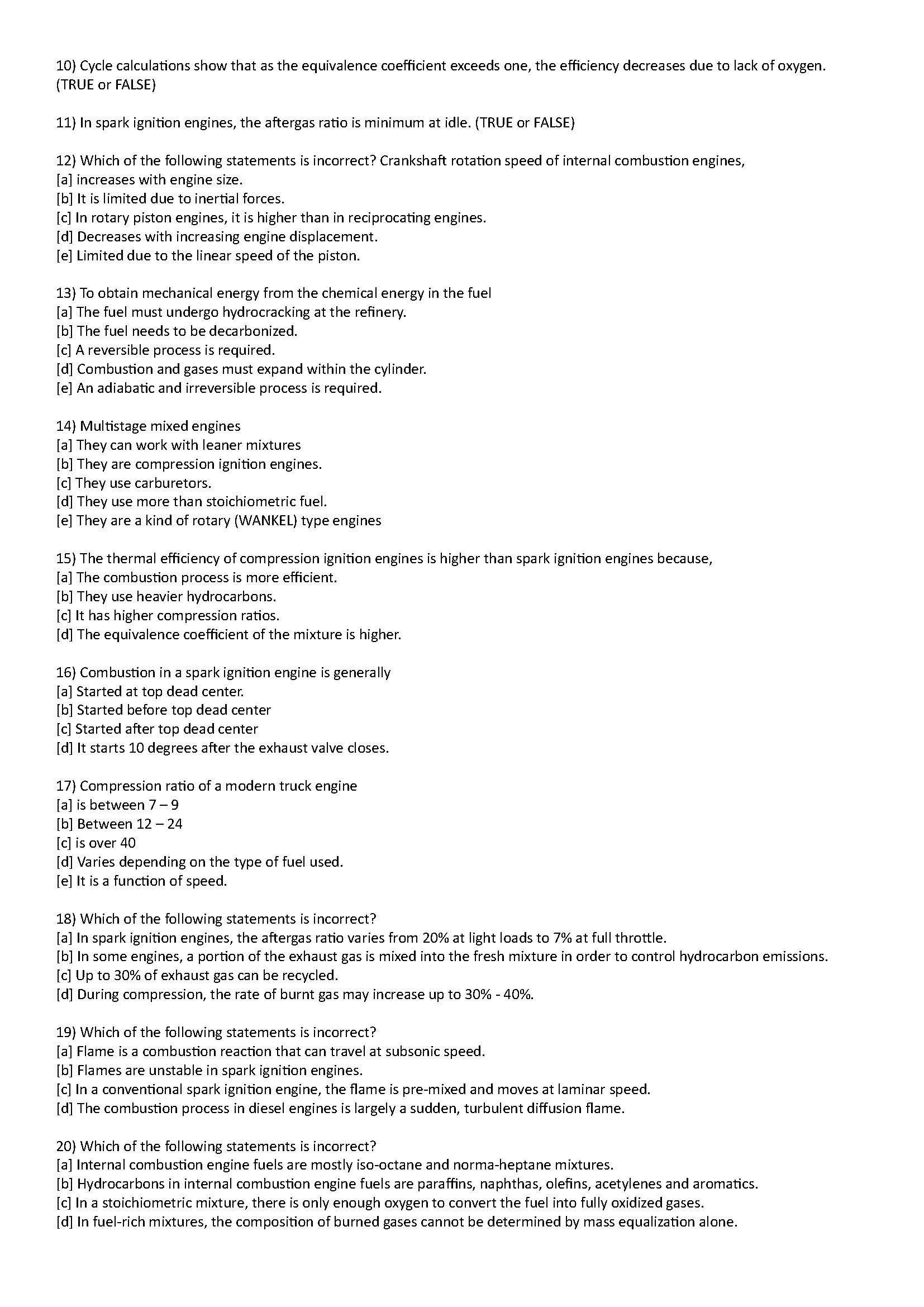
Question: Cycle calculations show that as the equivalence coefficient exceeds one, the efficiency decreases due to lack of oxygen. ( TRUE or FALSE ) In spark
Cycle calculations show that as the equivalence coefficient exceeds one, the efficiency decreases due to lack of oxygen.
TRUE or FALSE
In spark ignition engines, the aftergas ratio is minimum at idle. TRUE or FALSE
Which of the following statements is incorrect? Crankshaft rotation speed of internal combustion engines,
a increases with engine size.
b It is limited due to inertial forces.
c In rotary piston engines, it is higher than in reciprocating engines.
d Decreases with increasing engine displacement.
e Limited due to the linear speed of the piston.
To obtain mechanical energy from the chemical energy in the fuel
a The fuel must undergo hydrocracking at the refinery.
b The fuel needs to be decarbonized.
c A reversible process is required.
d Combustion and gases must expand within the cylinder.
e An adiabatic and irreversible process is required.
Multistage mixed engines
a They can work with leaner mixtures
b They are compression ignition engines.
c They use carburetors.
d They use more than stoichiometric fuel.
e They are a kind of rotary WANKEL type engines
The thermal efficiency of compression ignition engines is higher than spark ignition engines because,
a The combustion process is more efficient.
b They use heavier hydrocarbons.
c It has higher compression ratios.
d The equivalence coefficient of the mixture is higher.
Combustion in a spark ignition engine is generally
a Started at top dead center.
b Started before top dead center
c Started after top dead center
d It starts degrees after the exhaust valve closes.
Compression ratio of a modern truck engine
a is between
b Between
c is over
d Varies depending on the type of fuel used.
e It is a function of speed.
Which of the following statements is incorrect?
a In spark ignition engines, the aftergas ratio varies from at light loads to at full throttle.
b In some engines, a portion of the exhaust gas is mixed into the fresh mixture in order to control hydrocarbon emissions.
c Up to of exhaust gas can be recycled.
d During compression, the rate of burnt gas may increase up to
Which of the following statements is incorrect?
a Flame is a combustion reaction that can travel at subsonic speed.
b Flames are unstable in spark ignition engines.
c In a conventional spark ignition engine, the flame is premixed and moves at laminar speed.
d The combustion process in diesel engines is largely a sudden, turbulent diffusion flame.
Which of the following statements is incorrect?
a Internal combustion engine fuels are mostly isooctane and normaheptane mixtures.
b Hydrocarbons in internal combustion engine fuels are paraffins, naphthas, olefins, acetylenes and aromatics.
c In a stoichiometric mixture, there is only enough oxygen to convert the fuel into fully oxidized gases.
d In fuelrich mixtures, the composition of burned gases cannot be determined by mass equalization alone.
Step by Step Solution
There are 3 Steps involved in it
1 Expert Approved Answer
Step: 1 Unlock

Question Has Been Solved by an Expert!
Get step-by-step solutions from verified subject matter experts
Step: 2 Unlock
Step: 3 Unlock