







Question: Data Table I. For solubility: Does the substance mix with water (soluble) or not mix with water (insoluble)? Mark () if the substance is water
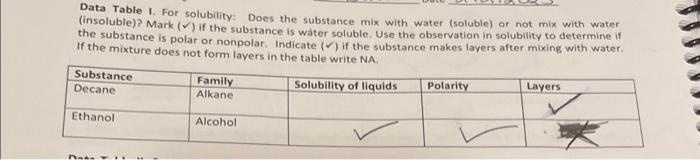
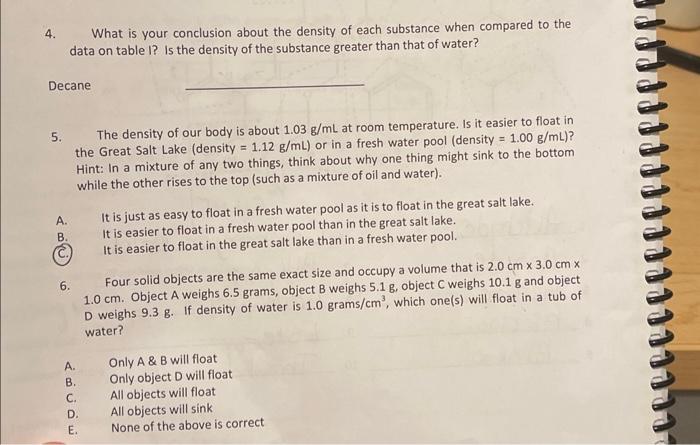
Data Table I. For solubility: Does the substance mix with water (soluble) or not mix with water (insoluble)? Mark () if the substance is water soluble. Use the observation in solubility to determine if the substance is polar or nonpolar. Indicate () if the substance makes layers after mixing with water. If the mixture does not form layers in the table write NA. 4. What is your conclusion about the density of each substance when compared to the data on table I? Is the density of the substance greater than that of water? Decane 5. The density of our body is about 1.03g/mL at room temperature. Is it easier to float in the Great Salt Lake (density =1.12g/mL ) or in a fresh water pool (density =1.00g/mL )? Hint: In a mixture of any two things, think about why one thing might sink to the bottom while the other rises to the top (such as a mixture of oil and water). A. It is just as easy to float in a fresh water pool as it is to float in the great salt lake. B. It is easier to float in a fresh water pool than in the great salt lake. (C.) It is easier to float in the great salt lake than in a fresh water pool. 6. Four solid objects are the same exact size and occupy a volume that is 2.0cm3.0cmx 1.0cm. Object A weighs 6.5 grams, object B weighs 5.1g, object C weighs 10.1g and object D weighs 9.3g. If density of water is 1.0grams/cm3, which one(s) will float in a tub of water? A. Only A \& B will float B. Only object D will float C. All objects will float D. All objects will sink E. None of the above is correct
Step by Step Solution
There are 3 Steps involved in it

Get step-by-step solutions from verified subject matter experts
 Study Help