







Question: Data Using Observational Model to Predict g, gravitational acceleration Using your experimental model and physics theory, it is possible to use data from timing the
Data
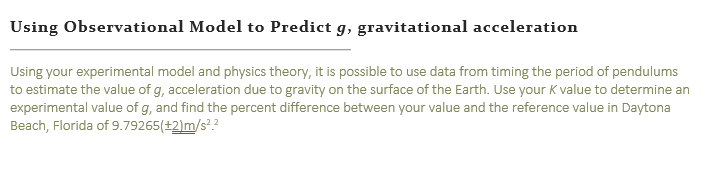
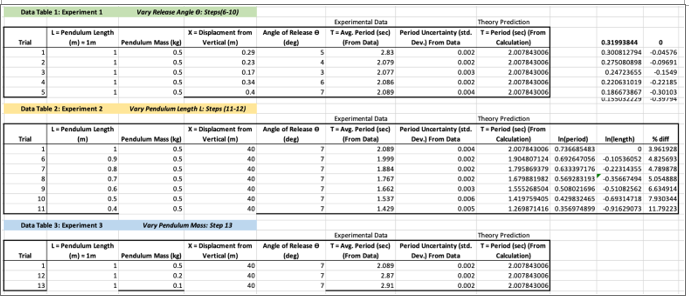
Using Observational Model to Predict g, gravitational acceleration Using your experimental model and physics theory, it is possible to use data from timing the period of pendulums to estimate the value of g, acceleration due to gravity on the surface of the Earth. Use your K value to determine an experimental value of g, and find the percent difference between your value and the reference value in Daytona Beach, Florida of 9.79265(+2)m/s?.2Data Table 1: Experiment 1 Vary Release Angle O: StepNo-10) Experimental Data Theory Prediction L - Pendulum Length X- Daplaoment from Angle of Rekau e To Avg. Period (sec] Period Uncertainty [stad. T. Period Ised) [From Trial Imjim Pendulum Mass |kel Vertical [m) [From Datal Dev ) From Data Calculationy 0.39 2.83 01002 2007843006 0 300812794 -0 04576 N 2.079 0.002 2 007843006 Q 275080198 -0.09691 0.17 2.077 0.009 2 007843006 0.24721455 -0.1549 0.007 2 007841006 0 320631010 -0.32185 2.089 2 007843036 0 186673 47 -0 30103 -U.59594 Outa Table 2: Experiment 2 Vary Pendulum Length L Stepi (11-12) Experimental Data Theory Prediction L= Pendulum Length X = Diplament from Angle of Rekam o To Avg. Period (cec] Period Uncertainty [otd. T . Period june) [From Imi Pendulum Mass [kel Vertical [m) Ideal IFrom Detel Dev ) From Data Calculation) Infearlodj Inflength] *din 1 0.D04 2 007841006 0.714685483 40 0.007 1904807124 0.692647056 -0.10536042 4 825691 40 1.884 1.795868379 0.630397176 -0.22314355 4.789878 F 1.767 1679881942 0.569283103-035667404 5054868 1.663 1555261504 0.501021696 -051083562 6.634914 0.5 40 1.537 1.419759405 0.429832465 0.69314718 7930344 11 0.4 05 40 1.429 OUDOS 1 269871416 0.356074890 091619073 11.79323 Data Table Jo Coperiment J Very Pendulum Moss Step 10 Experimental Data Theory Prediction L = Pendulum Length K - Diploonent from Angle of Hekearn e T - Avg. Period (sec) Period Uncertainty [sid. T . Period (sec) [From Trial Pendulum Main |kel Vertical [m) [From Datal Dwry ) From Dota Calculation! 1 21089 0.002 2007843006 17 02 2:87 20078-43006 01 2.91 2007843006
Step by Step Solution
There are 3 Steps involved in it

Get step-by-step solutions from verified subject matter experts
 Study Help