







Question: Davis proposes: I show that supporting a code of ethics with a certain content is rational by showing that supporting codes with a content of
- Davis proposes: I show that supporting a code of ethics with a certain content is rational by showing that supporting codes with a content of that sort is rational [for the profession of engineers to collectively agree to] (52).
- Imagine what engineering would be like if engineers did not generally act as the canons require (while satisfying the requirements of law, market, and ordinary morality). If, for example, engineers did not generally hold paramount the safety, health, and welfare of the public, what would it be like to be an engineer? The day-to-day work would, of course, be much the same. But every now and then an engineer might be asked to do something which, though profitable to the employer or client and legal, would put other people at risk, some perhaps about whom the engineer cared a great deal. Without a professional code, an engineer could not object as an engineer. An engineer could, of course, still object personally and refuse to do the job. But, if he did, he would risk being replaced by an engineer who would not object. An employer or client might rightly treat an engineers personal qualms as a disability much like a tendency to make errors. The engineer would be under tremendous pressure to keep personal opinions to himself and get on with the job. His interests as an engineer would conflict with his interests as a person; his conscience, with his self-interest. That, then, is why each engineer can generally expect to benefit from other engineers acting as their common code requires. The benefits are clearly substantial enough to explain how individuals could rationally enter into a convention that would equally limit what each can do (52-53).
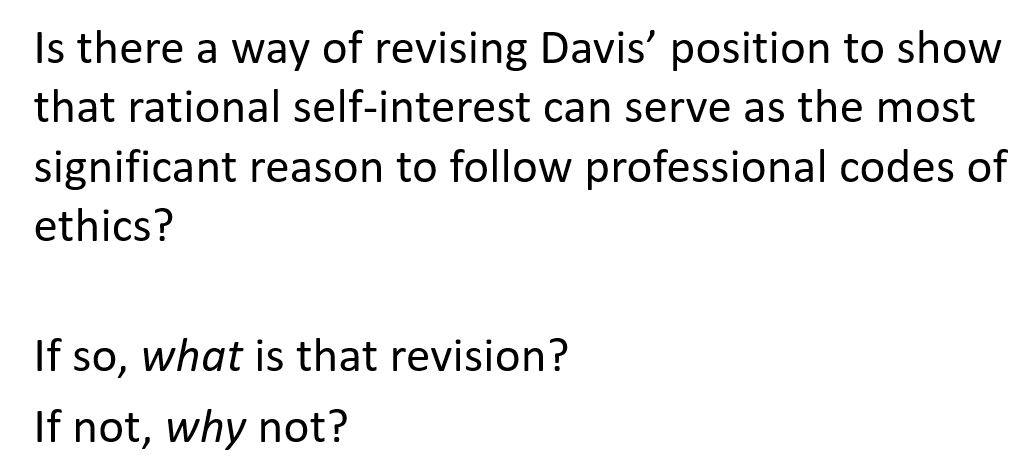
Is there a way of revising Davis' position to show that rational self-interest can serve as the most significant reason to follow professional codes of ethics? If so, what is that revision? If not, why not? Is there a way of revising Davis' position to show that rational self-interest can serve as the most significant reason to follow professional codes of ethics? If so, what is that revision? If not, why not
Step by Step Solution
There are 3 Steps involved in it
1 Expert Approved Answer
Step: 1 Unlock

Question Has Been Solved by an Expert!
Get step-by-step solutions from verified subject matter experts
Step: 2 Unlock
Step: 3 Unlock
 Study Help