







Question: Derive the transfer function of the DC motor whose specs are given in the table below. Let us assume that the motor is connected
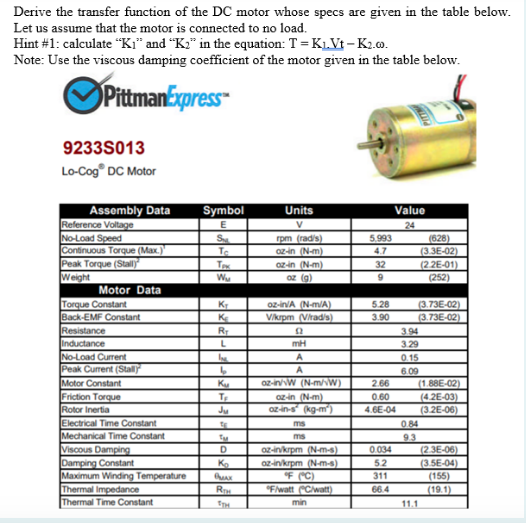
Derive the transfer function of the DC motor whose specs are given in the table below. Let us assume that the motor is connected to no load. Hint #1: calculate "K" and "K" in the equation: T = K.Vt - K.00. Note: Use the viscous damping coefficient of the motor given in the table below. PittmanExpress 9233S013 Lo-Cog DC Motor Assembly Data Reference Voltage No-Load Speed Continuous Torque (Max.)' Peak Torque (Stall) Weight Motor Data Torque Constant Back-EMF Constant Resistance Inductance No-Load Current Peak Current (Stall Motor Constant Friction Torque Rotor Inertia Electrical Time Constant Mechanical Time Constant Viscous Damping Damping Constant Maximum Winding Temperature Thermal Impedance Thermal Time Constant Symbol E S Tc Tx Wu Kr K R L 1-2-362023 2 Units V rpm (radis) oz-in (N-m) oz-in (N-m) az (g) oz-in/A (N-m/A) V/krpm (V/rad/s) Q mH A A oz-in/\W (N-m/W) oz-in (N-m) oz-in-s' (kg-m) ms ms oz-in/krpm (N-m-s) oz-in/krpm (N-m-s) F (C) F/watt (C/watt) min 5,993 4.7 32 9 5.28 3.90 Value 24 2.66 0.60 4.6E-04 0.034 5.2 311 66.4 (3.73E-02) (3.73E-02) (628) (3.3E-02) (2.2E-01) (252) 3.94 3.29 0.15 6.09 (1.88E-02) (4.2E-03) (3.2E-06) 0.84 11.1 (2.3E-06) (3.5E-04) (155) (19.1)
Step by Step Solution
There are 3 Steps involved in it
The given DC motor data provides us with the parameters needed to calculate the constants K1 and K2 for the equation T K1Vt K2omega where T is the motor torque Vt is the terminal voltage applied to th... View full answer

Get step-by-step solutions from verified subject matter experts
 Study Help