







Question: DESCRIPTION==== Solution :: (a) If carbon atom replaces a Ga atom, then carbon atom acts as a donor. Ga has 3 electrons in outermost shell.
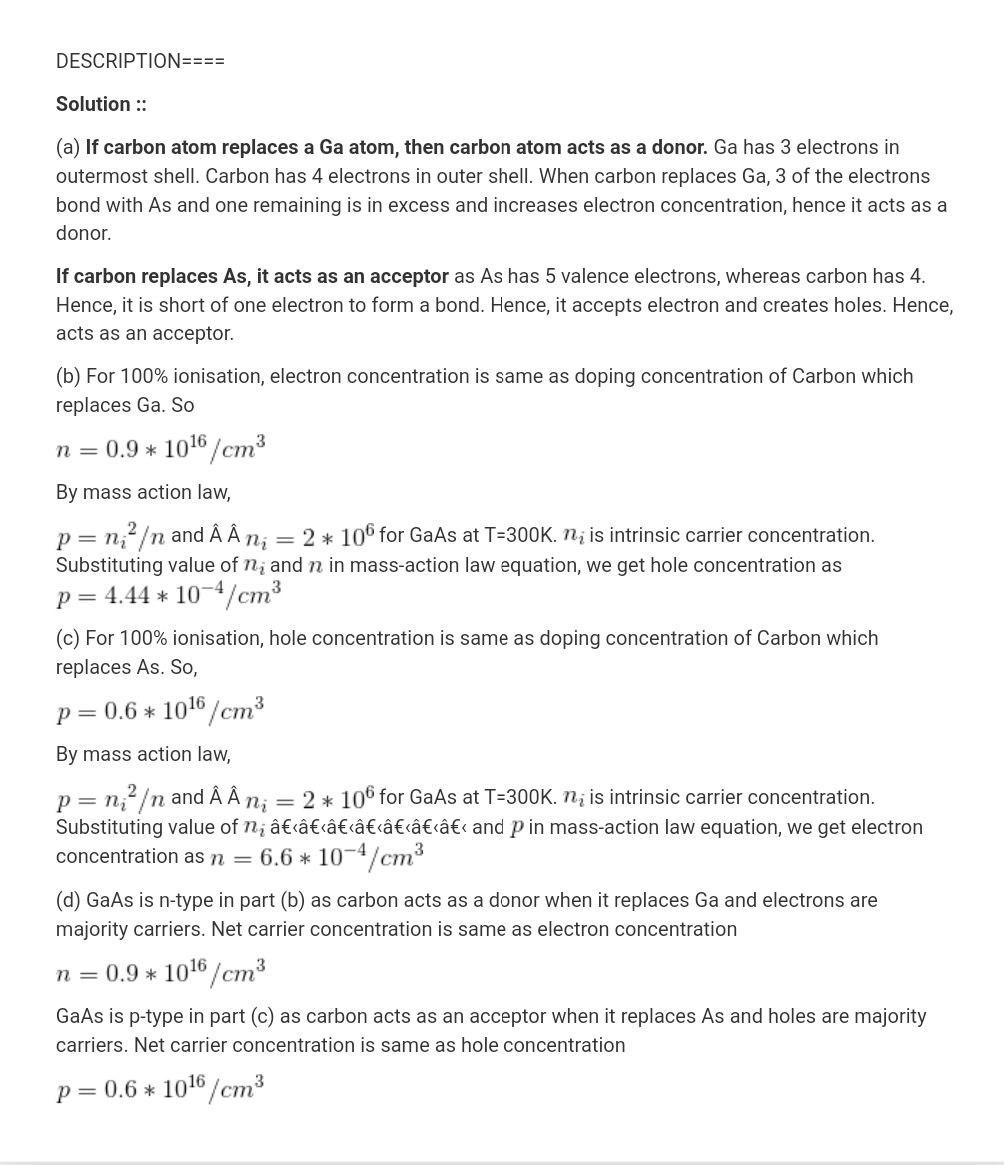
DESCRIPTION==== Solution :: (a) If carbon atom replaces a Ga atom, then carbon atom acts as a donor. Ga has 3 electrons in outermost shell. Carbon has 4 electrons in outer shell. When carbon replaces Ga, 3 of the electrons bond with As and one remaining is in excess and increases electron concentration, hence it acts as a donor. If carbon replaces As, it acts as an acceptor as As has 5 valence electrons, whereas carbon has 4. Hence, it is short of one electron to form a bond. Hence, it accepts electron and creates holes. Hence, acts as an acceptor. 2 = (b) For 100% ionisation, electron concentration is same as doping concentration of Carbon which replaces Ga. So n = 0.9 * 1016/cm3 By mass action law, p= n,? and ni = 2 * 106 for GaAs at T=300K. n; is intrinsic carrier concentration. Substituting value of n and n in mass-action law equation, we get hole concentration as p = 4.44 * 10-4/cm3 (c) For 100% ionisation, hole concentration is same as doping concentration of Carbon which replaces As. So, p=0.6 * 1016/cm3 By mass action law, p=n;? and n; = 2 * 106 for GaAs at T=300K. N; is intrinsic carrier concentration. Substituting value of n;
Step by Step Solution
There are 3 Steps involved in it

Get step-by-step solutions from verified subject matter experts
 Study Help