







Question: Determine the friction factor, f using the bisection method and the Newton - Raphson method. For turbulent flow, the Colebrook equation can be used to
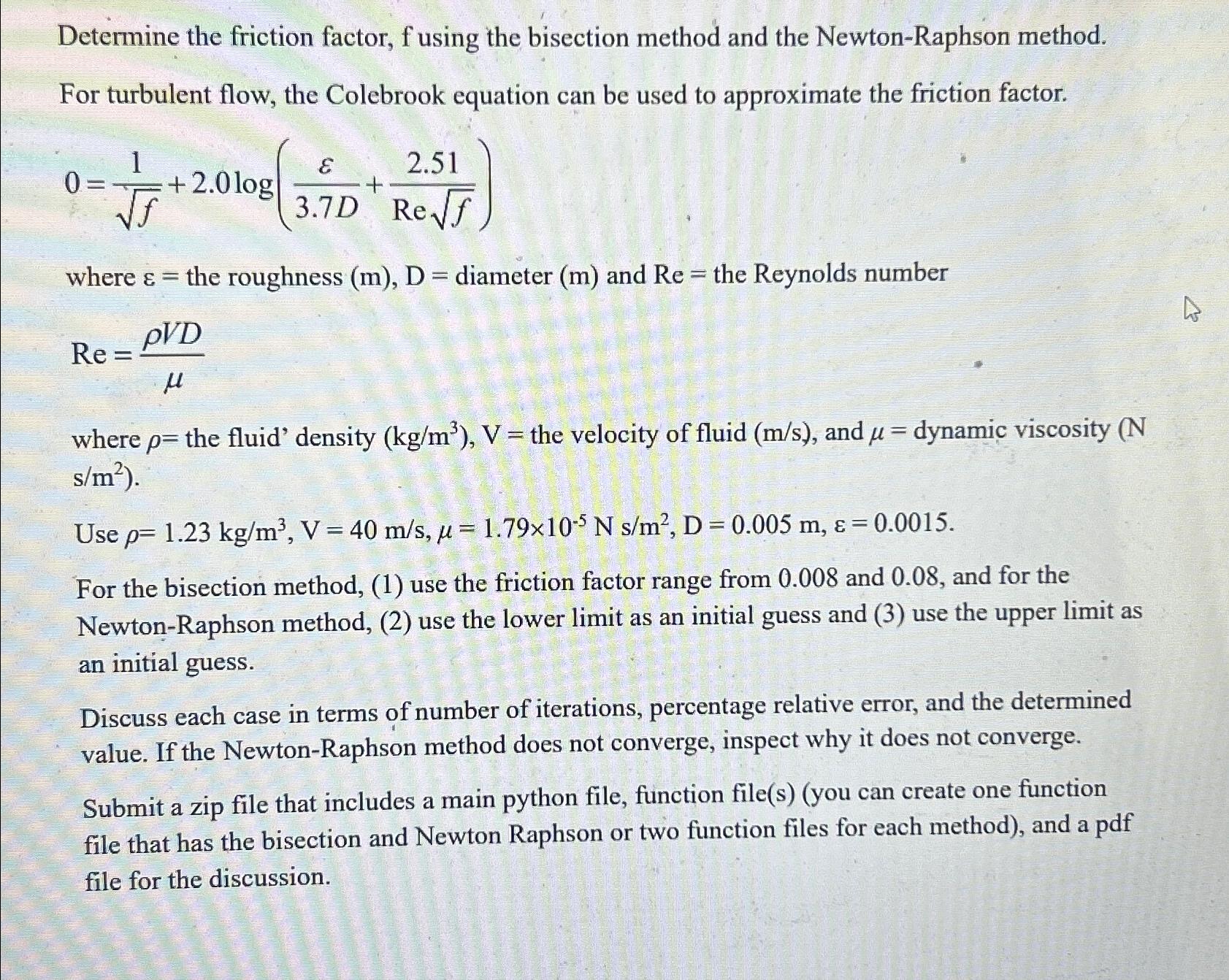
Determine the friction factor, using the bisection method and the NewtonRaphson method.
For turbulent flow, the Colebrook equation can be used to approximate the friction factor.
where the roughness diameter and the Reynolds number
where the fluid' density the velocity of fluid and dynamic viscosity
Use
For the bisection method, use the friction factor range from and and for the NewtonRaphson method, use the lower limit as an initial guess and use the upper limit as an initial guess.
Discuss each case in terms of number of iterations, percentage relative error, and the determined value. If the NewtonRaphson method does not converge, inspect why it does not converge.
Submit a zip file that includes a main python file, function filesyou can create one function file that has the bisection and Newton Raphson or two function files for each method and a pdf file for the discussion.
Step by Step Solution
There are 3 Steps involved in it
1 Expert Approved Answer
Step: 1 Unlock

Question Has Been Solved by an Expert!
Get step-by-step solutions from verified subject matter experts
Step: 2 Unlock
Step: 3 Unlock
 Study Help