







Question: discuss possibilities that BPO shall replace letter of credits in future international and domestic transaction which can help the entrepreneurs at any levels to expand
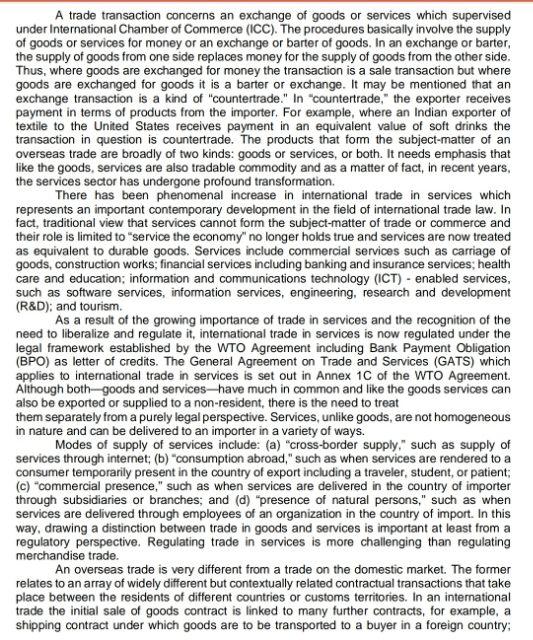
A trade transaction concerns an exchange of goods or services which supervised under International Chamber of Commerce (ICC). The procedures basically involve the supply of goods or services for money or an exchange or barter of goods. In an exchange or barter, the supply of goods from one side replaces money for the supply of goods from the other side. Thus, where goods are exchanged for money the transaction is a sale transaction but where goods are exchanged for goods it is a barter or exchange. It may be mentioned that an exchange transaction is a kind of countertrade." In "countertrade," the exporter receives payment in terms of products from the importer. For example, where an Indian exporter of textile to the United States receives payment in an equivalent value of soft drinks the transaction in question is countertrade. The products that form the subject-matter of an overseas trade are broadly of two kinds: goods or services, or both. It needs emphasis that like the goods, services are also tradable commodity and as a matter of fact, in recent years, the services sector has undergone profound transformation. There has been phenomenal increase in international trade in services which represents an important contemporary development in the field of international trade law. In fact, traditional view that services cannot form the subject-matter of trade or commerce and their role is limited to "service the economy" no longer holds true and services are now treated as equivalent to durable goods. Services include commercial services such as carriage of goods, construction works; financial services including banking and insurance services; health care and education, information and communications technology (ICT) - enabled services, such as software services, information services, engineering, research and development (R&D): and tourism. As a result of the growing importance of trade in services and the recognition of the need to liberalize and regulate it, international trade in services is now regulated under the legal framework established by the WTO Agreement including Bank Payment Obligation (BPO) as letter of credits. The General Agreement on Trade and Services (GATS) which applies to international trade in services is set out in Annex 1C of the WTO Agreement. Although both-goods and services-have much in common and like the goods services can also be exported or supplied to a non-resident, there is the need to treat them separately from a purely legal perspective. Services, unlike goods, are not homogeneous in nature and can be delivered to an importer in a variety of ways. Modes of supply of services include: (a) "cross-border supply." such as supply of services through internet: (b) "consumption abroad, such as when services are rendered to a consumer temporarily present in the country of export including a traveler, student, or patient: (c) "commercial presence," such as when services are delivered in the country of importer through subsidiaries or branches; and (d) "presence of natural persons," such as when services are delivered through employees of an organization in the country of import. In this way, drawing a distinction between trade in goods and services is important at least from a regulatory perspective. Regulating trade in services is more challenging than regulating merchandise trade. An overseas trade is very different from a trade on the domestic market. The former relates to an array of widely different but contextually related contractual transactions that take place between the residents of different countries or customs territories. In an international trade the initial sale of goods contract is linked to many further contracts, for example, a shipping contract under which goods are to be transported to a buyer in a foreign country; contract of insurance for minimizing or avoiding the risks involved in the transactions, contracts with bankers and distribution agreements. Therefore, when compared to a domestic transaction under which delivery of goods usually occurs at the seller's premises, it is a very complex transaction and exhibit many peculiar features. Having noted the distinctive features of international trade, it is now proposed to identify relevant criteria for determining international trade transactions. From a legal perspective, this is a matter of considerable importance for we need to know precisely whether a given trade transaction is international one or not. But considerable difficulties arise in agreeing on the defining characteristics of international commercial transactions First, international commercial transactions exhibit so diverse features that it is extremely difficult to devise a single formula to embrace all forms of transactions and activities commonly understood as international transactions. A further difficulty is that such transactions are governed by different set of legal rules-the domestic rules that remain largely un-harmonized as well as the rules contained in the uniform law instruments. Because the same transaction can be looked at in a variety of ways differences naturally arise. Since regulatory purposes differ, so also legal perspectives on international transactions and a definition arrived at for regulating international contracts of carriage may not be fit for regulating international sale of goods transactions. The legislative and non- legislative instruments, whether national, regional, or interational, differ on the issue of defining international transactions because they differ in their approaches. What further adds to complication is that interpretations of the courts or tribunals on the issue are not the same. In the face of these difficulties, it would be unrealistic to expect to find a precise and accurate criterion or formulae to distinguish international transactions from domestic ones. Instead our approach should be to find such criteria or criterion which is broad enough to cover as much transactions within its ambit as is needed in regulating international trade effectively. It is hoped that the insights gained from this inquiry will be helpful in understanding what is international trade and also subjecting to an in-depth analysis of the domestic and international law instruments dealing with international trade In attempting to identify international trade it is proposed here to proceed in an unconventional manner. Instead of looking at the definitional issues, here we would be directing our efforts to look at the provisions of the various national and international instruments laying down criteria for identifying international trade transactions. Case Scenario The International Chamber of Commerce (ICC) suggests that a bank payment obligation (BPO) can be viewed as an electronic letter of credit. You will be require to analyses the BPO and explores the differences between a BPO and a letter of credit, compares the transferability of BPOs and letters of credit in supply chain financing and considers the benefits and risks of automation for banks. You need to discuss how banks might use BPOs to offer financing to traders and considers whether BPOs will replace letters of credit as a method of payment settlement in international trade transactions. Dewan Perniagaan Antarabangsa (ICC) mencadangkan bahawa obligasi pembayaran bank (BPO) boleh dilihat sebagai surat kredit elektronik. Anda akan dikehendaki menganalisis BPO dan meneroka perbezaan antara BPO dan surat kredit membandingkan kebolehpindahan BPO dan surat kredit dalam pembiayaan rantaian bekalan dan mempertimbangkan faedah dan risiko automasi untuk bank. Anda perlu membincangkan cara bank mungkin menggunakan BPO untuk menawarkan pembiayaan kepada peniaga dan mempertimbangkan sama ada BPO akan menggantikan surat kredit sebagai kaedah penyelesaian pembayaran dalam urus niaga perdagangan antarabangsadiscuss possibilities that BPO shall replace letter of credits in future international and domestic transaction which can help the entrepreneurs at any levels to expand their business.
Step by Step Solution
There are 3 Steps involved in it
1 Expert Approved Answer
Step: 1 Unlock

Question Has Been Solved by an Expert!
Get step-by-step solutions from verified subject matter experts
Step: 2 Unlock
Step: 3 Unlock
 Study Help