







Question: draw a process flow diagram and identify the overall svstem boundarv Decaffeination removes nearly all the caffeine from coffee beans. This process is carried out
draw a process flow diagram and identify the overall svstem boundarv
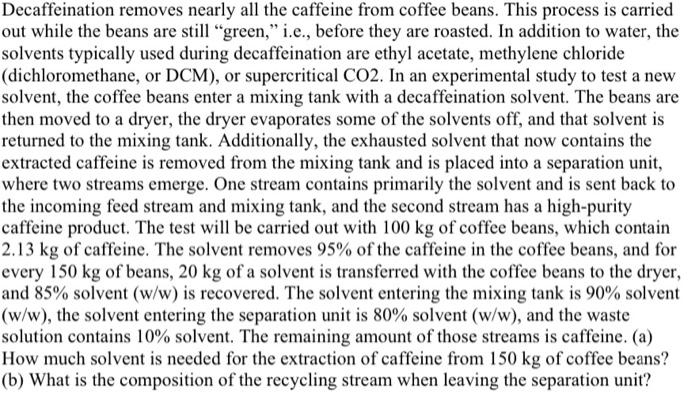
Decaffeination removes nearly all the caffeine from coffee beans. This process is carried out while the beans are still "green," i.e., before they are roasted. In addition to water, the solvents typically used during decaffeination are ethyl acetate, methylene chloride (dichloromethane, or DCM), or supercritical CO2. In an experimental study to test a new solvent, the coffee beans enter a mixing tank with a decaffeination solvent. The beans are then moved to a dryer, the dryer evaporates some of the solvents off, and that solvent is returned to the mixing tank. Additionally, the exhausted solvent that now contains the extracted caffeine is removed from the mixing tank and is placed into a separation unit, where two streams emerge. One stream contains primarily the solvent and is sent back to the incoming feed stream and mixing tank, and the second stream has a high-purity caffeine product. The test will be carried out with 100kg of coffee beans, which contain 2.13kg of caffeine. The solvent removes 95% of the caffeine in the coffee beans, and for every 150kg of beans, 20kg of a solvent is transferred with the coffee beans to the dryer, and 85% solvent (w/w) is recovered. The solvent entering the mixing tank is 90% solvent (w/w), the solvent entering the separation unit is 80% solvent (w/w), and the waste solution contains 10% solvent. The remaining amount of those streams is caffeine. (a) How much solvent is needed for the extraction of caffeine from 150kg of coffee beans? (b) What is the composition of the recycling stream when leaving the separation unit
Step by Step Solution
There are 3 Steps involved in it

Get step-by-step solutions from verified subject matter experts
 Study Help