Question: draw an ERD based on Issue one for the Registered Student Organization The School of Business at EU has several Registered Student Organizations (RSOs), such
draw an ERD based on Issue one for the Registered Student Organization
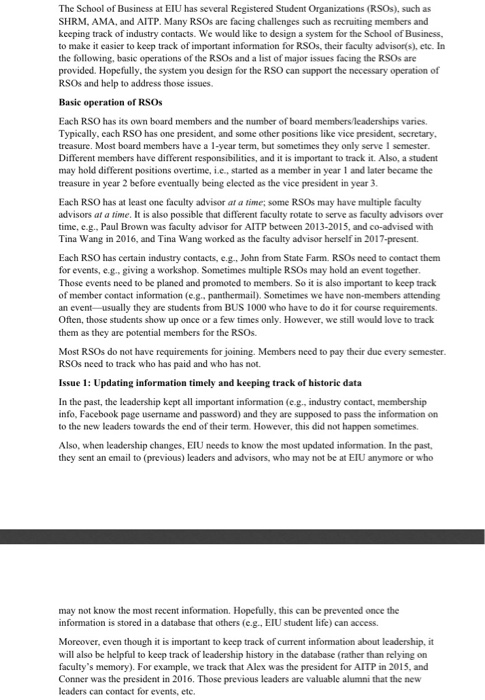
The School of Business at EU has several Registered Student Organizations (RSOs), such as SHRM, AMA, and AITP. Many RSOs are facing challenges such as recruiting members and keeping track of industry contacts. We would like to design a system for the School of Business, to make it easier to keep track of important information for RSOs, their faculty advisors), etc. In the following, basic operations of the RSOs and a list of major issues facing the RSOs are provided. Hopefully, the system you design for the RSO can support the necessary operation of RSOs and help to address those issues Basic operation of RSOS Each RSO has its own board members and the number of board members leaderships varies Typically, cach RSO has one president, and some other positions like vice president, secretary. treasure. Most board members have a l-year term, but sometimes they only serve I semester Different members have different responsibilities, and it is important to track it. Also, a student may hold different positions overtime, i.c., started as a member in year 1 and later became the treasure in year 2 before eventually being elected as the vice president in year 3 Fach RSO has at least one faculty advisor at a time, some RSOs may have multiple faculty advisors at a time. It is also possible that different faculty rotate to serve as faculty advisors over time, c.g., Paul Brown was faculty advisor for AITP between 2013-2015, and co-advised with Tina Wang in 2016, and Tina Wang worked as the faculty advisor herself in 2017-present. Each RSO has certain industry contacts, eg, John from State Farm. RSOs need to contact them for events, c.8. giving a workshop. Sometimes multiple RSOs may hold an event together Those events need to be planed and promoted to members. So it is also important to keep track of member contact information (c.g., panthermail). Sometimes we have non-members attending an event usually they are students from BUS 1000 who have to do it for course requirements. Often, those students show up once or a few times only. However, we still would love to track them as they are potential members for the RSOS. Most RSOs do not have requirements for joining. Members need to pay their due every semester. RSOs need to track who has paid and who has not. Issue 1: Updating information timely and keeping track of historie data In the past, the leadership kept all important information (e.g., industry contact, membership info, Facebook page username and password) and they are supposed to pass the information on to the new leaders towards the end of their term. However, this did not happen sometimes Also, when leadership changes, EIU needs to know the most updated information. In the past, they sent an email to (previous) leaders and advisors, who may not be at EU anymore or who may not know the most recent information. Hopefully, this can be prevented once the information is stored in a database that others (eg, EIU student life) can access Moreover, even though it is important to keep track of current information about leadership, it will also be helpful to keep track of leadership history in the database (rather than relying on faculty's memory). For example, we track that Alex was the president for AITP in 2015, and Conner was the president in 2016. Those previous leaders are valuable alumni that the new leaders can contact for events, etc. The School of Business at EU has several Registered Student Organizations (RSOs), such as SHRM, AMA, and AITP. Many RSOs are facing challenges such as recruiting members and keeping track of industry contacts. We would like to design a system for the School of Business, to make it easier to keep track of important information for RSOs, their faculty advisors), etc. In the following, basic operations of the RSOs and a list of major issues facing the RSOs are provided. Hopefully, the system you design for the RSO can support the necessary operation of RSOs and help to address those issues Basic operation of RSOS Each RSO has its own board members and the number of board members leaderships varies Typically, cach RSO has one president, and some other positions like vice president, secretary. treasure. Most board members have a l-year term, but sometimes they only serve I semester Different members have different responsibilities, and it is important to track it. Also, a student may hold different positions overtime, i.c., started as a member in year 1 and later became the treasure in year 2 before eventually being elected as the vice president in year 3 Fach RSO has at least one faculty advisor at a time, some RSOs may have multiple faculty advisors at a time. It is also possible that different faculty rotate to serve as faculty advisors over time, c.g., Paul Brown was faculty advisor for AITP between 2013-2015, and co-advised with Tina Wang in 2016, and Tina Wang worked as the faculty advisor herself in 2017-present. Each RSO has certain industry contacts, eg, John from State Farm. RSOs need to contact them for events, c.8. giving a workshop. Sometimes multiple RSOs may hold an event together Those events need to be planed and promoted to members. So it is also important to keep track of member contact information (c.g., panthermail). Sometimes we have non-members attending an event usually they are students from BUS 1000 who have to do it for course requirements. Often, those students show up once or a few times only. However, we still would love to track them as they are potential members for the RSOS. Most RSOs do not have requirements for joining. Members need to pay their due every semester. RSOs need to track who has paid and who has not. Issue 1: Updating information timely and keeping track of historie data In the past, the leadership kept all important information (e.g., industry contact, membership info, Facebook page username and password) and they are supposed to pass the information on to the new leaders towards the end of their term. However, this did not happen sometimes Also, when leadership changes, EIU needs to know the most updated information. In the past, they sent an email to (previous) leaders and advisors, who may not be at EU anymore or who may not know the most recent information. Hopefully, this can be prevented once the information is stored in a database that others (eg, EIU student life) can access Moreover, even though it is important to keep track of current information about leadership, it will also be helpful to keep track of leadership history in the database (rather than relying on faculty's memory). For example, we track that Alex was the president for AITP in 2015, and Conner was the president in 2016. Those previous leaders are valuable alumni that the new leaders can contact for events, etc









 Study Help