







Question: Dropdown choices #1: Plan Alpha, Plan Beta Dropdown choices #2: negative, positive Dropdown choices #3: greater than, less than Dropdown choices #1: equal to zero,

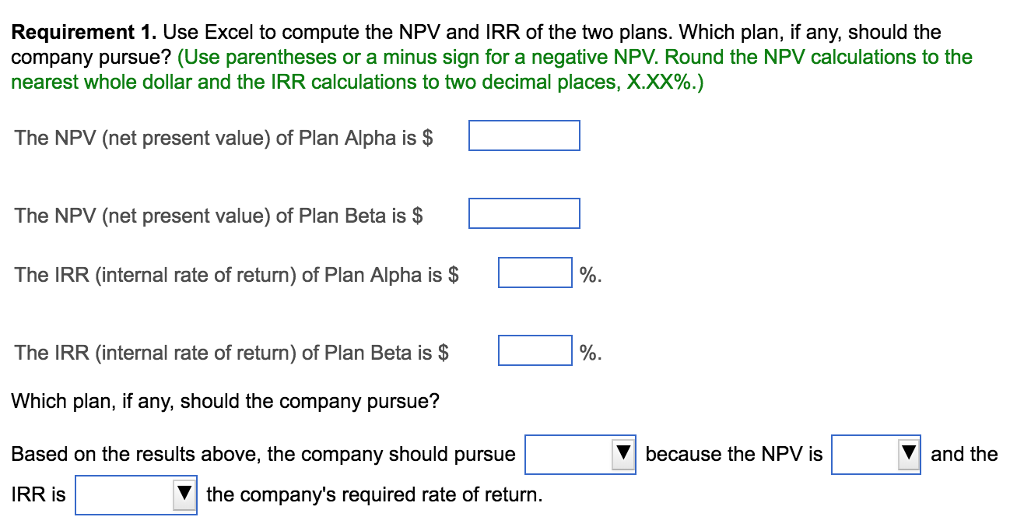
Dropdown choices #1: Plan Alpha, Plan Beta
Dropdown choices #2: negative, positive
Dropdown choices #3: greater than, less than
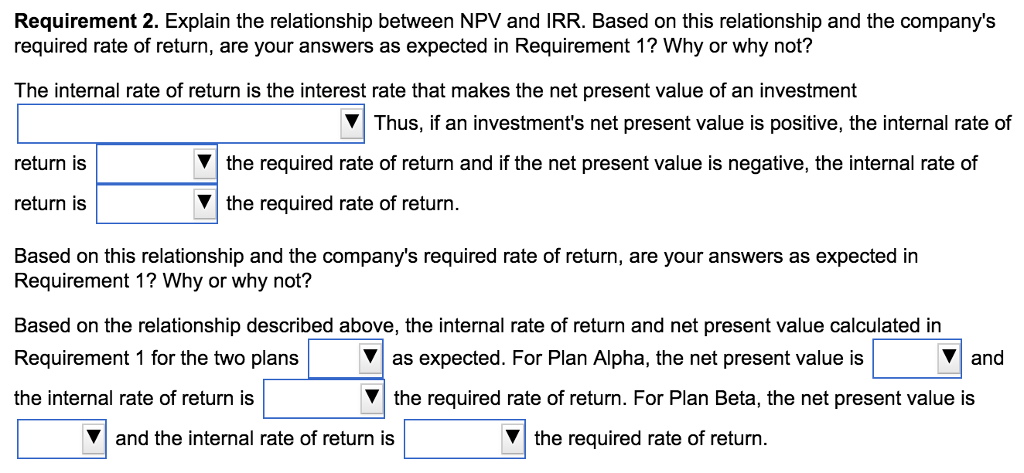
Dropdown choices #1: equal to zero, greater than original cost, less than the sum of cash inflows
Dropdown choices #2: greater than, less than
Dropdown choices #3: greater than, less than
Dropdown choices #4: are, are not
Dropdown choices #5: negative, positive
Dropdown choices #6: greater than, less than
Dropdown choices #7: negative, positive
Dropdown choices #8: greater than, less than
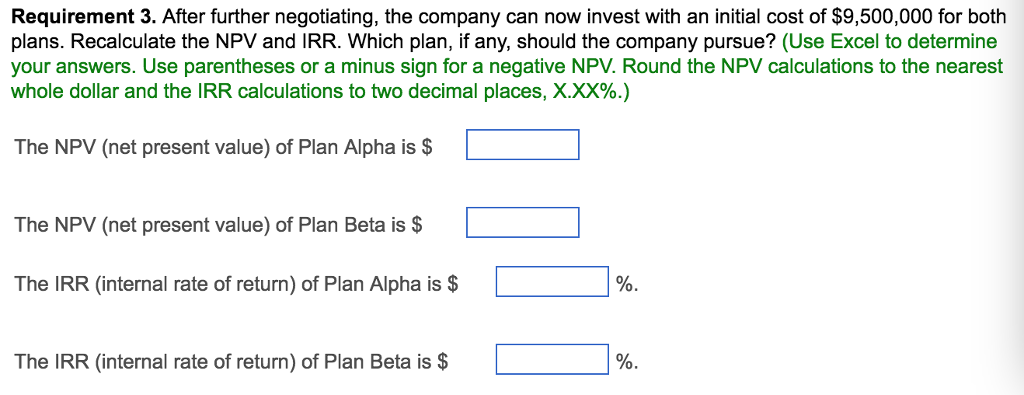
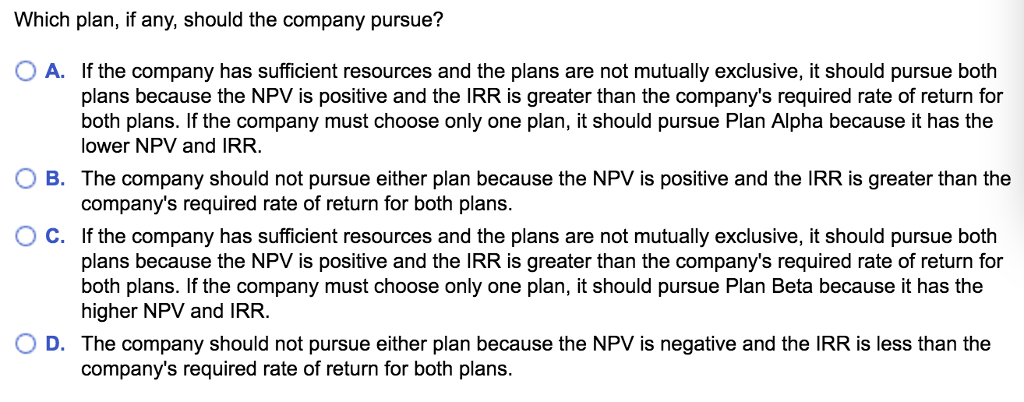
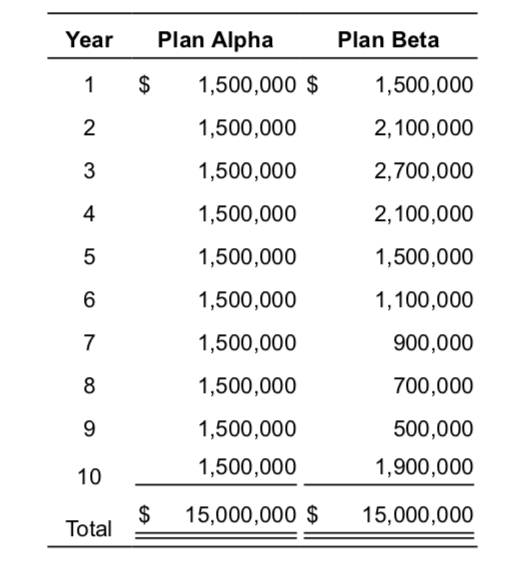
Vinson Company is considering two capital investments. Both investments have an initial cost of $8,000,000 and total net cash inflows of $15,000,000 over 10 years. Vinson requires a 14% rate of return on this type of investment. Expected net cash inflows are as follows: B (Click the icon to view the expected net cash inflows.) Read the requirements. Year Plan Alpha Plan Beta 1 $ 1,500,000 $ 1,500,000 2 1,500,000 2,100,000 3 1,500,000 2,700,000 4 1,500,000 2,100,000 5 1,500,000 1,500,000 CO 1,500,000 1,100,000 7 1,500,000 900,000 8 700,000 9 1,500,000 1,500,000 1,500,000 500,000 10 1,900,000 $ 15,000,000 $ 15,000,000 Total Requirement 1. Use Excel to compute the NPV and IRR of the two plans. Which plan, if any, should the company pursue? (Use parentheses or a minus sign for a negative NPV. Round the NPV calculations to the nearest whole dollar and the IRR calculations to two decimal places, X.XX%.) The NPV (net present value) of Plan Alpha is $ The NPV (net present value) of Plan Beta is $ The IRR (internal rate of return) of Plan Alpha is $ %. The IRR (internal rate of return) of Plan Beta is $ %. Which plan, if any, should the company pursue? Based on the results above, the company should pursue because the NPV is and the IRR is the company's required rate of return. Requirement 2. Explain the relationship between NPV and IRR. Based on this relationship and the company's required rate of return, are your answers as expected in Requirement 1? Why or why not? The internal rate of return is the interest rate that makes the net present value of an investment Thus, if an investment's net present value is positive, the internal rate of return is the required rate of return and if the net present value is negative, the internal rate of return is the required rate of return. Based on this relationship and the company's required rate of return, are your answers as expected in Requirement 1? Why or why not? Based on the relationship described above, the internal rate of return and net present value calculated in Requirement 1 for the two plans as expected. For Plan Alpha, the net present value is and the internal rate of return is the required rate of return. For Plan Beta, the net present value is and the internal rate of return is V the required rate of return. Requirement 3. After further negotiating, the company can now invest with an initial cost of $9,500,000 for both plans. Recalculate the NPV and IRR. Which plan, if any, should the company pursue? (Use Excel to determine your answers. Use parentheses or a minus sign for a negative NPV. Round the NPV calculations to the nearest whole dollar and the IRR calculations to two decimal places, X.XX%.) The NPV (net present value) of Plan Alpha is $ The NPV (net present value) of Plan Beta is $ The IRR (internal rate of return) of Plan Alpha is $ %. The IRR (internal rate of return) of Plan Beta is $ %. Which plan, if any, should the company pursue? O A. If the company has sufficient resources and the plans are not mutually exclusive, it should pursue both plans because the NPV is positive and the IRR is greater than the company's required rate of return for both plans. If the company must choose only one plan, it should pursue Plan Alpha because it has the lower NPV and IRR. B. The company should not pursue either plan because the NPV is positive and the IRR is greater than the company's required rate of return for both plans. OC. If the company has sufficient resources and the plans are not mutually exclusive, it should pursue both plans because the NPV is positive and the IRR is greater than the company's required rate of return for both plans. If the company must choose only one plan, it should pursue Plan Beta because it has the higher NPV and IRR. D. The company should not pursue either plan because the NPV is negative and the IRR is less than the company's required rate of return for both plans
Step by Step Solution
There are 3 Steps involved in it

Get step-by-step solutions from verified subject matter experts
 Study Help