







Question: DYNAMIC CHAOTICS: V sends each (n+1)st level to an nth-level interval. In this problem, we'll learn more about the lled Julia set of the V
DYNAMIC CHAOTICS: V sends each (n+1)st level to an nth-level interval.
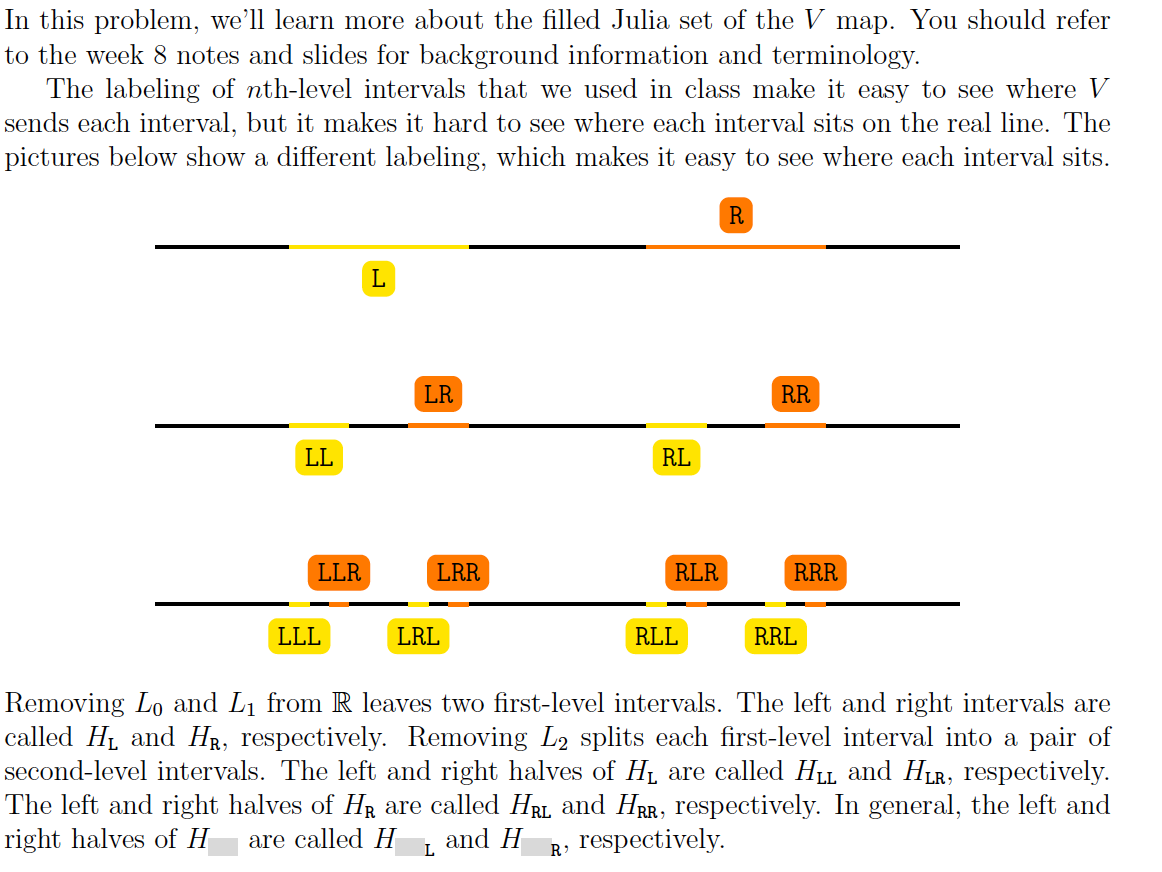
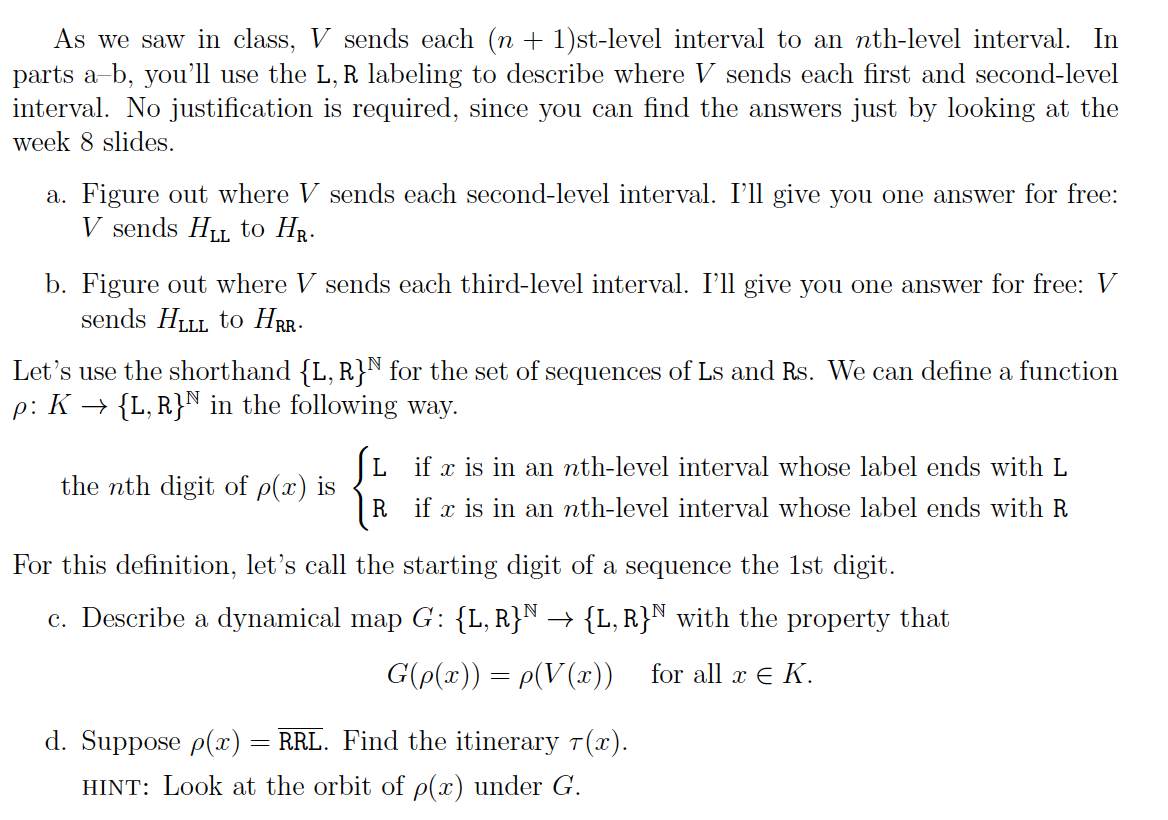
In this problem, we'll learn more about the lled Julia set of the V map. You should refer to the week 8 notes and slides for background information and terminology. The labeling of nthlevel intervals that we used in class make it easy to see where V sends each interval, but it makes it hard to see where each interval sits on the real line. The pictures below show a different labeling, which makes it easy to see Where each interval sits. LL RL Removing L0 and L1 from R leaves two rstlevel intervals. The left and right intervals are called HL and HR, respectively. Removing L2 splits each rstlevel interval into a pair of secondlevel intervals. The left and right halves of BL are called Hu. and H13, respectively. The left and right halves of HR are called Hm, and HER, respectively. In general, the left and right halves of H are called H L and H B, respectively. As we saw in class, V sends each (n + 1)st-level interval to an nthlevel interval. In parts ab, you'll use the L, R labeling to describe Where V sends each rst and secondlevel interval. No justication is required, since you can nd the answers just by looking at the week 8 slides. a. Figure out where V sends each second-level interval. I'll give you one answer for free: V sends Hm. to HR. b. Figure out where V sends each third-level interval. I'll give you one answer for free: V sends HLLL to Hm. Let's use the shorthand {L, M\" for the set of sequences of Ls and Rs. We can dene a function p: K > {L, R}N in the following way. , . . L if a: is in an nthlevel interval whose label ends with L the nth digit of ,0(:c) 1s . _ _ . ' R if .1: IS in an nthlevel Interval whose label ends w1th R For this denition, let's call the starting digit of a sequence the 1st digit. 0. Describe a dynamical map G' : {L, R}N > {L, R}N with the property that G(p($)) = p(V(:r)) for all a" E K. d. Suppose p(3:) : E. Find the itinerary 7(33) HINT: Look at the orbit of p(:r) under 0'
Step by Step Solution
There are 3 Steps involved in it

Get step-by-step solutions from verified subject matter experts
 Study Help