







Question: Example 15: Two stores and a warehouse This example builds on the electronics superstore and warehouse examples, by considering them simultaneously in a multi-level supply
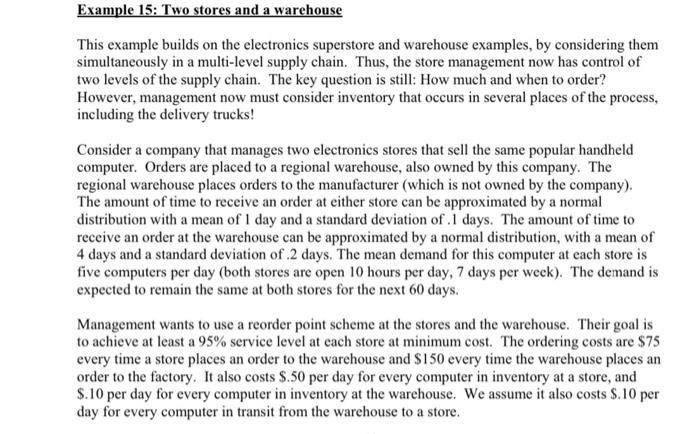
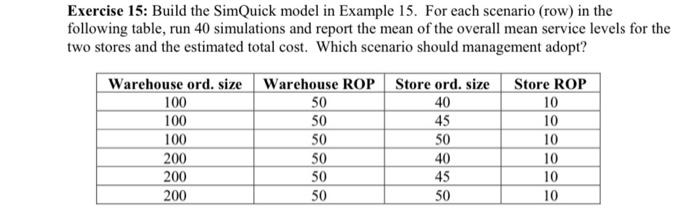
This example builds on the electronics superstore and warehouse examples, by considering them simultaneously in a multi-level supply chain. Thus, the store management now has control of two levels of the supply chain. The key question is still: How much and when to order? However, management now must consider inventory that occurs in several places of the process, including the delivery trucks! Consider a company that manages two electronics stores that sell the same popular handheld computer. Orders are placed to a regional warehouse, also owned by this company. The regional warehouse places orders to the manufacturer (which is not owned by the company). The amount of time to receive an order at either store can be approximated by a normal distribution with a mean of 1 day and a standard deviation of .1 days. The amount of time to receive an order at the warehouse can be approximated by a normal distribution, with a mean of 4 days and a standard deviation of .2 days. The mean demand for this computer at each store is five computers per day (both stores are open 10 hours per day, 7 days per week). The demand is expected to remain the same at both stores for the next 60 days. Management wants to use a reorder point scheme at the stores and the warehouse. Their goal is to achieve at least a 95% service level at each store at minimum cost. The ordering costs are $75 every time a store places an order to the warehouse and $150 every time the warehouse places an order to the factory. It also costs $.50 per day for every computer in inventory at a store, and $.10 per day for every computer in inventory at the warehouse. We assume it also costs $.10 per day for every computer in transit from the warehouse to a store. Exercise 15: Build the SimQuick model in Example 15. For each scenario (row) in the following table, run 40 simulations and report the mean of the overall mean service levels for the wo stores and the estimated total cost. Which scenario should management adopt
Step by Step Solution
There are 3 Steps involved in it

Get step-by-step solutions from verified subject matter experts
 Study Help